Bariatric surgery vs. semaglutide vs. tirzepatide
A Cleveland Clinic trial of 125 adults with obesity is running the first head-to-head comparison of bariatric surgery against semaglutide and tirzepatide. Recruitment has finished and the trial is underway, but no weight-loss results exist yet - here is exactly what it is designed to measure.
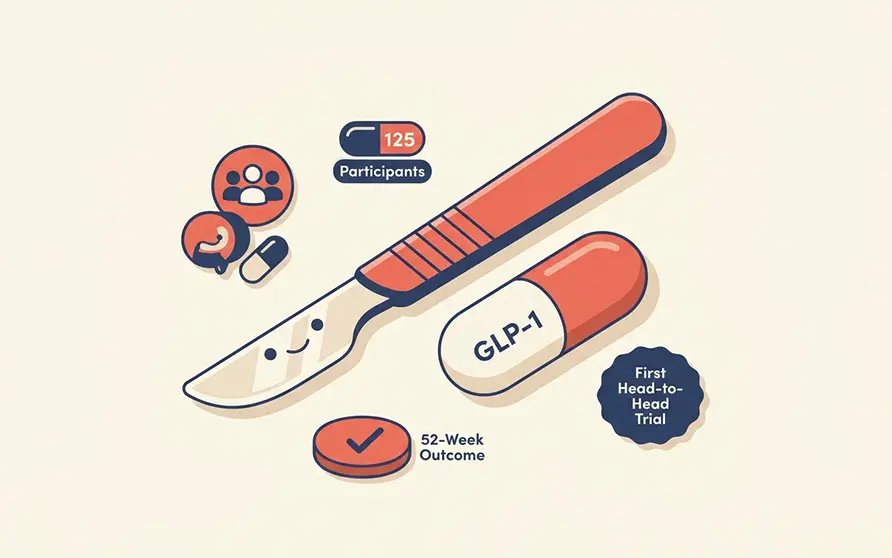
Anti-obesity medications now produce weight loss approaching what bariatric surgery has long delivered, but until now no randomized trial had compared surgery directly against both semaglutide and tirzepatide in the same cohort.1 A Cleveland Clinic study, registered as NCT06803888, is the first to do exactly that.
What is this trial actually comparing?
The official title is "Efficacy and Safety of Bariatric Surgery, Semaglutide Once Weekly, and Tirzepatide Once Weekly in Patients With Obesity."1 It is a randomized, non-blinded trial - blinding is not possible when one arm is a surgical operation and the others are weekly injections.
Researchers are randomizing 125 adults in a 2:2:1 ratio across three treatment arms. Two parts of the cohort receive bariatric surgery, two parts receive semaglutide, and one part receives tirzepatide.1 Participants and their surgeons jointly choose between Roux-en-Y gastric bypass (RYGB) and sleeve gastrectomy (SG) through shared clinical decision-making, rather than the trial assigning a specific operation.
| Arm | Intervention | Allocation |
|---|---|---|
| Surgery | RYGB or sleeve gastrectomy | 2 parts |
| Semaglutide | 0.25 mg weekly, escalated to 2.4 mg maintenance | 2 parts |
| Tirzepatide | 2.5 mg weekly, escalated to 15 mg maintenance | 1 part |
Source: ClinicalTrials.gov record NCT06803888.1 Doses shown are the standard escalation schedules used in each drug's approved label.
What counts as success at 52 weeks?
The primary outcome is percentage weight loss at 52 weeks, with bariatric surgery compared against semaglutide and against tirzepatide as two separate statistical comparisons.1 The trial also tracks twenty secondary measures: the proportion of patients reaching weight-loss milestones from 5% up to 35%, changes in BMI and waist circumference, blood pressure, lipid panels, glucose control, inflammatory markers, medication reduction, quality-of-life scores, liver fat content, and body composition.
"Anti-obesity medications now provide 15-22% average weight reduction - close enough to surgery that, until this trial, no one had tested the two head-to-head."
Who can join, and who is excluded?
Eligible participants are adults aged 18 to 70 with a BMI between 35 and 65 kg/m², who qualify as bariatric surgery candidates under the 2022 ASMBS/IFSO guidelines and have not lost more than 20 lbs in the prior three months.1 Participants with type 2 diabetes can join if their HbA1c is 12% or below and their medications have been stable for at least three months; women of childbearing potential must use contraception for two years.
Exclusions are clinically conservative: prior bariatric surgery or an intragastric balloon within six months, type 1 or autoimmune diabetes, an eGFR under 30 mL/min/1.73 m², decompensated cirrhosis, active cancer other than non-melanoma skin cancer, a personal or family history of medullary thyroid carcinoma or MEN2, and recent GLP-1/GIP therapy or a documented lack of response to it.
Why does this comparison matter?
Bariatric surgery has decades of long-term outcome data behind it, while semaglutide and tirzepatide are newer and reversible but require ongoing weekly injections indefinitely to maintain results.2 A direct, randomized comparison - rather than separate studies measured against different baselines - lets patients and clinicians weigh durability, side-effect profile, cost, and reversibility against each other using the same cohort and the same measurement tools.
The trial's second year, months 12 through 24, is designed specifically to study real-world durability: medication access, adherence, and whether patients cross over between surgery and drug therapy or combine the two. That is a question current GLP-1 trials, which mostly run 12 to 18 months, rarely address.
What this does not mean - yet
NCT06803888 has produced no weight-loss outcome data. It cannot be cited as evidence that surgery beats either drug, or that either drug beats surgery - that comparison is the hypothesis being tested, not a finding. The trial is listed as active, not recruiting, as of May 2026, meaning enrollment is closed but follow-up is ongoing.
In one sentence: a 125-person Cleveland Clinic trial is running the first direct, randomized comparison of bariatric surgery against semaglutide and tirzepatide, it has no results yet, and its primary completion is not expected before July 2027.
Frequently asked
Does the bariatric surgery vs. semaglutide vs. tirzepatide trial have results yet?+
What is the trial actually comparing?+
Who is running this trial?+
References
- Aminian A, Cleveland Clinic. Efficacy and Safety of Bariatric Surgery, Semaglutide Once Weekly, and Tirzepatide Once Weekly in Patients With Obesity. ClinicalTrials.gov. Identifier: NCT06803888. Status: Active, not recruiting (verified May 2026). Estimated primary completion: July 1, 2027.
Evidence current as of June 29, 2026. This article describes an ongoing, unpublished clinical trial and is educational only, not medical advice. It is not a report of trial results. Always consult your clinician before considering surgery or medication for weight loss.
Translating new metabolic and obesity research into plain English for people living on GLP-1 therapy. Every claim is traced to its source.