Can MariTide treat heart failure and obesity?
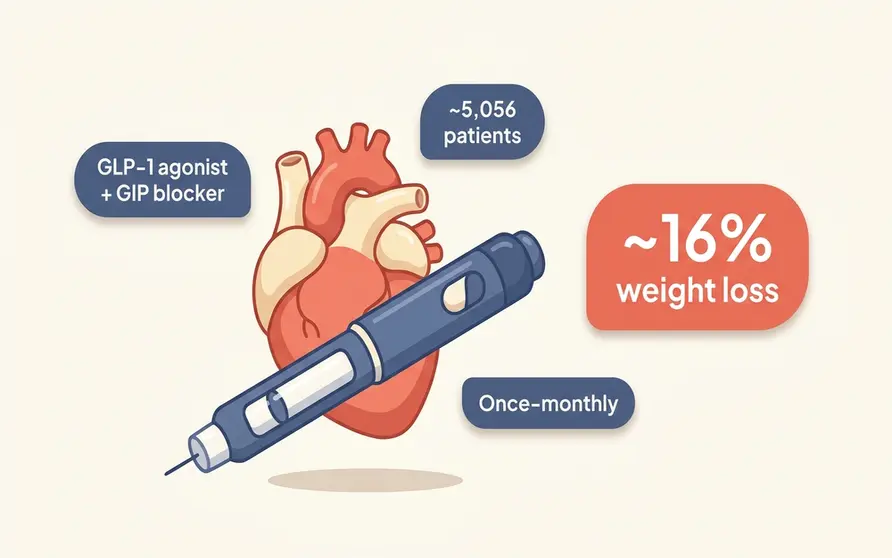
MariTide (maridebart cafraglutide) is an investigational once-monthly injection that activates the GLP-1 receptor and blocks the GIP receptor. Amgen's Phase 3 MARITIME-HF trial is testing whether it reduces cardiovascular death and heart failure events in about 5,056 people with obesity and heart failure. No results exist yet.
Heart failure with preserved ejection fraction, or HFpEF, is one of the hardest forms of heart failure to treat, and it is tightly bound to obesity. Recent trials have shown that GLP-1 medicines can help these patients, and now a third drug class is being put to the test. Amgen's Phase 3 MARITIME-HF trial is asking whether MariTide, a next-generation injection that works differently from Ozempic or Mounjaro, can prevent hospitalizations and deaths in people who have both obesity and heart failure.1
What is the MARITIME-HF trial testing?
The official title is "A Phase 3 Randomized, Double-blind, Placebo-controlled Study to Evaluate the Efficacy and Safety of Maridebart Cafraglutide on Mortality and Morbidity in Participants Living With Heart Failure With Preserved or Mildly Reduced Ejection Fraction and Obesity," registered as NCT07037459.1 MARITIME-HF is sponsored by Amgen and randomly assigns participants to receive either subcutaneous MariTide or a matching placebo, added on top of their standard heart failure therapy.1 The trial plans to enroll about 5,056 adults and is event-driven, meaning its first analysis is triggered after roughly 850 primary endpoint events occur rather than at a fixed calendar date.1
Eligible participants are adults 18 or older with a body mass index of 30 or higher, a heart failure diagnosis of at least 30 days, New York Heart Association class II to IV symptoms, and a left ventricular ejection fraction above 40%.1 The trial excludes people with type 1 diabetes, uncontrolled type 2 diabetes, a recent major cardiovascular event, a history of pancreatitis, or recent use of another GLP-1 receptor agonist.1 Its primary endpoint is the time to a first cardiovascular death or heart failure event, defined as a heart failure hospitalization or an urgent heart failure visit.1
How does MariTide work?
MariTide (maridebart cafraglutide) is an investigational peptide-antibody conjugate designed for once-monthly, or less frequent, dosing. It combines two opposite actions in one molecule: it activates the GLP-1 receptor, like semaglutide, while blocking the GIP receptor.2 This is a notable contrast with tirzepatide, which activates the GIP receptor rather than blocking it, yet both approaches produce substantial weight loss in trials. MariTide is not approved by the FDA for any indication and remains an experimental drug under study.2
| Trial feature | Detail |
|---|---|
| Design | Phase 3, randomized, double-blind, placebo-controlled |
| Estimated enrollment | About 5,056 participants (event-driven) |
| Population | Obesity plus HFpEF or HFmrEF (ejection fraction above 40%) |
| Comparison groups | MariTide vs. placebo, added to standard therapy |
| Primary endpoint | Cardiovascular death or heart failure event |
| Primary completion | Estimated June 30, 2028 |
Source: ClinicalTrials.gov record NCT07037459.1
"Two obesity drugs have already helped HFpEF patients. MARITIME-HF asks whether a third, with a different mechanism, can do the same."
Why test an obesity drug for heart failure?
Heart failure with preserved ejection fraction is heart failure in which the heart's main pumping chamber still squeezes with a normal or near-normal ejection fraction but cannot relax and fill properly. HFpEF is strongly driven by obesity, and until recently it had few effective drug treatments. That picture changed when obesity medicines were tested directly in these patients.
In the STEP-HFpEF trial, once-weekly semaglutide 2.4 mg improved heart failure symptoms and physical function and produced greater weight loss than placebo in 529 people with HFpEF and obesity.3 In the SUMMIT trial, tirzepatide reduced the risk of worsening heart failure events and improved health status in 731 people with HFpEF and obesity over roughly two years.4 MARITIME-HF extends this line of research by asking whether MariTide, with its different GIP-blocking mechanism, can lower cardiovascular death and heart failure events in a much larger group.1
What did MariTide's earlier trial show?
MariTide's weight-loss credentials come from a Phase 2 trial published in the New England Journal of Medicine in 2025, which enrolled 592 adults, including 127 with type 2 diabetes.2 Among participants with obesity but without diabetes, average body weight fell by 16.2% at 52 weeks on the highest dose, compared with 2.5% on placebo, using the treatment-policy estimand.2 In participants who also had type 2 diabetes, weight loss ranged from 8.4% to 12.3%, and HbA1c dropped by 1.2 to 1.6 percentage points versus a 0.1-point rise on placebo.2
Those results are about weight and blood sugar, not heart failure outcomes. Gastrointestinal side effects such as nausea were common with MariTide in the Phase 2 trial, though they were less frequent when the dose was escalated gradually from a lower starting point.2 MARITIME-HF is the first Phase 3 trial designed specifically to measure whether these metabolic effects translate into fewer heart failure hospitalizations and deaths.1
What MARITIME-HF cannot tell us yet
MARITIME-HF has produced no efficacy or safety results. The trial started in June 2025 and, as of its July 2, 2026 registry update, is still recruiting participants.1 Its estimated primary completion date is June 30, 2028, with full study completion estimated for September 29, 2030.1 Until outcome data are posted or published in a peer-reviewed journal, MARITIME-HF cannot be cited as evidence that MariTide helps, or does not help, people with heart failure.
In one sentence: Amgen's Phase 3 MARITIME-HF trial is testing whether MariTide, an investigational once-monthly GLP-1 agonist and GIP antagonist, can reduce cardiovascular death and heart failure events in about 5,056 people with obesity and heart failure, but with no results posted yet, the trial can only be described, not cited as an answer.
Frequently asked
Does the MARITIME-HF trial have results yet?+
What is MariTide, and how is it different from Ozempic or Mounjaro?+
Why is an obesity drug being tested for heart failure?+
References
- Amgen. A Phase 3 Randomized, Double-blind, Placebo-controlled Study to Evaluate the Efficacy and Safety of Maridebart Cafraglutide on Mortality and Morbidity in Participants Living With Heart Failure With Preserved or Mildly Reduced Ejection Fraction and Obesity (MARITIME-HF). ClinicalTrials.gov. Identifier: NCT07037459. Status: Recruiting. Estimated primary completion: June 30, 2028.
- Jastreboff AM, et al. Once-Monthly Maridebart Cafraglutide for the Treatment of Obesity - A Phase 2 Trial. N Engl J Med. 2025;393(9):843-857. DOI: 10.1056/NEJMoa2504214. PMID: 40549887.
- Kosiborod MN, et al. Semaglutide in Patients with Heart Failure with Preserved Ejection Fraction and Obesity (STEP-HFpEF). N Engl J Med. 2023;389(12):1069-1084. DOI: 10.1056/NEJMoa2306963.
- Packer M, et al. Tirzepatide for Heart Failure with Preserved Ejection Fraction and Obesity (SUMMIT). N Engl J Med. 2025;392(5):427-437. DOI: 10.1056/NEJMoa2410027. PMID: 39555826.
Evidence current as of July 11, 2026. This article describes an ongoing, unpublished Phase 3 trial and is educational only, not medical advice. It is not a report of study results. MariTide (maridebart cafraglutide) is an investigational drug not approved by the FDA. People with heart failure or obesity should discuss treatment options with their prescribing clinician, not this article.
Translating new metabolic and obesity research into plain English for people living on GLP-1 therapy. Every claim is traced to its source.