Can Ozempic help arthritis and grow new cartilage?
Semaglutide, the drug in Ozempic and Wegovy, eased knee-arthritis pain and improved physical function in people with obesity in the 407-person STEP 9 trial, mostly by driving weight loss. Growing new cartilage, though, has so far been shown only in mice and one small pilot study. No GLP-1 drug is FDA-approved for arthritis.
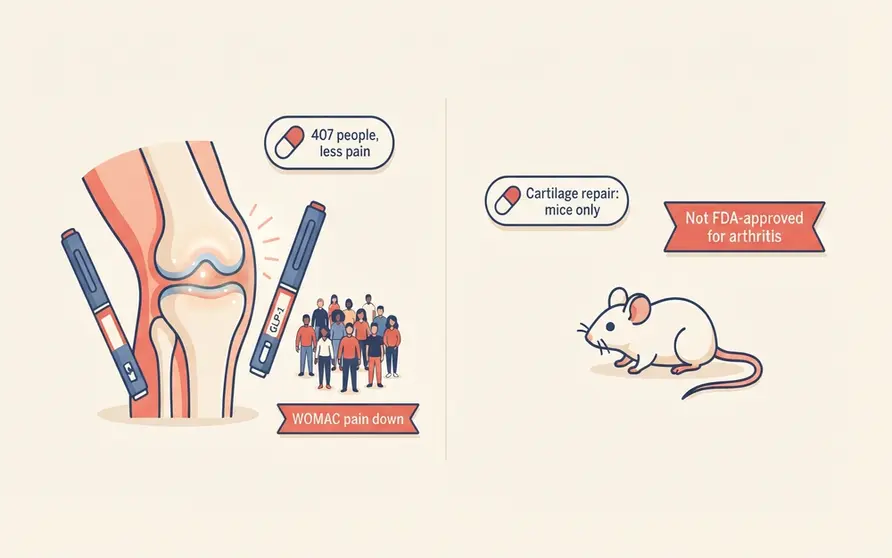
Two headlines have collided online. One says Ozempic makes arthritic knees hurt less. The other says the same drug can regrow the cartilage inside them. The first is supported by a large human trial. The second, so far, is a mouse study.
Both cannot be summarised in the same breath without misleading someone, so this article keeps them apart. It sets out exactly what semaglutide has been shown to do for arthritis in people, and where the exciting "new cartilage" claim actually comes from.
Can Ozempic reduce arthritis pain?
Yes, in the group that has been studied. The clearest evidence is STEP 9, a 68-week randomized, double-blind trial published in the New England Journal of Medicine in 2024.1 It enrolled 407 adults with obesity and knee osteoarthritis across 11 countries and gave them once-weekly semaglutide 2.4 mg, the dose sold as Wegovy, or a placebo.1
The pain result was substantial. The WOMAC pain score, where a bigger drop means less pain, fell by 41.7 points on semaglutide versus 27.5 points on placebo over 68 weeks.1 Physical function improved too: the SF-36 physical-function score rose by 12.0 points on the drug against 6.5 on placebo.1
That pain relief arrived alongside serious weight loss. Participants on semaglutide lost 13.7% of their body weight, compared with 3.2% on placebo.1 Since every kilogram lost takes several kilograms of load off the knee with each step, much of the pain benefit in STEP 9 is best read as a consequence of the weight loss, not proof of a direct action on the joint.
Does Ozempic actually grow new cartilage?
This is where the story gets stretched. The claim that a GLP-1 drug can rebuild cartilage traces to a 2026 Cell Metabolism paper, and it is genuinely interesting, but it is not a human result.2
In that study, semaglutide protected and restored cartilage in a mouse model of osteoarthritis with obesity, reducing cartilage degeneration, bony spurs, joint-lining damage and pain behaviour.2 Using a diet-controlled design that ruled out appetite suppression and weight loss, the researchers reported a weight-loss-independent mechanism: semaglutide reprogrammed the metabolism of cartilage cells through a GLP-1-receptor pathway.2 A small randomized pilot study in people supported the direction of the findings.2
That is real science worth watching, but the honest label on it is "shown in mice, plus a small pilot." A single mouse study and a pilot cannot establish that Ozempic grows cartilage in a human knee. The much-shared line that a 407-patient, 68-week study proved cartilage growth is a mix-up: the 407-patient, 68-week study is STEP 9, and STEP 9 measured pain, function and weight, not cartilage.1
The human trial measured pain. The cartilage repair was measured in mice. Merging the two into one sentence is how a mouse study becomes a miracle cure. STEP 9 (Bliddal et al., NEJM 2024) and Qin et al., Cell Metabolism 2026
Why is the evidence still mixed?
Because not every GLP-1 trial in arthritis has been positive. Before STEP 9, a randomized trial by Gudbergsen and colleagues, published in the American Journal of Clinical Nutrition in 2021, took a different approach.3 It first put people with knee osteoarthritis and excess weight through an eight-week diet, then added liraglutide or placebo on top.3
The result is the useful counterweight to the hype. Liraglutide produced more weight loss than placebo, but it did not reduce knee pain any further once the diet-driven weight loss had already happened.3 Read alongside STEP 9, that points to the same conclusion from two directions: in people, the joint benefit seems to travel with the weight loss, and a GLP-1 drug added without extra weight loss did not add extra pain relief.
A 2025 systematic review in Frontiers in Pharmacology gathered the field together: 15 studies, six in people and nine in the laboratory.4 It concluded that GLP-1 drugs significantly improved pain and function and are "promising disease-modifying agents" for metabolic-associated knee osteoarthritis, particularly in people who are obese or diabetic, while stating plainly that confirmatory phase 3 trials and long-term safety monitoring are still needed.4
Is Ozempic approved for arthritis?
No. No GLP-1 drug is approved by the US Food and Drug Administration to treat osteoarthritis or any other arthritis. The current US prescribing information for Ozempic lists its approved uses as type 2 diabetes and cardiovascular risk reduction, and it does not mention osteoarthritis or cartilage anywhere.6
That matters for anyone reading a hopeful headline. Using a GLP-1 drug for a sore knee today means using it off-label or inside a clinical trial, not taking an approved arthritis treatment. If you are weighing the joint question, it sits next to the separate worry we cover in does Ozempic cause joint pain, where the large-trial evidence points away from harm.
What does the research still need to prove?
The gap between the mouse cartilage finding and the human pain finding is exactly what the next trials exist to close. The systematic review was blunt about it: the human evidence so far is mostly about pain, function and weight, and the disease-modifying, structure-changing claim rests on laboratory work that needs testing in people.4
One registered trial is set to add data. NCT07360457, run by Beni-Suef University, plans to enrol 390 people with type 2 diabetes and compare GLP-1 drugs with an SGLT2 inhibitor and other antidiabetic treatment, using the WOMAC osteoarthritis score as its primary measure, with primary completion listed for December 2026.5 It is an association study rather than a cartilage-imaging trial, so it will speak to symptoms and risk, not to regrowth.5
Until a trial images cartilage in people over time, the accurate summary is narrow but useful: semaglutide can reduce arthritic knee pain in adults with obesity, mainly by helping them lose weight, and the cartilage-rebuilding idea is a promising laboratory lead, not a proven human treatment.
In one sentence: semaglutide reduced knee-arthritis pain and improved function in the 407-person STEP 9 trial, largely through weight loss, but "growing new cartilage" has only been shown in mice and a small pilot, no human trial has proven cartilage regrowth, and no GLP-1 drug is FDA-approved for arthritis.
| Question | Best evidence | What it shows |
|---|---|---|
| Less knee pain? | STEP 9, human RCT (407) | Yes: WOMAC pain -41.7 vs -27.5 |
| Better function? | STEP 9, human RCT | Yes: SF-36 physical function +12.0 vs +6.5 |
| More weight loss? | STEP 9, human RCT | Yes: -13.7% vs -3.2% |
| New cartilage? | Mouse model + small pilot | Cartilage restored in mice; not proven in people |
| Approved for arthritis? | FDA prescribing information | No: not an approved use |
Human pain, function and weight figures are from STEP 9; the cartilage finding is preclinical (mouse model plus a small pilot). The two are separate studies and should not be merged.12
Frequently asked
Can Ozempic help knee arthritis?+
Does Ozempic grow new cartilage?+
Is Ozempic approved to treat osteoarthritis?+
Does semaglutide help arthritis only by causing weight loss?+
References
- Bliddal H, Bays H, Czernichow S, Uddén Hemmingsson J, Hjelmesæth J, Hoffmann Morville T, et al. Once-weekly semaglutide in persons with obesity and knee osteoarthritis. N Engl J Med. 2024;391(17):1573-1583. PubMed. doi:10.1056/NEJMoa2403664. PMID: 39476339. The STEP 9 trial: 407 adults with obesity and knee osteoarthritis; primary outcomes were change in body weight and WOMAC pain score at week 68.
- Qin H, Yu J, Yu H, Zhou C, Yuan D, Wang Z, et al. Semaglutide ameliorates osteoarthritis progression through a weight loss-independent metabolic restoration mechanism. Cell Metab. 2026. PubMed. doi:10.1016/j.cmet.2026.01.008. PMID: 41666927. Preclinical: an obese-mouse osteoarthritis model plus a small randomized pilot study (ChiCTR2200066291); it does not demonstrate cartilage regrowth in humans.
- Gudbergsen H, Overgaard A, Henriksen M, Wæhrens EE, Bliddal H, Christensen R, et al. Liraglutide after diet-induced weight loss for pain and weight control in knee osteoarthritis: a randomized controlled trial. Am J Clin Nutr. 2021;113(2):314-323. PubMed. doi:10.1093/ajcn/nqaa328. PMID: 33471039. Liraglutide added after an eight-week diet produced weight loss but no additional reduction in knee pain versus placebo.
- Li Y, Yang L, Li F, Fu J, Zhao W, Wu X, et al. Emerging therapeutic potential of glucagon-like peptide-1 receptor agonists in knee osteoarthritis: a systematic review. Front Pharmacol. 2025;16:1627691. Europe PMC. doi:10.3389/fphar.2025.1627691. PMID: 41158135. PMCID: PMC12554640. Open access. Fifteen studies (six clinical, nine fundamental); the authors call for confirmatory phase 3 trials and long-term safety monitoring.
- Beni-Suef University. Association of GLP1 analogues and SGLT2 inhibitors with the risk of osteoarthritis in type 2 diabetic patients. ClinicalTrials.gov identifier NCT07360457. Estimated enrolment 390; primary outcome is the WOMAC score; primary completion listed for December 2026. An observational association study, not a cartilage-imaging trial.
- Novo Nordisk. OZEMPIC (semaglutide) injection, for subcutaneous use: US prescribing information. DailyMed, US National Library of Medicine, accessed August 2026. Approved indications are type 2 diabetes and cardiovascular risk reduction; the label does not mention osteoarthritis or cartilage.
Evidence current as of August 19, 2026. This article is educational only and is not medical advice. Semaglutide is prescription-only and is not approved to treat arthritis; any joint use is off-label or investigational and should be discussed with a clinician. The human pain and function findings come from a population with obesity and knee osteoarthritis and may not apply to everyone, and the STEP 9 benefit is closely tied to weight loss. The cartilage-repair evidence is preclinical: it comes from a mouse model plus a small pilot and does not establish that GLP-1 drugs regrow cartilage in people. Do not start, stop or change a prescribed medicine because of anything here.
Translating new metabolic and obesity research into plain English for people living on GLP-1 therapy. Every claim is traced to its source.