Can Ozempic help idiopathic intracranial hypertension?
The direction of the evidence is encouraging, but it is early and uncertain. In 2026 reviews, people with idiopathic intracranial hypertension (IIH, or pseudotumor cerebri) who used a GLP-1 drug like Ozempic had less papilloedema, fewer headaches and less surgery. No GLP-1 is approved for IIH, though, so this is a decision for a specialist, not one to make alone.
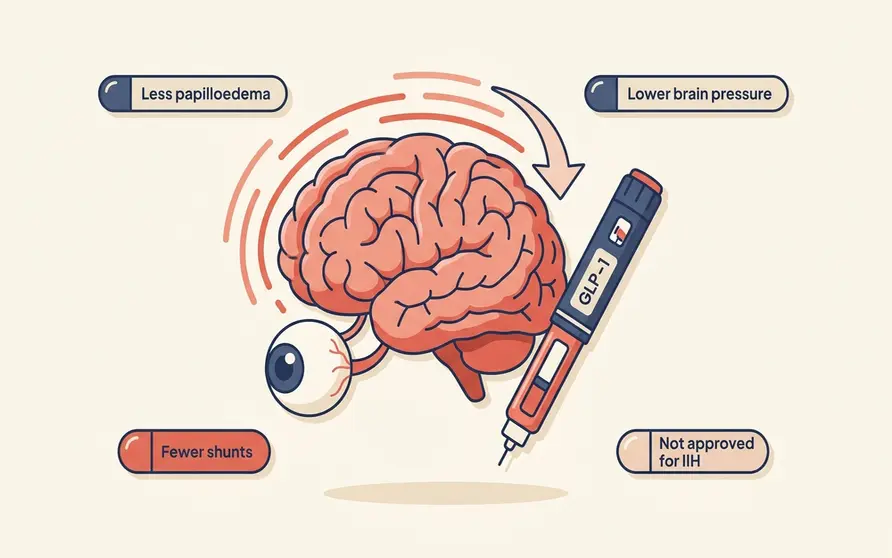
If you live with idiopathic intracranial hypertension and take, or are considering, a GLP-1 drug such as Ozempic, Wegovy or Mounjaro, the hopeful question is whether the medicine could lower the pressure and protect your sight. The honest answer from the latest evidence is that the signals are encouraging and consistent, but they are early, mostly observational, and not proof. No GLP-1 drug is approved to treat IIH, so this is a decision to make with a neurologist or neuro-ophthalmologist, not one to start on your own.
This question matters because IIH and weight are closely linked. Idiopathic intracranial hypertension overwhelmingly affects women of reproductive age with obesity, and losing weight is already one of the most effective treatments.4 That overlap is exactly why researchers began studying GLP-1 drugs, which are the most powerful weight-loss medicines available, in this condition.
What is idiopathic intracranial hypertension?
Idiopathic intracranial hypertension, once called pseudotumor cerebri, is raised pressure inside the skull when brain scans and spinal-fluid content are normal, so no tumour or clot explains it.4 It causes disabling daily headaches and swelling of the optic nerve, called papilloedema, which can permanently damage vision if the pressure is not controlled.
Standard drug treatment relies mainly on acetazolamide, sometimes topiramate, which give modest benefit and are often poorly tolerated.4 Because weight loss reliably lowers the pressure, it sits at the centre of care, which is the practical reason GLP-1 drugs have become a research question here rather than an afterthought.
Can Ozempic help IIH?
The broadest evidence comes from a 2026 systematic review and meta-analysis in the journal Headache, which pooled 8 studies covering 13,243 patients.1 Across those studies, GLP-1 receptor agonists were associated with less papilloedema (risk ratio 0.43, 95% CI 0.28-0.66 at 3 months; RR 0.47, 95% CI 0.38-0.58 at 24 months).1
The same meta-analysis linked GLP-1 use to fewer headaches (RR 0.69 at 3 months; RR 0.80 at 24 months), fewer visual disturbances (RR 0.41 at 3 months; RR 0.43 at 24 months) and less refractory IIH (RR 0.70 at 3 months; RR 0.81 at 24 months).1 Every one of these figures points in the same helpful direction, though some carried high statistical heterogeneity between studies, meaning the true effect is less precise than a single number suggests.1
Does it lower brain pressure directly?
There appear to be two separate mechanisms, and this is where the story gets interesting. The first is simple: GLP-1 drugs drive the weight loss that already lowers IIH pressure. The second is a possible direct effect on the pressure itself, independent of weight.
That direct effect comes from a small 2023 randomized, double-blind trial of exenatide, an older GLP-1 drug, in the journal Brain.2 In 16 women with active IIH who had telemetric catheters measuring their intracranial pressure, exenatide lowered pressure by about 5.7 cmCSF at 2.5 hours (P=0.048), 6.4 cmCSF at 24 hours (P=0.030) and 5.6 cmCSF at 12 weeks (P=0.058).2 A drop within 2.5 hours is far too fast to be explained by weight loss, which points to GLP-1 receptors reducing cerebrospinal-fluid secretion at the choroid plexus, the tissue that makes brain fluid.2
| Outcome | At 3 months | At 24 months |
|---|---|---|
| Papilloedema | RR 0.43 (0.28-0.66) | RR 0.47 (0.38-0.58) |
| Headache | RR 0.69 | RR 0.80 |
| Visual disturbance | RR 0.41 | RR 0.43 |
| Refractory IIH | RR 0.70 | RR 0.81 |
All figures from the 2026 meta-analysis of 8 studies and 13,243 patients; a risk ratio below 1.0 favours GLP-1 use, and some outcomes carried high heterogeneity.1
The signals all point the same way, less pressure on the brain and the eyes, but a consistent direction is not the same thing as proof.
Does it reduce the need for surgery?
When IIH does not respond to medicine, some people need surgery to protect their vision, such as a shunt to drain fluid or a stent to open a narrowed vein. A 2026 propensity-matched cohort study in Clinical Neurology and Neurosurgery, using the TriNetX database, matched 6,188 pairs of people with IIH to test whether GLP-1 use changed those odds.3
GLP-1 use was associated with a lower chance of needing brain surgery for IIH. There were fewer shunt operations (RR 0.42, 95% CI 0.23-0.76 at 1 year; RR 0.53, 95% CI 0.32-0.86 at 2 years) and fewer venous sinus stents (RR 0.53 at 1 year; RR 0.56 at 2 years), with no significant difference in optic nerve sheath fenestration.3 As a database study, this shows an association rather than cause and effect, and people prescribed a GLP-1 may differ in ways the matching cannot fully capture.3
How strong is this evidence?
It is consistent in direction but weak in certainty, and the authors say so themselves. Both 2026 systematic reviews rated their overall evidence as low-certainty and hypothesis-generating, because it leans heavily on database and observational studies rather than randomized trials.14 The vision benefit is the least settled part: the narrative systematic review found the visual and pressure data more variable and driven largely by database analyses, even though the meta-analysis pooled a significant visual benefit.4
The one randomized trial deserves its own caution. It included just 16 women, was designed as a proof of concept to justify a larger trial, and pre-set its significance threshold at a relaxed level, so its 12-week result did not meet the usual mark (P=0.058).2 Several of its authors also report interests in Invex Therapeutics, a company developing an exenatide-based drug for raised intracranial pressure, which is a direct commercial interest in a positive result and should be weighed when reading it.2
How is this different from Ozempic eye damage?
This is a common point of confusion, because both topics involve the eyes and GLP-1 drugs. IIH is raised-pressure papilloedema, swelling of the optic nerve caused by too much pressure around the brain. That is a separate condition from NAION, a sudden loss of blood flow to the optic nerve, which the Academy covers in its piece on whether Ozempic can damage your eyes. The IIH research here suggests a possible benefit for pressure; it does not change what is known about NAION.
What should I do?
Do not start, stop or change a GLP-1 drug or any IIH medicine based on anything you read, including this article. IIH can threaten your sight and is managed by neurologists and neuro-ophthalmologists, so if you are interested in a GLP-1 drug for weight or diabetes, raise it with your specialist and let them weigh it for your specific case.4
In one sentence: 2026 evidence consistently links GLP-1 drugs like Ozempic to less papilloedema, fewer headaches and less surgery in idiopathic intracranial hypertension, with a small trial hinting at a direct pressure-lowering effect, but the evidence is mostly observational and low-certainty, no GLP-1 drug is approved for IIH, and the decision belongs with a specialist.12
Frequently asked
Can Ozempic help idiopathic intracranial hypertension?+
Does Ozempic lower brain pressure directly, or only through weight loss?+
Can a GLP-1 drug reduce the need for IIH surgery?+
Is any GLP-1 drug approved to treat IIH?+
References
- Falcao L, Brenner LBO, Machado Magalhaes PL, Goyal A, et al. Glucagon-like peptide-1 receptor agonists in idiopathic intracranial hypertension: a systematic review and meta-analysis. Headache. 2026 Aug 20. DOI: 10.1111/head.70131. PMID: 42619634. The authors rate the overall certainty as low and describe the findings as hypothesis-generating, with high heterogeneity on some outcomes.
- Mitchell JL, Lyons HS, Walker JK, Yiangou A, ... Mollan SP, Sinclair AJ. The effect of GLP-1RA exenatide on idiopathic intracranial hypertension: a randomized clinical trial. Brain. 2023 May 2;146(5):1821-1830. DOI: 10.1093/brain/awad003. PMID: 36907221. PMCID: PMC10151178. Disclosure: several authors report interests in Invex Therapeutics, a company developing an exenatide-based drug (Presendin) for raised intracranial pressure; National Institute on Aging (NIH) co-authors were also involved. The trial pre-set its significance threshold at alpha 0.1.
- Kelleher S, Ricci S, Stump K, Kanuparthi P, et al. Glucagon-like peptide-1 receptor agonists and the risk of surgical intervention in idiopathic intracranial hypertension: a propensity-matched cohort study. Clinical Neurology and Neurosurgery. 2026 Jun;265:109372. DOI: 10.1016/j.clineuro.2026.109372. PMID: 41832796. A TriNetX database analysis; associations only, not proof of cause and effect.
- de Oliveira HM, Gallo Ruelas M, Fonseca PEO, Diaz CAV, ... Parker T, Kahle KT. Effect of GLP-1 receptor agonists on idiopathic intracranial hypertension: a systematic review. Headache. 2026 Jan;66(1):286-297. DOI: 10.1111/head.70005. PMID: 41246926. Protocol registered on PROSPERO (CRD420251058602). The review found visual and pressure data more variable and driven largely by database analyses.
Evidence current as of September 18, 2026. The findings summarised here come mostly from observational studies, which report average associations rather than a guarantee for any individual and cannot prove cause and effect; the one randomized trial included just 16 people. No GLP-1 drug is approved to treat idiopathic intracranial hypertension. This content is educational only, not medical advice. Do not start, stop or change a GLP-1 drug or any other medicine based on this article. IIH is a vision-threatening condition that needs specialist care, so anyone with IIH who is considering a GLP-1 drug should discuss it with their neurologist or neuro-ophthalmologist first.
Translating new metabolic and obesity research into plain English for people living on GLP-1 therapy. Every claim is traced to its source.