Can Ozempic help peripheral artery disease?
For people with type 2 diabetes and peripheral artery disease, the 2026 STRIDE trial found that semaglutide, the drug in Ozempic, helped them walk noticeably farther before leg pain stopped them. A large 2026 cohort also links GLP-1 drugs to fewer amputations and lower death. Both are real findings, and both come with limits.
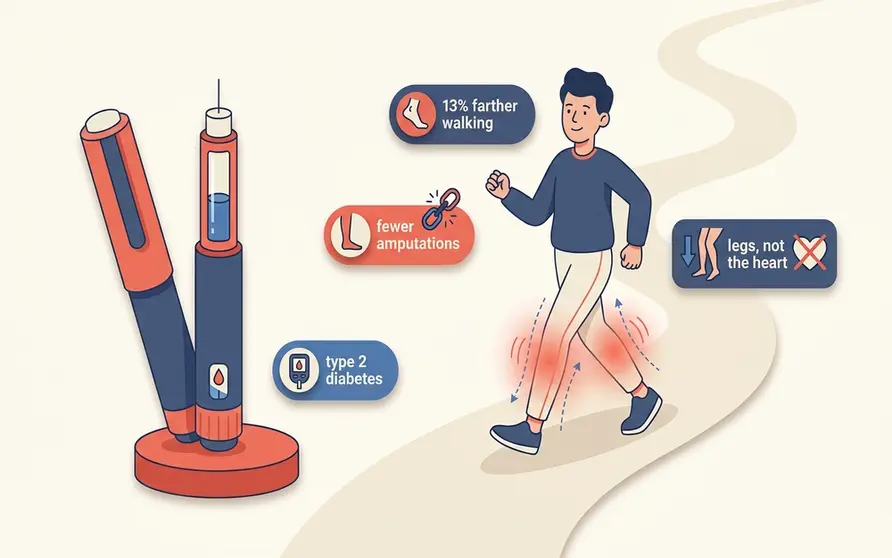
People with type 2 diabetes are far more likely to develop peripheral artery disease, the narrowing of the arteries that feed the legs. So a natural question follows for anyone already on a GLP-1 drug: can a medicine known for weight loss and blood-sugar control do anything for poor circulation and the leg pain that comes with it?
In 2026, for the first time, a randomized trial answered part of that question directly. This article walks through that trial, then a large real-world cohort that looked at amputations and survival, and it is careful throughout to separate what has been proven from what has only been observed.
What is peripheral artery disease?
Peripheral artery disease, often shortened to PAD, is a form of atherosclerosis in which fatty plaque narrows the arteries supplying the legs. It is estimated to affect more than 230 million people worldwide, and it clusters in people with diabetes, which is exactly the population most likely to be prescribed a GLP-1 drug.12
Its most common symptom is intermittent claudication: a cramping leg pain that comes on while walking and eases with rest, because narrowed arteries cannot supply enough blood to working muscles. Few treatments reliably improve how far people with PAD can walk, which is what made the STRIDE result notable.1
Can Ozempic help you walk farther?
The strongest evidence is a randomized trial. STRIDE was a double-blind, placebo-controlled trial run at 112 sites in 20 countries, and it enrolled 792 adults who had both type 2 diabetes and symptomatic peripheral artery disease with intermittent claudication.1
Participants had to be able to walk more than 200 metres and have a reduced ankle-brachial or toe-brachial index, a simple pressure measurement that confirms narrowed leg arteries.1 They were randomly assigned to subcutaneous semaglutide 1.0 mg once a week or a matching placebo for 52 weeks, and the main measure was how their maximum walking distance on a treadmill changed from the start of the trial.1
At 52 weeks, the semaglutide group improved more. Their maximum walking distance rose to a median of 1.21 times its starting value, against 1.08 times in the placebo group, an estimated treatment ratio of 1.13 (95% CI 1.06 to 1.21; p=0.0004).1 In plain terms, semaglutide produced roughly a 13% greater improvement in how far people could walk before pain stopped them. STRIDE is the first randomized trial to show a GLP-1 drug improves functional walking capacity in PAD.1
Safety looked consistent with the rest of the GLP-1 class. Serious side effects judged possibly or probably related to treatment were uncommon in both groups, the most frequent being gastrointestinal, and there were no treatment-related deaths.1
| 2026 study | Who it studied | Main finding |
|---|---|---|
| STRIDE (randomized trial) | 792 adults with PAD + type 2 diabetes | About 13% greater improvement in walking distance vs placebo (ratio 1.13; p=0.0004) |
| JAHA cohort (observational) | PAD + type 2 diabetes, GLP-1 vs metformin | Lower major amputation (HR 0.52) and death (HR 0.74) over 5 years |
The two 2026 sources behind this article. STRIDE is a randomized controlled trial, so it can support cause and effect for walking distance; the JAHA study is a retrospective cohort that compared GLP-1 drugs with metformin, so its amputation and survival findings are associations, not proof. Both studies found overall cardiovascular events broadly similar between groups.12
A randomized trial shows semaglutide helped people walk farther, and a large cohort links GLP-1 drugs to fewer amputations. But farther and fewer are not the same as proven for everyone. The 2026 limb evidence, in one line
Does it prevent amputations?
Beyond walking distance, a separate 2026 study looked at the outcomes that matter most in advanced PAD: amputation and survival. Published in the Journal of the American Heart Association, it used the TriNetX health network to compare people who had both peripheral artery disease and type 2 diabetes and were taking either a GLP-1 drug or metformin.2
After matching the groups on their background characteristics, the researchers followed 2,133 patients in each group for five years, having excluded people with recent cardiovascular events, end-stage kidney disease or a prior amputation.2 Over that period, GLP-1 users had a lower rate of major amputation (2.30% versus 4.36%; hazard ratio 0.52) and minor amputation (4.03% versus 6.42%; hazard ratio 0.63).2
They also had lower all-cause mortality (10.31% versus 14.49%; hazard ratio 0.74), fewer revascularization procedures to reopen blocked arteries (hazard ratio 0.64) and fewer hospitalizations (hazard ratio 0.87).2 Those are large differences in serious outcomes.
The important caveat is built into the study design. This is a retrospective, observational cohort, so it can show that GLP-1 users did better, not that the drug caused the difference. People prescribed a GLP-1 drug rather than metformin may differ in ways that also affect their limbs and survival, and even careful matching cannot remove every such difference.2
What about heart attacks and strokes?
Here the two studies agree, and it matters for interpreting them honestly. In the JAHA cohort, major adverse cardiovascular events, heart attack, stroke and major kidney events were all similar between the GLP-1 and metformin groups.2 The differences showed up in the legs, not the heart.
That is what makes this a distinct story from the well-known heart benefits of these drugs. GLP-1 medicines already carry cardiovascular evidence of their own, covered in our piece on which GLP-1 drug protects the heart more. The new finding in 2026 is specifically about limb outcomes and walking ability, so it should be read as an addition to that picture, not a restatement of it.
Why might semaglutide help the legs?
Researchers propose a few plausible reasons, none of them settled. One is that semaglutide improves the metabolic conditions that drive atherosclerosis, including body weight and blood sugar, which could slow the disease in the leg arteries over time.1
Another is a more direct effect on the blood vessels and inflammation, since GLP-1 receptor agonists have anti-inflammatory properties and atherosclerosis is partly an inflammatory disease.2 The STRIDE investigators were explicit that the trial was not designed to prove why walking improved, and they called for future studies to work out the mechanism.1
What this means if you have PAD
The bottom line is genuinely encouraging but bounded. A randomized trial shows semaglutide helped people with PAD and diabetes walk farther, and a large cohort links GLP-1 drugs to fewer amputations and lower death in the same kind of patient.12
What that evidence does not do is make Ozempic a treatment for peripheral artery disease. GLP-1 drugs such as Ozempic are approved for blood-sugar control in type 2 diabetes and for reducing cardiovascular risk, not for treating PAD.3 The amputation and survival benefits come entirely from an observational study, where cause and effect cannot be confirmed.
There is also a clear limit on who was studied. STRIDE enrolled only people who had both PAD and type 2 diabetes, and its authors specifically flagged that the drug's effect in people who have PAD without diabetes has not yet been tested.1 If you have poor circulation but not diabetes, the walking result cannot simply be assumed to apply to you.
The practical rule is the same one that applies to every GLP-1 finding: do not start, stop or change any prescribed medicine because of research you read about. Standard PAD care, including managing blood pressure, cholesterol and blood sugar, not smoking, and staying as active as your symptoms allow, still matters. If you have PAD and are considering or already taking a GLP-1 drug, raise it with the doctor who manages your circulation so both conditions are handled together.
In one sentence: The 2026 evidence shows semaglutide helped people with peripheral artery disease and type 2 diabetes walk about 13% farther in a randomized trial, and links GLP-1 drugs to fewer amputations and lower death in a large cohort, but the limb and survival benefits are observational, the drug is not approved for PAD, and only people who also had diabetes were studied.
Frequently asked
Can Ozempic improve circulation and leg pain from peripheral artery disease?+
Does Ozempic prevent amputations?+
Is Ozempic approved to treat peripheral artery disease?+
Does Ozempic help peripheral artery disease if I do not have diabetes?+
References
- Bonaca MP, Catarig AM, Houlind K, et al; STRIDE Trial Investigators. Semaglutide and walking capacity in people with symptomatic peripheral artery disease and type 2 diabetes (STRIDE): a phase 3b, double-blind, randomised, placebo-controlled trial. Lancet. 2025. Europe PMC. doi:10.1016/S0140-6736(25)00509-4. PMID: 40169145. ClinicalTrials.gov NCT04560998. Funded by Novo Nordisk; several authors are Novo Nordisk employees or shareholders. In 792 adults with symptomatic PAD and type 2 diabetes, semaglutide 1.0 mg improved maximum walking distance at 52 weeks versus placebo (estimated treatment ratio 1.13; 95% CI 1.06 to 1.21; p=0.0004), with no treatment-related deaths.
- Rosenzveig A, Tefera L, Agrawal A, et al. Long-term outcomes of glucagon-like peptide-1 receptor agonists in patients with peripheral artery disease and type 2 diabetes. J Am Heart Assoc. 2026. Europe PMC. doi:10.1161/JAHA.125.045664. PMID: 42383806. Retrospective TriNetX cohort, 2,133 propensity-matched patients per group with PAD and type 2 diabetes; over 5 years GLP-1 use versus metformin was associated with lower major amputation (HR 0.52), lower mortality (HR 0.74) and fewer revascularizations (HR 0.64), while major cardiovascular events were similar. Observational, not causal.
- Novo Nordisk. OZEMPIC (semaglutide) injection, for subcutaneous use: US prescribing information. DailyMed, US National Library of Medicine, accessed August 2026. Lists the approved indications as glycemic control in type 2 diabetes and reduction of cardiovascular and kidney-disease risk in type 2 diabetes; peripheral artery disease is not an approved indication.
Evidence current as of August 29, 2026. This article is educational only and is not medical advice. Semaglutide is prescription-only and should be used under medical supervision. GLP-1 drugs are not approved to treat peripheral artery disease; the STRIDE walking-distance result applies specifically to people who also had type 2 diabetes, and the amputation and survival findings come from a retrospective, observational study, so they show association rather than cause and effect, and individual results vary. Do not start, stop, or change any prescribed medicine because of anything you read here, and seek prompt care for sudden, severe or persistent leg pain, coldness, numbness or a non-healing wound.
Translating new metabolic and obesity research into plain English for people living on GLP-1 therapy. Every claim is traced to its source.