Can Ozempic or Mounjaro affect your hearing?
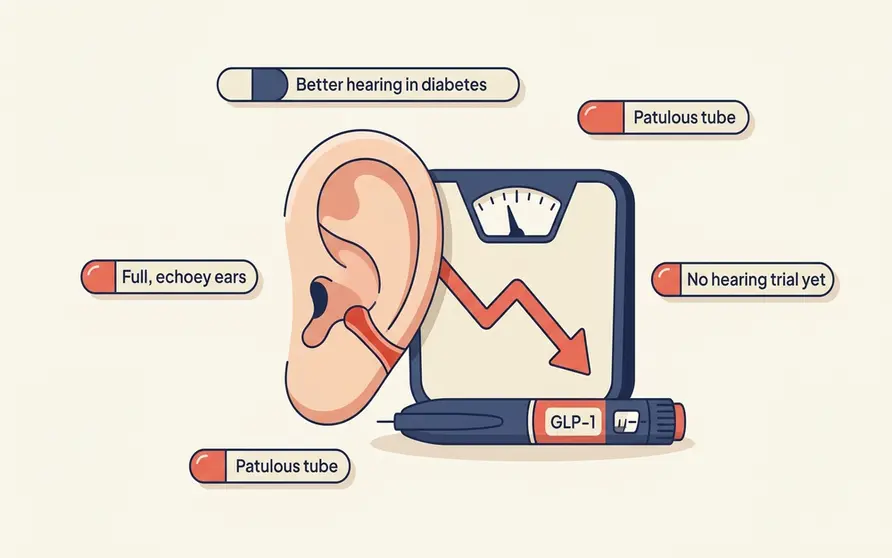
There is no good evidence that Ozempic or Mounjaro damage your hearing. A 2026 study in people with diabetes found GLP-1 use tracked with better hearing, not worse. But rapid weight loss can leave the eustachian tube abnormally open, causing blocked, echoey ears that feel like hearing loss but are usually manageable without stopping the drug.
A new ringing in the ears, a blocked or echoey feeling, or the sense that your own voice is suddenly too loud can be unsettling, and it is natural to blame a new medicine. Because Ozempic, Wegovy and Mounjaro are taken by so many people, ear symptoms and these drugs now often show up together, and the search for a link is understandable.
The honest 2026 answer has two parts, and both are true at once. There is no good evidence that GLP-1 drugs damage the hearing nerve, and the best available data actually point toward better hearing in people with diabetes who take them. But the rapid weight loss these drugs cause can trigger a mechanical middle-ear problem that feels like hearing loss. Nothing here is a reason to start, stop or switch a medicine.
Does Ozempic affect your hearing?
The most relevant study so far points in a reassuring direction. In a 2026 retrospective study in the journal Pharmacology Research & Perspectives, researchers at the University of Palermo measured hearing with standardized pure-tone audiometry in 240 adults with type 2 diabetes and 105 people without diabetes.1 Diabetes itself was linked to clearly worse hearing: the average hearing threshold was 64.4 decibels in the diabetes group versus 56.4 decibels in controls, a difference that held after adjusting for age, sex, body weight and smoking.1
Within the diabetes group, the drugs told a different story. GLP-1 receptor agonists, along with metformin and pioglitazone, were associated with lower thresholds, meaning better hearing, and the authors singled out GLP-1 drugs and metformin as tracking with the most favourable hearing.1 That fits the idea that controlling diabetes and its blood-vessel damage helps protect the inner ear, and it lines up with early interest in whether GLP-1 drugs have a broader neuroprotective effect.2
Read this carefully, though. This was an observational study in people who already had hearing impairment and diabetes, so it shows an association, not proof, and the authors themselves called for prospective studies.1 The 64.4 versus 56.4 decibel gap is a diabetes-versus-control comparison, not a measure of how much a GLP-1 drug improves hearing, so it should never be read as "Ozempic gives you better ears."
Why might your ears feel blocked?
The symptom that most often sends GLP-1 users searching is not deafness but a blocked, full or echoey feeling, and here there is a real and specific explanation. Your middle ear connects to the back of the nose through the eustachian tube, and a cushion of fatty tissue normally keeps that tube closed at rest. Rapid, large weight loss can thin that peritubal fat, leaving the tube abnormally open.2
A tube that stays open produces a distinctive set of symptoms people easily mistake for hearing loss: a blocked or full feeling in the ear, hearing your own voice or breathing unusually loudly (a symptom called autophony), and a fluctuating, muffled quality to sound.3 A 2026 otolaryngology review named this weight-loss route explicitly, listing it alongside the possible hearing benefit as the two-sided reality of what GLP-1 drugs may do in the head and neck.2 The same tissue loss that thins the face after big weight loss can thin the padding around this tube, which is why the effect connects to the wider question of how much muscle and tissue you lose on a GLP-1.
The signal is that GLP-1 drugs are not shown to harm the hearing nerve. The blocked, echoey feeling after big weight loss is a pressure problem in the ear, not deafness.
Hearing loss, tinnitus, or a blocked tube?
The single most useful thing to do with an ear symptom is name which problem it is, because they have different causes and different fixes. The table below sorts the three patterns people most often confuse after starting a GLP-1 drug.
| What you notice | Likely name | What it points to |
|---|---|---|
| Blocked, full ears; your own voice sounds loud; sound fluctuates | Patulous eustachian tube | A pressure problem from a tube left too open after weight loss |
| Gradual or one-sided loss of clarity; struggling with speech | Sensorineural hearing loss | A nerve or inner-ear problem, not linked to these drugs |
| Ringing, buzzing or hissing with no outside sound | Tinnitus | Many causes; pulsatile ringing needs its own check |
The distinction matters because a patulous eustachian tube is a plumbing and pressure problem, while true sensorineural hearing loss is a nerve or inner-ear problem that these drugs are not shown to cause. Tinnitus is different again. A throbbing ringing that keeps time with your pulse, in particular, has its own set of causes and can occur in raised pressure inside the skull, which is a separate topic we cover in whether GLP-1 drugs help idiopathic intracranial hypertension.
What is a patulous eustachian tube?
A patulous eustachian tube is an uncommon condition where the tube linking the middle ear to the nose stays abnormally open, and rapid weight loss is a recognised trigger.3 A 2026 case report described a 79-year-old man who developed intermittent fullness and popping in both ears, with no pain or dizziness, after losing about 200 pounds on semaglutide.3 His ear examination and prior pressure testing were normal, and doctors made a clinical diagnosis of patulous eustachian tube dysfunction.3
How it was handled is the practical point. The man was managed conservatively, with good hydration, saline sprays and avoiding decongestants, and not by stopping his medicine.3 Recognising the condition, the report noted, can spare people unnecessary tests and treatments. It is worth being clear about the strength of this evidence: a review plus one case report describes a real mechanism, but it is not a rate, and a single 79-year-old patient does not tell you how common the problem is. There is also no randomized trial and no dedicated GLP-1 hearing study to settle the question.
When should you get ear symptoms checked?
Most blocked-ear symptoms after weight loss are not dangerous, but some ear problems are urgent for anyone, whatever medicine they take. Sudden hearing loss, hearing loss in one ear only, or hearing loss with dizziness needs prompt medical assessment, because sudden sensorineural hearing loss is treated as an emergency where hours matter. Any new or persistent ear symptom that worries you deserves a real examination rather than a self-diagnosis from an article.
None of this is a reason to change your treatment on your own. The evidence here is about understanding a symptom, not about whether the drug is right for you, and no GLP-1 is approved to treat or affect hearing. If an ear symptom is troubling you, the useful move is to describe it accurately to a clinician, who can tell a pressure problem from a nerve problem and act accordingly.
In one sentence: there is no good evidence that Ozempic or Mounjaro damage hearing, a 2026 study even linked GLP-1 use to better hearing in people with diabetes, but the rapid weight loss these drugs cause can unmask a patulous eustachian tube that feels like hearing loss and is usually manageable without stopping the drug.123
Frequently asked
Does Ozempic or Mounjaro cause hearing loss?+
Why do my ears feel full or blocked on Ozempic?+
Is ear fullness after weight loss the same as hearing loss?+
Should I stop Ozempic if my hearing changes?+
References
- Martines F, Salvago P, Vaccaro F, Vaccaro D, Malta G, Plescia F, Cascioferro S, Lavanco G, Plescia F. Associations between antidiabetic pharmacotherapy and hearing thresholds in adult hearing-impaired patients with type 2 diabetes. Pharmacology Research & Perspectives. 2026 Oct;14(5):e70316. DOI: 10.1002/prp2.70316. PMID: 42717744. A retrospective observational study of 240 adults with type 2 diabetes and 105 normoglycemic controls at the University of Palermo, using standardized pure-tone audiometry; diabetes was associated with worse hearing thresholds (PTA-mean 64.4 vs 56.4 dB, p=0.007) after adjustment for age, sex, BMI and smoking, and among treatments GLP-1 receptor agonists, metformin and pioglitazone were associated with better thresholds. Association, not causation; the authors call for prospective studies. The authors declare no conflicts of interest.
- Anderson BJ, Van Daele DJ, Claussen AD, Tanenbaum Z, Owen SR. Implications of glucagon-like peptide-1 receptor agonists in otolaryngology - head and neck surgery: a review. The Annals of Otology, Rhinology & Laryngology. 2026 Oct;135(10):801-809. DOI: 10.1177/00034894261450724. PMID: 42126155. A narrative review from the University of Iowa setting out both beneficial and adverse head-and-neck effects of GLP-1 drugs, including investigation of a neuroprotective benefit in neurotoxicity-associated hearing loss and, as an adverse route, that muscle and fat loss with weight loss may contribute to a patulous eustachian tube and conductive hearing changes. Cited for mechanism, not for any effect size. Disclosure: Dr Van Daele reports education and funding support from NYXOAH and INSPIRE; the other authors report no conflicts.
- Burmeister JR, Jawad M, Zazay I, Kobernick A. Patulous Eustachian tube dysfunction following rapid weight loss associated with semaglutide use: a case report. SAGE Open Medical Case Reports. 2026 Sep 2;14:2050313X261486164. DOI: 10.1177/2050313X261486164. PMID: 42694263. A single case report of a 79-year-old man who developed intermittent bilateral aural fullness and popping, without pain or vertigo, after intentional weight loss of about 200 lb on semaglutide; examination and prior tympanometry were normal, a clinical diagnosis of patulous eustachian tube dysfunction was made, and he was managed conservatively with hydration, intranasal saline and avoidance of decongestants. A single case illustrates a mechanism, not an incidence. The authors declared no conflicts of interest.
Evidence current as of September 28, 2026. The reassuring hearing signal comes from a single observational study in people with type 2 diabetes and existing hearing impairment; it shows association, not causation, and the diabetes-versus-control threshold figures are not a measure of any GLP-1 hearing gain. The patulous eustachian tube route rests on one narrative review and a single case report, which describe a mechanism rather than a measured rate. There is no completed randomized trial and no dedicated GLP-1 hearing trial. No GLP-1 or GLP-1/GIP drug is approved to treat or affect hearing. This content is educational only, not medical advice. Do not start, stop or change any medicine based on this article. Sudden hearing loss, hearing loss in one ear, or hearing loss with dizziness needs urgent, same-day medical care.
Translating new metabolic and obesity research into plain English for people living on GLP-1 therapy. Every claim is traced to its source.