Can Ozempic or Mounjaro help bladder leaks?
Losing weight is one of the best-evidenced non-surgical ways to reduce stress incontinence, and Ozempic and Mounjaro cause weight loss, so fewer leaks are plausible and often reported. But that benefit is inferred from weight-loss and bariatric-surgery data. No GLP-1 is approved or proven to treat bladder leaks, and the first dedicated trial reports in 2028.
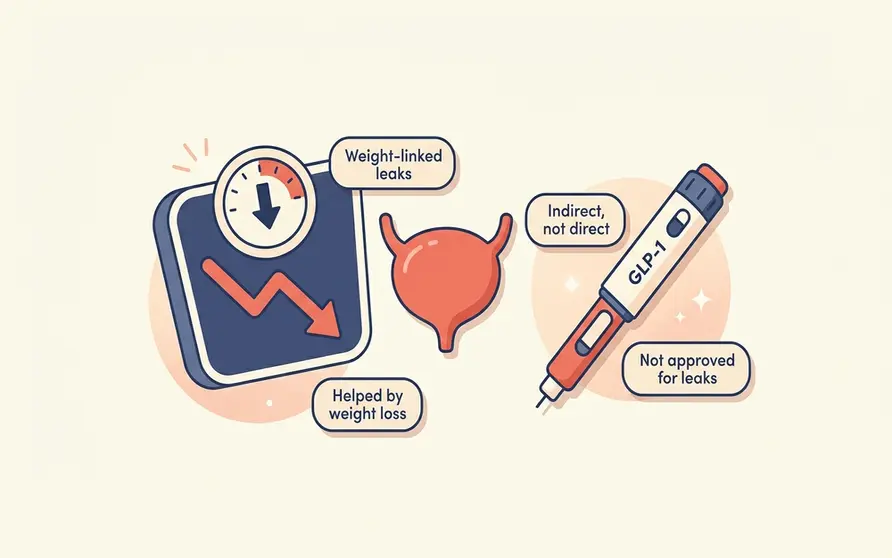
Bladder leaks are common, rarely discussed, and often embarrassing, so it makes sense that people losing weight on a GLP-1 drug like Ozempic, Wegovy or Mounjaro want to know whether the leaks will ease too. The honest answer is a qualified yes: weight loss is one of the few well-evidenced non-surgical ways to reduce stress incontinence, and these drugs drive weight loss, so improvement is plausible and is often reported.
The catch is where the benefit comes from. The evidence that leaks improve is drawn from weight-loss and bariatric-surgery studies, not from trials of the drugs themselves. No GLP-1 medicine is approved to treat incontinence, the drug-specific data are thin, and the group most affected by bladder leaks, women, has the least evidence of all. So nothing here is a reason to start, stop or switch a medicine.
What counts as a bladder leak?
Bladder leaks come in two main types, and they are not the same problem. Stress incontinence is leaking a little urine when pressure rises inside the abdomen, such as when you cough, laugh, sneeze, lift or exercise. It happens when a weakened pelvic floor cannot hold against that pressure, and it is the type most tightly linked to body weight.
Overactive bladder, sometimes called urge incontinence, is different. It is a sudden, hard-to-defer need to urinate, driven by the bladder muscle contracting at the wrong time rather than by pressure on the pelvic floor. This distinction matters for the GLP-1 question, because the strongest weight-loss link and the one dedicated trial now running both target stress incontinence, not overactive bladder.
| Feature | Stress incontinence | Overactive bladder |
|---|---|---|
| Trigger | Coughing, laughing, sneezing, exercise | A sudden, urgent need to go |
| Mechanism | Pressure on a weakened pelvic floor | Bladder muscle contracting too soon |
| Link to body weight | Strong | Present, less direct |
| Focus of the new GLP-1 trial | Yes | Not the primary target |
Does losing weight reduce bladder leaks?
Yes, and this is the best-evidenced part of the whole question. The clearest number comes from the weight-loss surgery literature, not from any drug. A 2026 systematic review in Cureus pooled 84 studies covering more than 165,000 participants and graded the evidence with the AMSTAR-2 and GRADE tools.1 It reported that urinary incontinence and overactive bladder improve or resolve in 50-70% of women after bariatric surgery.1
Read that figure carefully, because it is easy to misuse. The 50-70% improvement is a bariatric-surgery result in women, not an Ozempic or Mounjaro result, and there is no equivalent proven percentage for the GLP-1 drugs.1 What it establishes is the underlying principle: when body weight comes down, the pressure on the pelvic floor and bladder comes down with it, and leaks often ease. That principle is why a drug that causes weight loss is a reasonable thing to study here.
Can Ozempic or Mounjaro help directly?
Here the honest answer gets thinner. A 2026 urology review in Zentralblatt fur Chirurgie ran a systematic search of the literature from 2020 to 2026 and summarised what GLP-1 drugs do across the urinary tract.2 On bladder leaks, its conclusion was cautious: GLP-1 receptor agonists offer an indirect benefit for stress incontinence and overactive bladder through weight loss, rather than a direct action on the bladder itself.2
The same review flagged the biggest gap in the field. It reported a near-complete absence of data in women, which is striking because women are the group most affected by stress incontinence.2 So the current picture is a plausible, weight-driven benefit with very little direct drug evidence behind it, and almost none in the people who most want the answer. No study has produced a GLP-1-specific figure for leak reduction that stands on its own.2
Losing weight lowers the risk of bladder leaks, and GLP-1 drugs cause weight loss. What the drugs have not yet shown is a bladder benefit of their own.
Is any GLP-1 approved for bladder leaks?
No. No GLP-1 or GLP-1/GIP drug is approved anywhere to treat urinary incontinence, and using one for bladder leaks would be off-label. The clearest sign that the drug-specific answer is not yet in is that the manufacturer is running a large trial to find it. Eli Lilly is testing orforglipron, its oral GLP-1 drug, specifically for stress urinary incontinence.3
That study (NCT07202884) is a Phase 3, randomized, double-blind, placebo-controlled trial in 1,000 women who have stress urinary incontinence together with obesity or overweight.3 Its main measure is the change in how often participants leak, the incontinence episode frequency. The trial began recruiting in late 2025, and its primary results are not expected until early 2028.3 A drug-profile summary in the journal Drugs confirms this stress-incontinence programme is part of orforglipron's development plan.4 A company running a 1,000-patient trial is itself the clearest evidence that the question is still open.
Why isn't the answer settled?
Three things keep this at plausible rather than proven. First, the strongest number, the 50-70% improvement, is bariatric surgery, not a GLP-1 drug, so it cannot be transferred onto Ozempic or Mounjaro.1 Second, the drug-specific benefit that reviews do describe is indirect, working through weight loss rather than any bladder-specific action.2 Third, there is no completed randomized trial, and the one now running will not report until 2028.3
It is worth keeping this question separate from other GLP-1 urinary topics. Bladder control is not the same as kidney function, which the Academy covers in its piece on what tirzepatide and dulaglutide do for the kidneys. The urology reviews behind this article also discuss men's sexual and fertility questions, which are a separate topic covered in whether Ozempic affects fertility. This article is about bladder leaks, a problem that falls mostly on women and has the least drug-specific evidence of all.
What actually helps bladder leaks now?
Bladder leaks have effective, established first-line treatments that do not involve a GLP-1 drug. For stress incontinence, pelvic-floor muscle training with a physiotherapist is a standard, well-supported first step, and a clinician can also weigh other options depending on the type and severity of leaking. Losing excess weight, by whatever route a person and their doctor choose, sits alongside those treatments rather than replacing them.
The practical takeaway is a conversation, not a prescription. If you have bladder leaks and also carry extra weight, the weight-loss link is a reasonable thing to raise with a clinician who can assess which type of incontinence you have and what fits your wider health. That is different from seeking a GLP-1 drug for your bladder, which no evidence yet supports.
In one sentence: Weight loss reliably reduces stress incontinence and GLP-1 drugs cause weight loss, so fewer bladder leaks are plausible and often reported, but the benefit is indirect, no GLP-1 is approved or proven to treat incontinence, and the first dedicated trial does not report until 2028.13
Frequently asked
Will losing weight on Ozempic or Mounjaro help my bladder leaks?+
Is the 50-70% improvement figure an Ozempic or Mounjaro number?+
Is any GLP-1 drug approved to treat urinary incontinence?+
Do GLP-1 drugs help stress incontinence or overactive bladder?+
References
- Khalil W, Bibi K, Fareed T, Khan S, Chiran J. Urological Complications of Morbid Obesity and the Role of Bariatric Surgery and Glucagon-Like Peptide-1 Receptor Agonists in Their Management: A Systematic Review. Cureus. 2026 Jun;18(6):e110952. DOI: 10.7759/cureus.110952. PMID: 42465136. A systematic review of 84 studies (more than 165,000 participants) graded with AMSTAR-2 and GRADE; the 50-70% improvement or resolution of urinary incontinence and overactive bladder is a bariatric-surgery finding in women, not a GLP-1 drug effect size. Authors declare no financial relationships.
- Klotz T. GLP-1 Receptor Agonists in Urology and Andrology: Indications, Opportunities and Clinically Relevant Adverse Effects. Zentralblatt fur Chirurgie. 2026 Sep 16. DOI: 10.1055/a-2943-1080. PMID: 42748969. A narrative review of a systematic PubMed search (2020-2026) concluding that GLP-1 receptor agonists give an indirect benefit for stress incontinence and overactive bladder via weight loss, and flagging a near-complete absence of data in women. Author declares no conflict of interest. Article in German with an English abstract.
- Eli Lilly and Company. A Study of Orforglipron in Female Participants With Stress Urinary Incontinence Who Have Obesity or Overweight. ClinicalTrials.gov. Identifier NCT07202884. Phase 3, randomized, double-blind, placebo-controlled trial of orforglipron versus placebo in 1,000 women with stress urinary incontinence and obesity or overweight; primary outcome is change from baseline in incontinence episode frequency. Status: recruiting; started September 2025; estimated primary completion March 2028. Industry-sponsored by Eli Lilly, which owns orforglipron.
- Shirley M. Orforglipron: First Approval. Drugs. 2026 Jul 21. DOI: 10.1007/s40265-026-02363-5. PMID: 42479349. A drug-profile summary of orforglipron (an oral non-peptide GLP-1 receptor agonist) that documents its Phase 3 stress-urinary-incontinence programme; cited here to confirm the trial programme exists, not for any efficacy claim.
Evidence current as of September 23, 2026. The only quantified figure here (50-70% improvement or resolution) is a bariatric-surgery result in women, not a GLP-1 drug effect, and must not be read as one. The drug-specific evidence for bladder leaks is indirect and observational, there is no completed randomized trial of a GLP-1 drug for incontinence, and the first dedicated trial does not report until 2028. No GLP-1 or GLP-1/GIP drug is approved to treat urinary incontinence. This content is educational only, not medical advice. Do not start, stop or change any medicine based on this article. Bladder leaks have effective first-line treatments; anyone affected should discuss them with a clinician.
Translating new metabolic and obesity research into plain English for people living on GLP-1 therapy. Every claim is traced to its source.