Can Ozempic or Mounjaro help hidradenitis suppurativa?
Early evidence is encouraging but not proof. In pooled observational studies, most people with hidradenitis suppurativa on a GLP-1 drug saw their lesions and quality of life improve, and reviews disagree on whether that comes from weight loss or a direct anti-inflammatory effect. No GLP-1 is approved for HS, and the first randomized trial has not started.
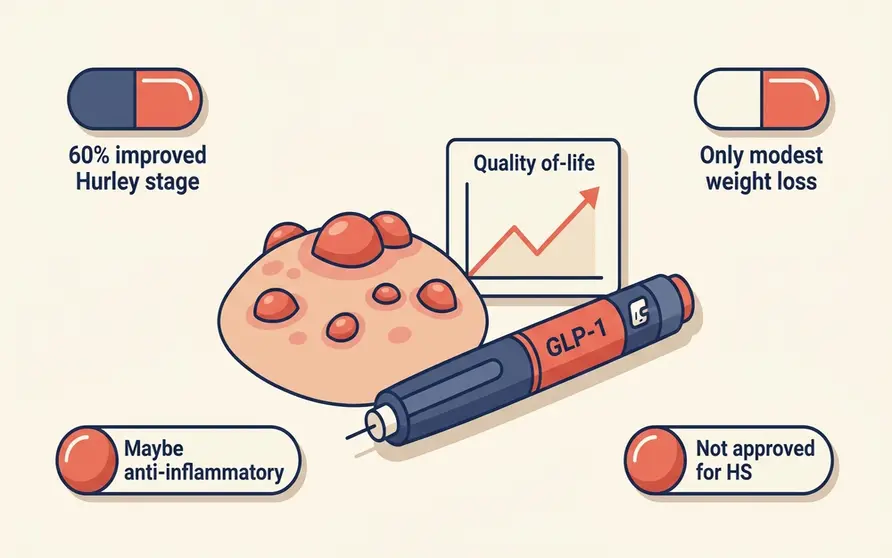
If you live with hidradenitis suppurativa and you take, or are thinking about, a GLP-1 drug such as Ozempic, Wegovy or Mounjaro, the hopeful question is whether the medicine might calm the abscesses, drainage and pain. The honest answer is that early evidence points the right way, but it is not proof, and the reason it works is genuinely unsettled.
The short version: pooled observational studies report that most people with HS on a GLP-1 drug improved, both in their skin and in their quality of life. But every one of those studies is a cohort or case series, not a randomized trial, and the reviews cannot agree on whether the improvement comes from losing weight or from a direct effect on inflammation. No GLP-1 drug is approved to treat HS, so nothing here is a reason to start, stop or switch a medicine on your own.
What is hidradenitis suppurativa?
Hidradenitis suppurativa (HS) is a chronic inflammatory skin disease that causes recurring deep, painful nodules, abscesses and draining sinus tracts, usually in the armpits, groin and under the breasts. It starts in the hair-follicle unit, it is often under-diagnosed and slow to diagnose, and it takes a heavy toll on quality of life and mental health.
HS matters for this question because it is one of the most tightly obesity-linked and metabolic-syndrome-linked conditions in all of dermatology. That overlap is exactly why researchers began asking whether drugs that drive weight loss and shift metabolism, like the GLP-1 medicines, might also quiet the disease. Its existing treatments, including long antibiotic courses, biologics and surgery, are limited and often disappointing, which adds to the search for alternatives.
Can GLP-1 drugs help HS?
The evidence that exists is consistent, and it points toward benefit. The strongest current source is a 2026 systematic review with pooled analysis (American Journal of Clinical Dermatology), which combined 19 studies covering 67,568 HS patients.1 In that pooled analysis, 60% of GLP-1-treated HS patients achieved clinical improvement in their Hurley stage, the standard measure of HS severity (95% CI 52 to 67).1
Quality of life improved too. The Dermatology Life Quality Index, a standard skin-disease questionnaire, improved by a mean of -3.83 points (95% CI -5.14 to -2.51), and the review also reported lower C-reactive protein, a marker of inflammation, by -1.35 mg/L (95% CI -2.33 to -0.36) and a small drop in average blood sugar (HbA1c -0.39%, 95% CI -0.59 to -0.18).1 Large real-world cohorts within the review reported less antibiotic and corticosteroid use and fewer hospitalizations.1
| Outcome on a GLP-1 drug | Pooled result (95% CI) |
|---|---|
| Improved Hurley stage | 60% (52 to 67) |
| Quality of life (DLQI) | -3.83 points (-5.14 to -2.51) |
| C-reactive protein | -1.35 mg/L (-2.33 to -0.36) |
| Average BMI change | -2.64 kg/m2 |
Pooled results from the 2026 systematic review of 19 observational studies (67,568 patients). These are averages from cohorts and case series, not a randomized trial, so they show association rather than proof.1
Is it the weight loss or the drug?
This is the question the whole topic turns on, and it is honestly unresolved. In the largest review, HS improved despite only a modest average BMI change of -2.64 kg/m2, and inflammation markers fell at the same time.1 A separate 2026 mechanistic review (Science Progress) makes the case for two routes working together: weight loss reduces skin-fold friction and improves metabolism, and the drugs may also act directly on inflammation by dampening the NF-kB pathway and cytokine signalling, partly independent of weight.3
But a second 2026 systematic review (Journal of Clinical Medicine) pushes back. It agreed on the overall direction, less pain and suppuration, better quality of life and mental health, and more improvement at higher GLP-1 doses.2 Yet it found no significant change in inflammatory parameters, and it found that weight or BMI reduction did not correlate with improvement in Hurley stage, pain or depression.2 In plain terms, one set of reviewers sees a direct anti-inflammatory effect, another does not, and the data cannot yet settle it.
The skin seems to improve on these drugs. Whether that is the weight coming off or the drug calming inflammation is a question the current evidence cannot answer.
It is also not a clean story about fixing the comorbidities. Even inside the strongest review, results for biologic use, surgical procedures and cardiovascular outcomes were mixed: two studies reported fewer major adverse cardiovascular events, while one cohort of people with both HS and diabetes suggested a persistent excess cardiovascular risk compared with diabetes alone.1 So this is a promising and consistent signal, not a settled case that GLP-1 drugs repair HS and everything linked to it.
What about the weight-loss tradeoffs?
The same weight loss that may quiet HS lesions can bring its own downsides, and it is fair to weigh both. A 2026 patient-reported survey (Dermatology and Therapy) asked 1,226 people in a virtual cardio-kidney-metabolic program about the skin effects of GLP-1 therapy.4 Among those who lost more than 20% of their body weight, 72% reported skin sagging (95% CI 67 to 76), 52% reported hair loss (47 to 58), 50% reported decreased facial volume (45 to 55) and 33% reported reduced strength (28 to 38).4
Read those numbers with care. They are self-reported from a single program, so they carry selection and recall bias and are not measured clinical outcomes. The muscle and strength side of this tradeoff is covered in more depth in the Academy's piece on how much muscle you lose on a GLP-1. The point here is simply that rapid weight loss has its own effects on skin, hair and muscle, and those sit alongside any benefit to HS.
Is any GLP-1 approved for HS?
No. No GLP-1 or GLP-1/GIP drug is approved anywhere to treat hidradenitis suppurativa, and every drug named in the research so far is being used off its label or is still investigational. HS is a specialist-managed disease, and the realistic way to read this evidence is as an emerging, actively-studied option a dermatologist might weigh in someone who also has obesity, not as an established HS therapy and not as a reason to self-start a medicine.
The first real test is only now beginning. Regeneron has registered a Phase 2, randomized, double-blind, placebo-controlled trial of olatorepatide, an investigational GLP-1/GIP drug, in 300 adults with moderate-to-severe HS and overweight or obesity (NCT07830329).5 Its main measure is the change in the count of abscesses and inflammatory nodules over 52 weeks. The trial is registered but not yet recruiting, with an estimated start in late 2026 and primary results not due until November 2028, so a definitive answer is still years away.5
How strong is this evidence?
It is worth being blunt about the limits. Every human study behind the benefit signal is observational: cohorts, case series and reviews of them.123 There is no completed randomized trial of a GLP-1 drug in HS, so this is association, not proof, and each review says plainly that the data are limited. The survey on weight-loss tradeoffs is patient-reported, not clinically measured.4
Funding and interests are worth naming too. The second systematic review includes an author who reports advisory and speaker roles with LEO Pharma, Eli Lilly, Novartis and Pfizer.2 The mechanistic review includes a senior author with extensive research and consultant ties across the dermatology and metabolic drug industry, including Eli Lilly, Novo Nordisk, AbbVie, LEO Pharma and others.3 The ongoing Phase 2 trial is sponsored by Regeneron, which owns the investigational drug being tested.5 None of this makes the numbers wrong, but it is context to weigh.
What should I do?
Do not start, stop or switch a GLP-1 drug or any HS treatment based on anything you read here. If you have HS and also carry extra weight, the evidence so far is a reasonable thing to raise with your dermatologist, who manages HS and can judge whether a GLP-1 drug fits your wider health, rather than a reason to seek one for your skin alone. HS treatment is specialist territory, and the tools that already have approval, from antibiotics to biologics to surgery, remain the backbone of care.
In one sentence: Pooled observational studies suggest GLP-1 drugs like Ozempic and Mounjaro may calm HS lesions and improve quality of life, the reviews disagree on whether that is the weight loss or a direct anti-inflammatory effect, no GLP-1 is approved for HS, the first randomized trial has not started, and any decision belongs with a dermatologist.15
Frequently asked
Can Ozempic or Mounjaro help hidradenitis suppurativa?+
Is HS improvement from GLP-1 drugs just from weight loss?+
Is any GLP-1 drug approved to treat hidradenitis suppurativa?+
Can GLP-1 weight loss cause skin or hair problems?+
References
- Visan MA, Carroll E, Ryan SL, Pender E, Costache DO, Caruntu C, Hughes R, Kirby B. A Systematic Review of the Clinical Impact of GLP-1 Receptor Agonists in Hidradenitis Suppurativa. American Journal of Clinical Dermatology. 2026 Sep. DOI: 10.1007/s40257-026-01049-8. PMID: 42295612. PROSPERO CRD420251110220. A systematic review with pooled analysis of 19 observational studies covering 67,568 patients; the pooled estimates come from cohorts and case series, not randomized trials, and the review reports results for biologic use, surgery and cardiovascular outcomes as mixed.
- Caliezi A, Hosseini A, Wolf R, Seyed Jafari SM. Effects of GLP-1 Agonists on Patients with Hidradenitis Suppurativa: A Systematic Review. Journal of Clinical Medicine. 2026 Apr. DOI: 10.3390/jcm15082909. PMID: 42074711. A systematic review of 10 studies that agreed on the direction of benefit but found no significant change in inflammatory parameters and no correlation between weight or BMI reduction and improvement in Hurley stage, pain or depression. Disclosure: author S.M. Seyed Jafari reports advisory boards and speaker roles for LEO Pharma, Eli Lilly, Novartis and Pfizer.
- Brogaard E, Nielsen VW, Pedersen NH, Holgersen N, Thomsen SF. Clinical and mechanistic effects of GLP-1 receptor agonists in hidradenitis suppurativa and comorbidities. Science Progress. 2026 Jul-Sep. DOI: 10.1177/00368504261464855. PMID: 42389771. A narrative review of 12 cohorts and 4 case reports proposing that benefit may come from both weight loss and a direct anti-inflammatory action. Disclosure: senior author Simon Francis Thomsen reports extensive research support and consultant or speaker roles across the dermatology and metabolic drug industry, including AbbVie, Eli Lilly, LEO Pharma, Novartis, Novo Nordisk, Pfizer, Sanofi and UCB.
- Rao S, Midura I, Mangual KPS, Igel LI, Saunders KH, Carter J, Murase JE, Kourosh AS. Skin Impacts and Tradeoffs of GLP-1 Therapy: Improved Patient-Reported Outcomes of Inflammatory Skin Disease in the Era of "Ozempic Face". Dermatology and Therapy. 2026 Sep. DOI: 10.1007/s13555-026-01882-z. PMID: 42579223. An anonymous patient-reported survey of 1,226 people in one virtual cardio-kidney-metabolic program; the skin, hair and strength figures are self-reported and carry selection and recall bias, not measured clinical outcomes.
- Regeneron Pharmaceuticals. A Study to Assess Olatorepatide in Adult Participants With Hidradenitis Suppurativa and Overweight or Obesity. ClinicalTrials.gov. Identifier NCT07830329. Phase 2, randomized, double-blind, placebo-controlled trial of the investigational GLP-1/GIP drug olatorepatide versus placebo in 300 adults with moderate-to-severe HS and overweight or obesity; primary outcome is percent change in total abscess and inflammatory nodule count over 52 weeks. Status: not yet recruiting; estimated primary completion November 2028. Industry-sponsored by Regeneron, which owns the investigational drug.
Evidence current as of September 22, 2026. The benefit figures come from pooled observational studies (cohorts and case series), which report average associations rather than proof of cause and effect; there is no completed randomized trial of a GLP-1 drug in hidradenitis suppurativa, and the reviews disagree on the mechanism. The weight-loss tradeoff figures are self-reported survey data. No GLP-1 or GLP-1/GIP drug is approved to treat hidradenitis suppurativa. This content is educational only, not medical advice. Do not start, stop or change any medicine based on this article. HS is a specialist-managed disease; anyone considering these drugs should discuss it with their dermatologist first.
Translating new metabolic and obesity research into plain English for people living on GLP-1 therapy. Every claim is traced to its source.