Can Ozempic or Mounjaro prevent type 2 diabetes?
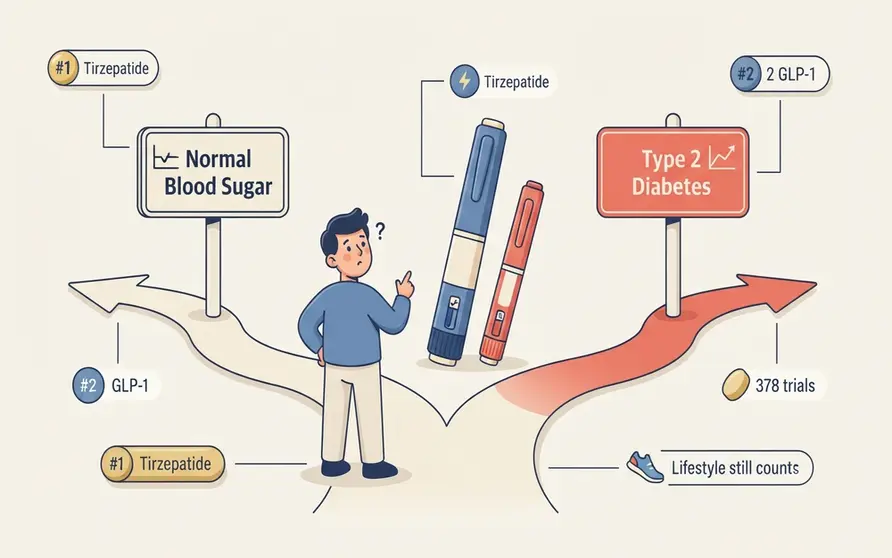
In the largest analysis so far, a 2026 network meta-analysis of 378 trials and 113,122 adults with prediabetes ranked incretin drugs first at preventing type 2 diabetes. Tirzepatide (Mounjaro) cut new diabetes the most, single GLP-1 drugs like semaglutide (Ozempic) ranked second, and metformin plus intensive lifestyle followed closely. No GLP-1 drug is approved to prevent diabetes.
More than 2 in 5 American adults, about 115.2 million people, have prediabetes, and 8 in 10 of them do not know it.2 Prediabetes means blood sugar is higher than normal but not yet in the diabetes range, and a large share of these people go on to develop type 2 diabetes without a change. The obvious question in 2026 is whether the new weight-loss and diabetes drugs can stop that slide.
A 2026 network meta-analysis set out to rank every option side by side.1 Its answer: incretin-based drugs, the family that includes semaglutide (Ozempic, Wegovy) and tirzepatide (Mounjaro, Zepbound), came out on top for preventing type 2 diabetes, ahead of metformin and lifestyle change.1
What did the study find?
The analysis pooled 378 randomised controlled trials covering 113,122 adults with prediabetes, making it the largest comparison of diabetes-prevention options to date.1 It ranked drug classes, supplements and lifestyle programmes against each other for one main outcome: how many people went on to develop type 2 diabetes.1
Incretin drugs led that ranking. Dual GLP-1 and GIP therapy, meaning tirzepatide, showed the largest reduction in new diabetes, and single GLP-1 drugs such as semaglutide and liraglutide ranked second, just ahead of metformin combined with intensive lifestyle change.1
Which drugs ranked highest?
The gap between the top options was smaller than the headline suggests. Here is how the three leaders compared against control for preventing type 2 diabetes, where a lower relative risk means fewer people developed diabetes.1
| Intervention | Rank for preventing diabetes | Relative risk vs control |
|---|---|---|
| Tirzepatide (GLP-1 + GIP) | First, largest reduction | 0.10 (95% CI 0.05-0.21)1 |
| Single GLP-1 (e.g. semaglutide) | Second | 0.26 (95% CI 0.19-0.40)1 |
| Metformin + intensive lifestyle | Close third | 0.27 (95% CI 0.12-0.64)1 |
"Incretin-based therapies, particularly dual GLP-1 + GIP RA and single GLP-1 RA, followed by metformin together with intensive lifestyle intervention, are the most effective interventions to prevent type 2 diabetes in patients with prediabetes."1
Is this a cure or just a delay?
There is an important catch in the word "prevent". GLP-1 drugs and tirzepatide lower blood sugar directly, so while a person takes them a prediabetes reading can move back into the normal range. That can mean diabetes is genuinely delayed, but it can also mean a diagnosis is masked for as long as treatment continues, which is why the durable question is what happens after stopping.1
The evidence on stopping is sobering. In the STEP 1 trial extension, adults who lost 17.3% of their weight on semaglutide regained about two-thirds of it within a year of stopping, and most of their improvements in blood sugar and other risk markers drifted back toward the starting point.3 So the prevention seen on treatment should not be assumed to be permanent once the drug is stopped.
Are these drugs approved for prevention?
No. Semaglutide and tirzepatide are approved to treat type 2 diabetes and to manage obesity, not to prevent diabetes in people with prediabetes.4 Using them specifically for prevention would be an off-label decision, and this article is not a recommendation to seek one. For people who already have type 2 diabetes the questions are different, and our piece on whether CagriSema beats Ozempic for type 2 diabetes compares two of these drugs head to head.
Does diet and exercise still matter?
Yes, and the study reinforces it. Metformin plus intensive lifestyle change ranked essentially alongside single GLP-1 drugs for preventing type 2 diabetes, so lifestyle is not a weak runner-up to medication.1 For lowering HbA1c, a marker of average blood sugar, by more than 0.3% at one year, only four interventions cleared that bar: curcumin, dual GLP-1 and GIP therapy, single GLP-1 drugs, and physical activity.1
Those supplement signals come with limits. Curcumin and zinc showed up only in single blood-sugar measures, not in the main ranking of who actually avoided diabetes, which incretin drugs and metformin plus lifestyle led.1 The practical reading is that drugs and lifestyle work together here, not that one replaces the other.
How strong is this evidence?
This is a network meta-analysis of randomised trials, the strongest design for comparing many options at once, and its protocol was registered in advance (PROSPERO CRD42023473875) with the authors declaring no conflicts of interest.1 That combination makes the ranking a serious piece of evidence rather than a single trial's snapshot.
The rankings still rest partly on indirect comparisons, because few trials tested these interventions head to head, and there was substantial variation between trials.1 The tirzepatide estimate in particular has a wide confidence interval (relative risk 0.10, 95% CI 0.05-0.21), so it is best read as "ranked first in this analysis" rather than a precise 90% guarantee for any one person.1
In one sentence: the largest analysis so far ranks tirzepatide and then single GLP-1 drugs like semaglutide as the most effective options for preventing type 2 diabetes in prediabetes, closely followed by metformin plus lifestyle, but none is approved for prevention and the effect may not last after stopping.1
Frequently asked
Can Ozempic or Mounjaro prevent type 2 diabetes?+
Which is better for preventing diabetes: GLP-1 drugs, metformin, or lifestyle?+
Does the effect last after you stop the medication?+
Are GLP-1 drugs approved to prevent diabetes?+
References
- Maria B, Orsolya E, Iulian PR, et al. Evidence-based ranking of diabetes prevention in prediabetes: A comprehensive network meta-analysis of 378 randomised controlled trials. Clin Transl Med. 2026 Sep;16(9):e70829. DOI: 10.1002/ctm2.70829. PMID: 42711998. PMCID: PMC13554713. Protocol PROSPERO CRD42023473875; the authors declare no conflicts of interest.
- Centers for Disease Control and Prevention. Prediabetes: Could It Be You? CDC Diabetes. Updated February 17, 2026. Reports that 115.2 million American adults, more than 2 in 5, have prediabetes, and 8 in 10 do not know they have it.
- Wilding JPH, Batterham RL, Davies M, et al. Weight regain and cardiometabolic effects after withdrawal of semaglutide: The STEP 1 trial extension. Diabetes Obes Metab. 2022 Aug;24(8):1553-1564. DOI: 10.1111/dom.14725. PMID: 35441470.
- U.S. Food and Drug Administration / Novo Nordisk. Ozempic (semaglutide) injection, prescribing information: indications and usage. DailyMed. Indicated for glycemic control in type 2 diabetes, cardiovascular risk reduction in type 2 diabetes with established cardiovascular disease, and kidney disease risk reduction in type 2 diabetes with chronic kidney disease; no diabetes-prevention indication is listed.
Evidence current as of September 14, 2026. This article describes a network meta-analysis that ranks interventions using indirect comparisons across trials, not head-to-head prevention trials, and reports average effect sizes rather than a guarantee for any individual. This content is educational only, not medical advice. No GLP-1 drug is approved to prevent type 2 diabetes, and no one should start, stop, or change a medicine based on this article. Anyone with prediabetes should discuss their options with a clinician.
Translating new metabolic and obesity research into plain English for people living on GLP-1 therapy. Every claim is traced to its source.