Can Ozempic or Wegovy help multiple sclerosis?
No. No GLP-1 drug is approved or proven to treat multiple sclerosis, and none of the weight-loss pens treats it. The one dedicated trial, Johns Hopkins' TAG-MS, began recruiting in 2026, tests an experimental drug called NLY01 rather than Ozempic or Wegovy, and is not expected to report until around 2030.
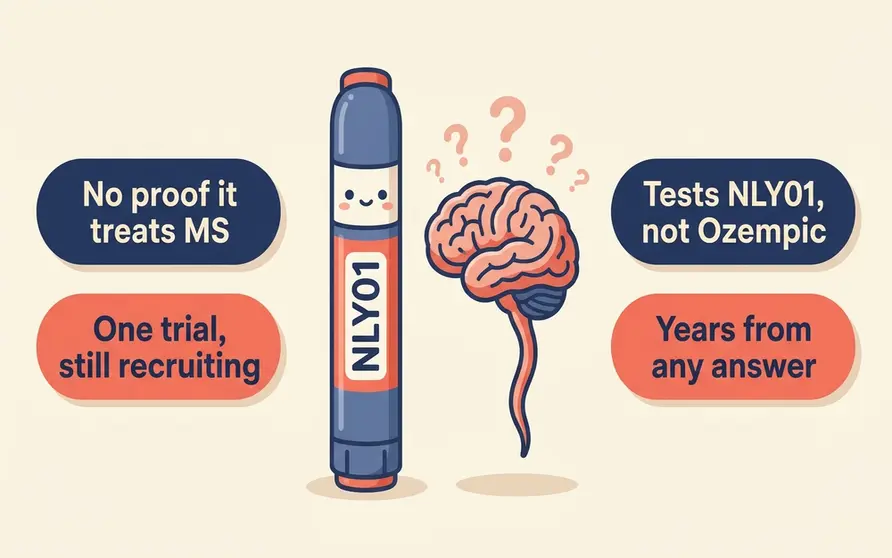
If you or someone in your family has multiple sclerosis, you have probably seen a headline about a "GLP-1 trial for MS" and wondered whether the pen in the fridge could help. It is a fair question, and the honest answer is worth more than a hopeful one. So here it is, plainly: no GLP-1 drug treats multiple sclerosis today, and the one real trial is not testing the drug most people assume.
This article walks through what is actually happening in the research, why the picture is easy to misread, and what it does and does not mean for anyone living with MS right now. Nothing here is a reason to start, stop or change a medicine.
Can a GLP-1 drug treat MS?
No. No GLP-1 receptor agonist is approved to treat multiple sclerosis anywhere, and no completed human trial has shown that any of them slows the disease, reduces relapses or protects against disability. Multiple sclerosis is a condition in which the immune system attacks the protective coating around nerves in the brain and spinal cord, and its approved treatments are a separate class of drugs chosen for that specific job.
What exists is a hypothesis now entering its first dedicated test. That is a meaningful piece of news, because it is the moment a research idea becomes a real experiment. It is not the same as a result, and it is certainly not a reason to expect a weight-loss drug to change the course of MS.
What is the TAG-MS trial testing?
The actual news is a single early study. Johns Hopkins University opened a Phase 2 trial called TAG-MS (Targeting Agonists of Glucagon-like Peptide-1 Receptor for Multiple Sclerosis), which began recruiting on April 28, 2026.1 It is randomised and double-blind, plans to enrol about 120 people, and is run with the National Multiple Sclerosis Society and the charity Race to Erase MS.1
Its main measure is not weight and not symptoms. TAG-MS is designed to see whether the drug slows the loss of brain tissue, measured as normalised brain parenchymal volume on MRI scans over about 96 weeks.1 That is a disease-modification question, which is the right kind of question to ask, but the trial is recruiting now and is estimated to run until around January 2030, so it has no results.1
Why is it not testing Ozempic or Wegovy?
This is the detail that gets lost. TAG-MS does not use semaglutide (Ozempic, Wegovy) or tirzepatide (Mounjaro). The trial drug is NLY01, an experimental long-acting GLP-1 receptor agonist, specifically a pegylated form of exenatide, given as a weekly injection.1 NLY01 was chosen for its studied effects inside the brain, not for weight loss, which is why the researchers picked it over the familiar commercial pens.
So a reader who hears "GLP-1 trial for MS" and pictures the weight-loss pen in their fridge has the wrong picture. The trial is testing a different, investigational molecule that is not sold in any pharmacy. Correcting that single misunderstanding is the most useful thing this article can do.
| Study | What it asks | Which drug | Status |
|---|---|---|---|
| TAG-MS (Johns Hopkins) | Can a GLP-1 drug slow MS brain-tissue loss? | NLY01 (experimental) | Recruiting; results about 2030 |
| Northwestern cohort | How do MS patients on ocrelizumab do when they also take a GLP-1? | A commercial GLP-1 (for weight) | Recruiting; observational |
Sources: TAG-MS, ClinicalTrials.gov NCT07497399;1 Northwestern cohort, ClinicalTrials.gov NCT07207148.4 Neither has results yet.
Did NLY01 work in other brain diseases?
Here is the counterweight that keeps expectations honest. NLY01 has already been tested in the brain once, in Parkinson's disease, and it did not pass. A randomised, double-blind, placebo-controlled Phase 2 trial in 255 people with early, untreated Parkinson's disease gave weekly NLY01 for 36 weeks and missed its primary endpoint: the drug showed no significant benefit on the standard Parkinson's rating scale, and the authors reported no clear motor or non-motor improvement overall.2
That result does not rule out a future use in MS, which is a different disease with a different mechanism. But it is a reminder that a drug reaching the brain is not the same as a drug helping it. The same molecule now being tried for MS has one completed brain trial behind it, and that trial was negative.
Why might GLP-1 drugs help MS at all?
The idea is biologically plausible, which is exactly why it is being studied. In laboratory and animal work, GLP-1 receptor agonists calm microglia, the brain's resident immune cells, and reduce inflammation in nerve tissue.3 Because MS is driven by immune attack and inflammation in the brain and spinal cord, researchers have asked whether quieting that inflammation could, in principle, protect nerves.
A 2026 narrative review in Annals of Clinical and Translational Neurology lays out this reasoning but is careful with its own language, describing "potentially pleiotropic effects" on the MS disease course.3 That phrasing is a signpost toward a question, not a claim of benefit. The review's authors also run a Genentech-funded GLP-1 study in MS patients, a tie worth knowing when reading an optimistic mechanism paper.3 A plausible mechanism is where good research starts, not where it ends.
"A drug reaching the brain is not the same as a drug helping it."
Should I take a GLP-1 if I have MS?
Many people with MS already take a commercial GLP-1, and for good reason: obesity, type 2 diabetes, sleep apnea and fatty liver are common alongside MS, and those are the conditions these drugs are actually approved to treat. A separate study at Northwestern University (NCT07207148) is simply watching how people with MS who are on the MS drug ocrelizumab get on when they also take a GLP-1 for weight.4 That is managing weight and metabolic health in someone who happens to have MS. It is not treating the MS.
So the practical line is clear. Treating a comorbidity like obesity with a GLP-1, under a doctor's care, is a normal medical decision. Taking a weight-loss GLP-1 in the hope of slowing MS itself is not supported by any data, and MS is distinct from other neurological conditions a GLP-1 has been studied in, such as idiopathic intracranial hypertension, which is raised pressure around the brain rather than an immune attack on nerves. Any change to MS treatment belongs with a neurologist who knows your case.
In one sentence: No GLP-1 drug is proven to treat multiple sclerosis, the single dedicated trial tests an experimental drug called NLY01 rather than Ozempic or Wegovy and will not report until around 2030, so taking a weight-loss GLP-1 to slow MS is not supported by evidence today.
Frequently asked
Can Ozempic or Wegovy treat multiple sclerosis?+
What drug is the TAG-MS trial actually testing?+
Should I take a weight-loss GLP-1 to slow my MS?+
References
- Johns Hopkins University. Targeting Agonists of Glucagon-like Peptide-1 Receptor for Multiple Sclerosis (TAG-MS): A Phase 2, Randomized, Double-Blind, Parallel-Arm Study. ClinicalTrials.gov, NCT07497399. First posted March 27, 2026; recruiting as of the last update July 17, 2026; estimated enrolment 120; study drug NLY01 versus placebo; primary outcome change in normalised brain parenchymal volume over approximately 96 weeks; estimated completion January 2030. Collaborators: National Multiple Sclerosis Society and Race to Erase MS.
- McGarry A, Rosanbalm S, Leinonen M, et al. Safety, tolerability, and efficacy of NLY01 in early untreated Parkinson's disease: a randomised, double-blind, placebo-controlled trial. The Lancet Neurology. 2024 Jan;23(1):37-45. DOI: 10.1016/S1474-4422(23)00378-2. PMID: 38101901. The trial of the GLP-1 drug NLY01 in Parkinson's disease did not meet its primary endpoint.
- Chang AY, Mateen FJ. Glucagon-Like Peptide-1 Receptor Agonists in Multiple Sclerosis: A Topical Narrative Review. Annals of Clinical and Translational Neurology. 2026 Oct 12. DOI: 10.1002/acn3.70547. PMID: 42860897. A narrative review (not evidence of benefit) describing "potentially pleiotropic effects" of GLP-1 drugs on the MS disease course. The authors disclose a Genentech-funded investigator-initiated GLP-1 trial in people with MS.
- Northwestern University. People With Multiple Sclerosis Treated With Ocrelizumab and GLP-1 Agonists. ClinicalTrials.gov, NCT07207148. Observational prospective cohort; recruiting since November 2025; estimated enrolment 100; observes MS progression, tolerability and weight in people with MS who take both ocrelizumab and a GLP-1 agonist. Not a test of a GLP-1 as an MS treatment.
Evidence current as of October 23, 2026. This article is educational and not medical advice. Multiple sclerosis treatment decisions belong with your neurologist; always consult a qualified clinician before starting, stopping or changing a medication.
Translating new metabolic and obesity research into plain English for people living on GLP-1 therapy. Every claim is traced to its source.