Can semaglutide help people with schizophrenia lose weight?
A randomised trial at Toronto's Centre for Addiction and Mental Health (NCT05333003) is testing whether weekly semaglutide can reduce weight in people with schizophrenia spectrum disorders who did not respond to metformin, the current first-line treatment for antipsychotic-induced weight gain. The trial also tracks psychiatric symptoms and cognition throughout treatment.
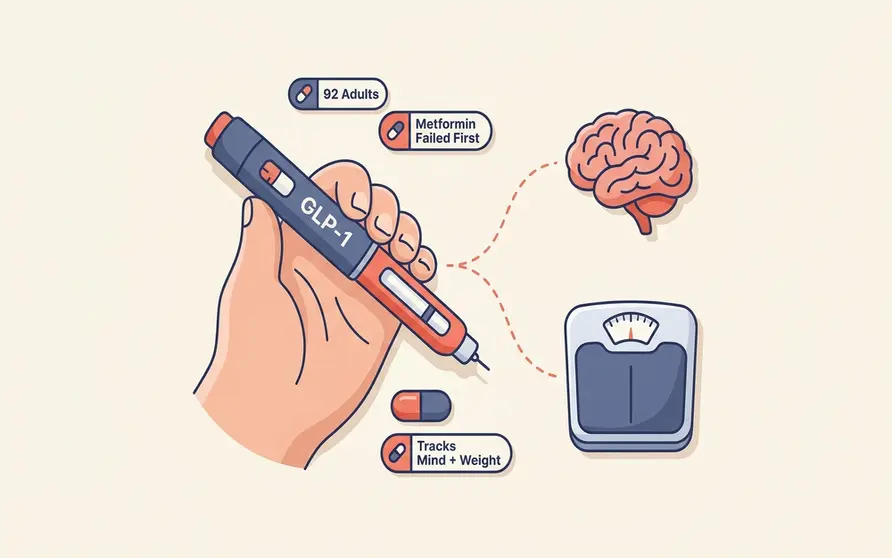
People with schizophrenia and related psychotic disorders face some of the highest rates of antipsychotic-induced weight gain in medicine. Metformin is the current first-line drug offered to counter it, but many patients do not respond. A trial now underway at the Centre for Addiction and Mental Health (CAMH) in Toronto is testing whether semaglutide, the GLP-1 drug behind Ozempic and Wegovy, can succeed where metformin failed - and whether it is safe to use in a population already managing a serious mental illness.1
What is the CAMH semaglutide trial testing?
The trial, registered as NCT05333003, is a single-blind, placebo-controlled randomised trial run by CAMH.1 It is enrolling an estimated 92 adults aged 18 to 70 who have schizophrenia spectrum disorder, major depressive disorder with psychotic features, or bipolar disorder, and who are on stable antipsychotic therapy for at least three months.1 Every participant must have a body mass index of 30 or higher, or 27 or higher with a weight-related health condition, and must already have tried metformin without adequate weight loss or with a documented intolerance.1
Participants are randomly assigned to weekly injectable semaglutide or a matching placebo, with the active dose escalated from 0.25 mg to a maximum of 2 mg over four-week intervals.1 That ceiling sits below Wegovy's approved 2.4 mg weekly dose for obesity, reflecting a cautious, stepwise approach in a population that has not previously been studied at the full obesity dose. The primary outcome is the percentage change in body weight at 32 weeks.1
Why does the trial require metformin to have already failed?
Weight gain on antipsychotics is common enough to be considered near-universal for some drugs. A 2014 meta-analysis of 307 randomised trials found that almost all antipsychotics produce weight gain, with olanzapine and clozapine causing the most severe increases and only amisulpride, aripiprazole, and ziprasidone remaining close to weight-neutral with long-term use.2 Metformin has the strongest evidence base of any pharmacological countermeasure and is the treatment clinicians reach for first.3 In one 12-week randomised trial, metformin reduced weight by 5.79% from baseline while a placebo group gained 5.51%, a difference of roughly 7 kg.4
But metformin does not work for everyone, and no established second-line drug exists once it fails.3 The CAMH trial is built specifically around that gap: it enrolls only people whose antipsychotic-induced weight gain did not respond to metformin, testing semaglutide as the next option rather than as a first-line alternative.
| Intervention | Evidence status | Weight effect |
|---|---|---|
| Switching to a weight-neutral antipsychotic | Established | Weight-neutral with long-term use2 |
| Metformin | Established first-line | -5.79% vs +5.51% placebo at 12 weeks in one RCT4 |
| Semaglutide (this trial) | Being tested, no results yet | Unknown - primary outcome at 32 weeks1 |
"A weight-loss trial that watches psychiatric symptoms as closely as it watches the scale."
Is it safe to give semaglutide to someone with schizophrenia?
This is the safety question the trial is explicitly designed to answer, and it echoes a broader debate playing out at the FDA. After receiving postmarketing reports of suicidal thoughts in patients taking GLP-1 drugs, the FDA opened a formal safety review in 2023.5
In January 2026, the FDA completed that review, examining a meta-analysis of 91 placebo-controlled trials covering 107,910 patients, plus a separate cohort of more than 2.2 million patients.5 The agency concluded there was no evidence of increased risk for suicidal ideation, suicidal behavior, depression, anxiety, irritability, or psychosis with GLP-1 drugs compared with placebo.5 It requested that suicidality warnings be removed from the labels of Saxenda, Wegovy, and Zepbound.5
Not every review reaches the same level of confidence. A separate 2025 systematic review of GLP-1 drugs and suicidal ideation found no statistically significant increase in risk, but flagged substantial variability across the underlying pharmacovigilance data and concluded that clinicians should continue to monitor patients, particularly those with psychiatric conditions.6 The CAMH trial reflects that caution directly: participants are tracked on four psychiatric symptom scales and a full cognitive test battery throughout the study, not just on the scale.1
When will results be available?
NCT05333003 started in May 2022 and is currently listed as active but not recruiting, meaning enrollment has closed and existing participants are completing the study.1 The registry's most recent update, posted May 27, 2026, lists both primary completion and study completion as estimated for August 2026.1 No results have been published yet, so it is not yet known whether semaglutide succeeds where metformin did not.
In one sentence: a Toronto trial is testing whether semaglutide can produce meaningful weight loss in people with schizophrenia and antipsychotic-induced obesity who already failed metformin, while closely monitoring for psychiatric side effects - and the results are not in yet.1
Frequently asked
Is semaglutide being tested in people with schizophrenia?+
Why does the trial only enroll people who already failed metformin?+
Is it safe to give semaglutide to someone with schizophrenia?+
What dose of semaglutide is used in the trial, and are there results yet?+
References
- Centre for Addiction and Mental Health. Semaglutide in Comorbid Schizophrenia Spectrum Disorder and Obesity for Metformin Non-responders: a Single-blind Randomized Control Trial. ClinicalTrials.gov. Identifier: NCT05333003. Status: Active, not recruiting. Estimated enrollment 92. Last update posted: May 27, 2026.
- Bak M, Fransen A, Janssen J, van Os J, Drukker M. Almost All Antipsychotics Result in Weight Gain: A Meta-Analysis. PLoS ONE. 2014;9(4):e94112. DOI: 10.1371/journal.pone.0094112. PMID: 24763306.
- Stogios N, Humber B, Agarwal SM, Hahn M. Antipsychotic-Induced Weight Gain in Severe Mental Illness: Risk Factors and Special Considerations. Curr Psychiatry Rep. 2023;25(11):707-721. DOI: 10.1007/s11920-023-01458-0. PMID: 37755655.
- Kang D, Jing Z, Li R, et al. Effect of Betahistine and Metformin on Antipsychotic-Induced Weight Gain: An Analysis of Two Clinical Trials. Front Psychiatry. 2018;9:620. DOI: 10.3389/fpsyt.2018.00620. PMID: 30542300. Note: 12-week trial in early-stage antipsychotic-induced weight gain; not directly comparable to the CAMH trial's metformin-non-responder population.
- U.S. Food and Drug Administration. FDA Requests Removal of Suicidal Behavior and Ideation Warning from Glucagon-Like Peptide-1 Receptor Agonist (GLP-1 RA) Medications. Drug Safety Communication. Issued January 13, 2026.
- Bushi G, Khatib MN, Rohilla S, et al. Association of GLP-1 Receptor Agonists With Risk of Suicidal Ideation and Behaviour: A Systematic Review and Meta-Analysis. Diabetes Metab Res Rev. 2025. DOI: 10.1002/dmrr.70037. PMID: 39945396.
Evidence current as of July 17, 2026. This article describes an ongoing clinical trial with no published results and is not a report of trial outcomes. This content is educational only, not medical advice. Anyone with a psychiatric condition considering a change to medication should speak with their prescribing clinician, not this article.
Translating new metabolic and obesity research into plain English for people living on GLP-1 therapy. Every claim is traced to its source.