Can tirzepatide help people with type 1 diabetes and obesity?
Eli Lilly's SURPASS-T1D-2 trial is giving about 465 adults with type 1 diabetes and a BMI of 25 or higher either weekly tirzepatide or a placebo for up to 72 weeks. It is one of the first large trials to test a GLP-1/GIP drug in this group, but it has no results yet.
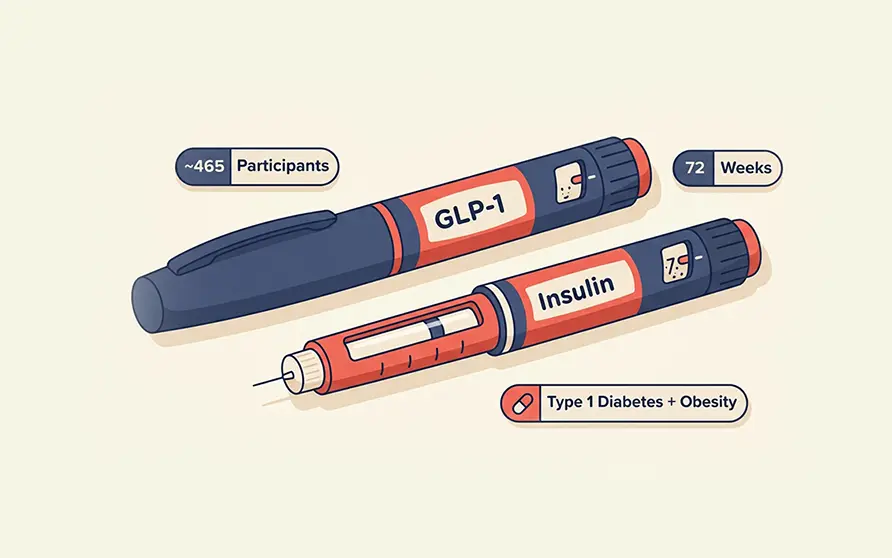
Large GLP-1 and GLP-1/GIP trials for weight loss, including the SURPASS and SURMOUNT programs, have mostly enrolled people with type 2 diabetes or no diabetes at all.2 People with type 1 diabetes have largely been left out, in part because these drugs slow digestion and blunt appetite in ways that can interact unpredictably with insulin dosing. A new Eli Lilly trial, SURPASS-T1D-2, is now testing weekly tirzepatide directly in adults who have both type 1 diabetes and excess weight.
What is SURPASS-T1D-2 actually testing?
The official title is "A Phase 3, Multicenter, Randomized, Double-Blind, Placebo-Controlled, Parallel-Group Study Evaluating the Efficacy and Long-Term Safety of Tirzepatide Once Weekly Compared to Placebo in Adults With Type 1 Diabetes and Obesity or Overweight," registered as NCT06962280.1 It is sponsored by Eli Lilly and Company, the manufacturer of tirzepatide (branded Mounjaro for diabetes and Zepbound for obesity), with an estimated 465 participants across multiple sites.1 The design randomizes participants to weekly subcutaneous tirzepatide (LY3298176) or a matching weekly placebo injection, with neither participants nor investigators told which arm a given person is in.1
Who can join, and who is excluded?
Eligible participants must already have type 1 diabetes with at least one year of insulin therapy, an HbA1c between 7.0% and 10.5% at screening, a BMI of 25 kg/m² or higher, and a stable weight for at least 90 days before enrollment.1 The exclusion criteria are where the trial's central safety concern shows up directly: anyone with two or more hospitalizations for hyperglycemia or diabetic ketoacidosis in the 180 days before screening, or a single severe hypoglycemic event in the 90 days before screening, cannot enroll.1 The trial also excludes anyone with a history of pancreatitis, active diabetic retinopathy treatment, or recent use of another weight-loss medication or herbal supplement.1
That exclusion list is not incidental. It is the clearest evidence in the public registry record of exactly why GLP-1/GIP trials have historically avoided this population: combining an appetite-suppressing, digestion-slowing drug with exogenous insulin dosing raises a real hypoglycemia risk that this trial is designed to screen for and monitor rather than ignore.
| Outcome measure | Timepoint |
|---|---|
| HbA1c change (primary) | Baseline to Week 40 |
| HbA1c change (secondary) | Baseline to Week 72 |
| CGM time-in-range (70-180 mg/dL) | Baseline to Week 72 |
| Body weight (absolute & % change) | Baseline to Week 72 |
| Daily insulin dose | Baseline to Week 72 |
| Systolic blood pressure, lipids, hsCRP | Baseline to Week 72 |
Source: ClinicalTrials.gov record NCT06962280.1 Additional secondary outcomes include waist circumference and quality of life measured with the EQ-5D-5L questionnaire, both from baseline to week 72.
"The exclusion list is the clearest evidence of why this population has been left out of GLP-1 trials until now."
Why does hypoglycemia risk matter so much here?
In type 1 diabetes, all insulin is injected or pumped rather than produced by the body, so there is no internal feedback loop to automatically stop insulin action if a meal is smaller or later than expected. Tirzepatide's appetite-suppressing, gastric-emptying-delaying effects can shift how much and how quickly a person eats, which changes how much insulin they actually need.3 Mistiming that shift is the mechanism behind low blood sugar, which is why SURPASS-T1D-2 screens out anyone with a recent severe hypoglycemic episode before they can even enroll.1
What this does not mean - yet
NCT06962280 has produced no HbA1c, weight, or safety outcome data. It cannot be cited as evidence that tirzepatide is safe or effective for people with type 1 diabetes - that is the exact question the trial exists to answer, not a finding it has already delivered. The trial started May 12, 2025, is listed as active but not recruiting, and has an estimated primary completion date of November 2026 with full study completion estimated July 2027.1
In one sentence: Eli Lilly's SURPASS-T1D-2 is testing weekly tirzepatide against placebo in about 465 adults who have both type 1 diabetes and obesity, but with no results published yet, it can only describe what the trial is measuring, not what it has found.
Frequently asked
Does the SURPASS-T1D-2 trial have results yet?+
What is SURPASS-T1D-2 actually testing?+
Why are people with type 1 diabetes usually excluded from GLP-1 weight-loss trials?+
References
- Eli Lilly and Company. A Phase 3, Multicenter, Randomized, Double-Blind, Placebo-Controlled, Parallel-Group Study Evaluating the Efficacy and Long-Term Safety of Tirzepatide Once Weekly Compared to Placebo in Adults With Type 1 Diabetes and Obesity or Overweight (SURPASS-T1D-2). ClinicalTrials.gov. Identifier: NCT06962280. Status: Active, not recruiting. Estimated primary completion: November 2026.
Evidence current as of July 4, 2026. This article describes an ongoing, unpublished clinical trial and is educational only, not medical advice. It is not a report of trial results. People with type 1 diabetes should never start, stop, or adjust insulin or GLP-1 medication without direct guidance from their prescribing clinician, given the hypoglycemia risks discussed above.
Translating new metabolic and obesity research into plain English for people living on GLP-1 therapy. Every claim is traced to its source.