Do I stop Ozempic before surgery or a colonoscopy?
Do not decide this on your own. GLP-1 drugs like Ozempic, Wegovy and Mounjaro often leave more food in the stomach before anaesthesia, yet the best current evidence does not show they raise actual aspiration into the lungs. Guidance has shifted from "stop it" toward individualised timing, so tell your surgical and anaesthesia team early and follow their instructions.
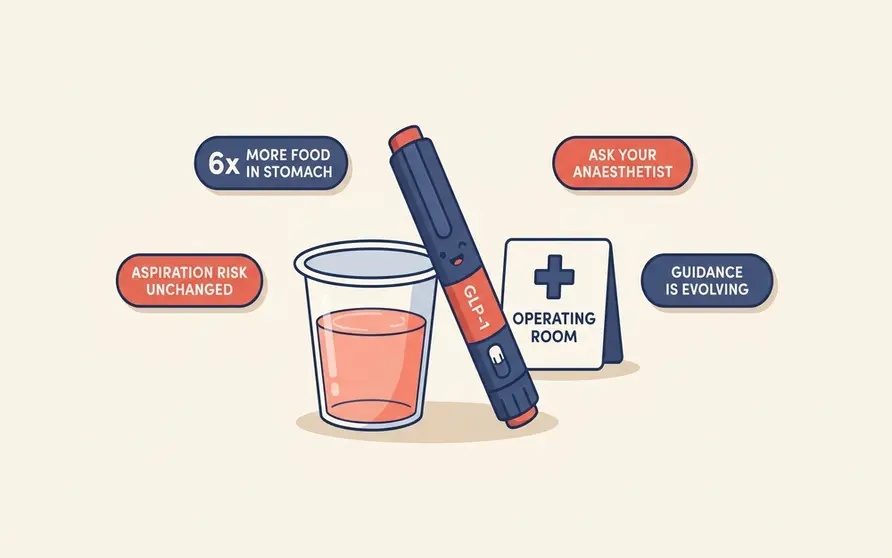
If you take a GLP-1 drug such as Ozempic, Wegovy or Mounjaro and you have an operation, an endoscopy or a colonoscopy coming up, you have probably heard that you may need to stop it first. The honest answer is that this is not a decision to make on your own. It depends on the drug, the dose and the procedure, and it belongs to your anaesthesia and surgical team.
The worry behind the question is real. GLP-1 drugs slow how fast the stomach empties, so food can still be present when a person is put under, and a full stomach under anaesthesia raises the fear of aspiration, where stomach contents enter the lungs.1 What the best current evidence shows, though, is more reassuring and more specific than the headlines, so it helps to separate what is measured from what is feared.
Do I have to stop it myself?
No. The reason the guidance around GLP-1 drugs and surgery has become so detailed is that the right choice varies from person to person: which drug you take, whether it is a weekly or daily version, your dose, why you take it, and the type of procedure.3 The single most useful thing you can do is tell your surgical and anaesthesia team that you are on a GLP-1 drug, well before the date, and then follow their specific instructions.
In practice that means naming the drug, your dose, and when you last took it, at your pre-operative assessment rather than on the morning of the procedure. Do not stop, hold or continue the medicine on your own based on something you read, including this article. If your procedure is dental work rather than surgery, the considerations differ a little, and our guide on whether to tell your dentist you are on Ozempic covers sedation and healing for dental visits.
Why does surgery care about these drugs?
GLP-1 drugs delay gastric emptying, which is part of how they curb appetite, and that same effect can leave food in the stomach even after the standard fasting period before anaesthesia.1 A 2025 systematic review and meta-analysis in the journal Anaesthesia pooled 28 observational studies to measure how much this actually matters.1
In 18 studies covering 165,522 patients, GLP-1 users were far more likely to have residual gastric contents despite fasting correctly, with an odds ratio of 5.96 (95% CI 3.96 to 8.98).1 In plain terms, they were roughly six times as likely to still have food in the stomach. Withholding at least one dose before the procedure was linked to lower odds of that fuller stomach (odds ratio 0.51, 95% CI 0.33 to 0.81).1
Does a full stomach mean aspiration?
This is the distinction that matters most, and it is easy to blur. A fuller stomach is not the same as aspiration into the lungs. The same 2025 meta-analysis pooled nine studies covering 185,414 patients and 471 aspiration cases and found no increase in actual pulmonary aspiration for GLP-1 users (odds ratio 1.04, 95% CI 0.87 to 1.25).1
A separate, very large study points the same way. A 2025 cohort in JAMA Network Open looked at 366,476 adults undergoing common operations, 5,931 of whom were on a GLP-1 drug, and found no significant difference in 30-day aspiration pneumonia between users and non-users (adjusted odds ratio 0.78, 95% CI 0.57 to 1.06, P=.12).2 Its authors went further, suggesting it may be time to reassess routine advice to withhold these drugs before surgery.2
| What was measured | Result for GLP-1 users | Certainty |
|---|---|---|
| Food left in the stomach despite fasting | Higher: odds ratio 5.96 (95% CI 3.96-8.98)1 | Low |
| Actual pulmonary aspiration | No increase: odds ratio 1.04 (95% CI 0.87-1.25)1 | Low |
| Withholding at least one dose first | Less food left: odds ratio 0.51 (95% CI 0.33-0.81)1 | Very low |
"Patients using glucagon-like peptide-1 receptor agonists are at increased risk of presenting for anaesthesia with residual gastric contents, though the available evidence does not indicate that this translates to an increased risk of pulmonary aspiration."1
What about a colonoscopy or endoscopy?
The same pattern shows up for scopes. A 2026 review in Chronic Diseases and Translational Medicine, focused on endoscopy, reports that real-world aspiration during colonoscopy runs at roughly 0.01% to 0.05% of procedures, and during upper gastrointestinal endoscopy at under about 0.3%.4 Because these are figures a review has gathered rather than one measured rate, they are best read as an order of magnitude, and they are small.
That review describes current guidance as favouring continuing the GLP-1 drug alongside a pre-procedure clear-liquid diet, structured risk assessment, and selective use of bedside gastric ultrasound, rather than stopping it routinely.4 The direction of travel is toward individualised timing, not a blanket rule for everyone.
Has the advice changed?
Yes, and it is still not uniform, which is part of why there is confusion. Earlier advice from 2023 leaned toward withholding doses before a procedure. Newer guidance has moved toward tailoring the decision to the person and the procedure.3
A 2024 to 2025 multi-society guidance document, representing US gastroenterology, anaesthesiology and bariatric-surgery bodies, set out an individualised, risk-stratified approach rather than automatic cessation.3 A 2025 set of Australian and New Zealand recommendations, from their diabetes, anaesthesia, gastroenterology and obesity societies, took a similarly individualised line.5 The bodies differ in emphasis, so this remains a live area where experts do not fully agree.
How strong is this evidence?
It is helpful but not settled. The meta-analysis grades its own certainty as low for the aspiration and residual-content findings, and very low for the dose-withholding finding, because every included study was observational rather than a randomised trial.1 Observational data can be shaped by differences between the people who take a drug and those who do not.
So the fair reading is that GLP-1 drugs genuinely leave more people with a full stomach at anaesthesia, which is why the guidance was tightened, but the best evidence so far does not show they raise the rate of the thing everyone actually fears, aspiration.12 That is exactly why the decision is individualised rather than a simple yes or no.
In one sentence: do not stop your GLP-1 drug on your own before surgery or a colonoscopy, tell your anaesthesia and surgical team early, because these drugs leave more food in the stomach but have not been shown to raise actual aspiration, and current guidance now individualises the timing rather than stopping the drug for everyone.1
Frequently asked
Do I have to stop Ozempic before surgery or a colonoscopy?+
Do GLP-1 drugs cause aspiration under anaesthesia?+
How long before surgery should I mention my GLP-1 drug?+
Has the advice about GLP-1 drugs and surgery changed?+
References
- Elkin J, Rele S, Sumithran P, et al. Association between glucagon-like peptide-1 receptor agonist use and peri-operative pulmonary aspiration: a systematic review and meta-analysis. Anaesthesia. 2025 Jul;80(7):846-858. DOI: 10.1111/anae.16601. PMID: 40230298. PMCID: PMC12171790. The review grades its certainty of evidence as low to very low across outcomes.
- Chen YH, Zink T, Chen YW, et al. Postoperative aspiration pneumonia among adults using GLP-1 receptor agonists. JAMA Netw Open. 2025 Mar 3;8(3):e250081. DOI: 10.1001/jamanetworkopen.2025.0081. PMID: 40036031. PMCID: PMC11880946. Disclosure: Dr Smith reported personal fees from Conformis and DePuy (a Johnson & Johnson company) outside the submitted work.
- Kindel TL, Wang AY, Wadhwa A, et al. Multi-society clinical practice guidance for the safe use of glucagon-like peptide-1 receptor agonists in the perioperative period. Surg Endosc. 2025 Jan;39(1):180-183. DOI: 10.1007/s00464-024-11263-2. PMID: 39370500. PMCID: PMC11666732. Several panel members report relationships with pharmaceutical companies, including Novo Nordisk.
- Beig J, Ta J, Jones S, et al. GLP-1 receptor agonists and endoscopy: understanding gastric stasis, aspiration risk, and contemporary peri-procedural guidance. Chronic Dis Transl Med. 2026 Sep;12(3):183-196. DOI: 10.1002/cdt3.70059. PMID: 42494946. PMCID: PMC13393514. The authors declare no conflicts of interest.
- Australian Diabetes Society, ANZCA, GESA and NACOS. 2025 ADS/ANZCA/GESA/NACOS clinical practice recommendations on the peri-procedural use of GLP-1/GIP receptor agonists. Anaesth Intensive Care. 2025 Sep;53(5):300-306. DOI: 10.1177/0310057X251355288. PMID: 40814081. PMCID: PMC12420935.
Evidence current as of September 16, 2026. The findings summarised here come mainly from observational studies, which the underlying meta-analysis grades as low to very low certainty, and report average effects rather than a guarantee for any individual. This content is educational only, not medical advice. Do not start, stop, hold or change a GLP-1 drug or any other medicine based on this article. Anyone facing surgery, an endoscopy or a colonoscopy while taking a GLP-1 drug should tell their surgical and anaesthesia team in advance and follow their specific instructions.
Translating new metabolic and obesity research into plain English for people living on GLP-1 therapy. Every claim is traced to its source.