Does Mounjaro protect your heart better than other GLP-1s?
On August 28, 2026 the FDA approved Mounjaro to lower the risk of heart attack, stroke and cardiovascular death in adults with type 2 diabetes at high risk. But the trial behind that approval compared Mounjaro against another heart-protective GLP-1, not a placebo, and Mounjaro matched that drug without clearly beating it.
The headline is real and it is big: Mounjaro now carries an FDA approval for protecting the heart. On August 28, 2026 the agency cleared tirzepatide, the drug in Mounjaro, to reduce major adverse cardiovascular events in adults with type 2 diabetes at high cardiovascular risk.3 It is the first dual GIP and GLP-1 receptor agonist to earn a cardiovascular indication.
But the trial behind the approval has a design detail that most coverage skips, and it changes what the result actually means. SURPASS-CVOT did not compare Mounjaro against a placebo. It compared Mounjaro against another GLP-1 drug that was already proven to protect the heart. That single choice is why the honest answer to the question in the title is more measured than the headline suggests.
What did the FDA actually approve?
The FDA approved Mounjaro to lower the risk of a three-part outcome, cardiovascular death, non-fatal heart attack and non-fatal stroke, in adults with type 2 diabetes and high cardiovascular risk.3 Mounjaro was already approved to improve blood-sugar control in type 2 diabetes, so this adds a cardiovascular claim on top of the diabetes one.3
The approval does not extend to people without type 2 diabetes. Mounjaro is not approved to protect the heart in someone who takes it purely for weight loss, and the trial that supports the approval enrolled only people who had both type 2 diabetes and established heart disease.1
Why the comparison drug matters
SURPASS-CVOT was an active-comparator, double-blind noninferiority trial. It randomly assigned 13,299 adults with type 2 diabetes and established atherosclerotic cardiovascular disease to weekly tirzepatide, up to 15 mg, or weekly dulaglutide, the GLP-1 drug sold as Trulicity, at 1.5 mg.1 Both drugs are made by Eli Lilly, which also funded the trial.1
The comparator was not chosen at random. Dulaglutide had already been shown in an earlier trial to reduce cardiovascular events, so it was a genuinely heart-protective yardstick, not an inert placebo.1 That makes the question SURPASS-CVOT asked a tougher one: not "does Mounjaro beat doing nothing?" but "does Mounjaro at least match a drug that already works?"
Noninferiority is the statistical way of asking that question. The trial was designed to show tirzepatide was no worse than dulaglutide within a preset margin, and a stricter test, whether the upper edge of the confidence interval fell below 1.00, would have signalled that tirzepatide was actually better.1 Keeping those two questions separate is the whole point of reading this result honestly.
Did Mounjaro beat Trulicity?
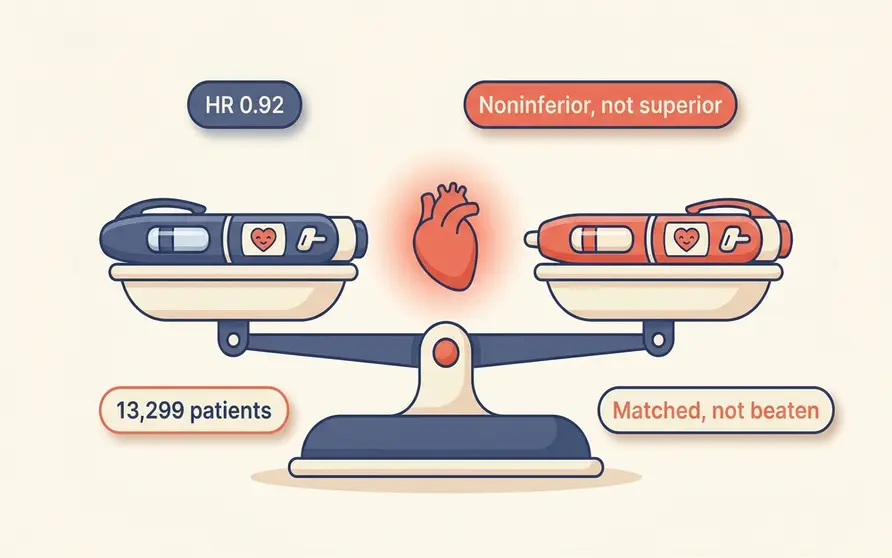
On the primary outcome, Mounjaro matched Trulicity but did not beat it. A first heart attack, stroke or cardiovascular death occurred in 801 of 6,586 people on tirzepatide (12.2%) and in 862 of 6,579 on dulaglutide (13.1%), a hazard ratio of 0.92 (95.3% CI 0.83 to 1.01).1
That result met the bar for noninferiority (P=0.003), meaning Mounjaro was at least as good as an already heart-protective GLP-1.1 But the test for superiority was not met (P=0.09), and the confidence interval reached just past 1.00.1 In plain terms, Mounjaro kept pace with Trulicity. It did not pull ahead.
Side effects were broadly similar between the two drugs, with one clear difference: gastrointestinal side effects were more common on tirzepatide, reported in 42.5% of that group versus 35.9% on dulaglutide.2 That gap fits the wider GLP-1 pattern, where the more potent drug tends to bring more nausea, vomiting and diarrhoea.
Mounjaro was measured against a rival that already protects the heart, and it kept pace. Keeping pace is a real result. It is not the same as pulling ahead. The SURPASS-CVOT design, in one line
What about the broader heart and kidney results?
The primary three-part outcome is not the only number from SURPASS-CVOT. A prespecified post hoc analysis, published separately in JAMA Cardiology, looked at a wider six-part cardiorenal outcome that added all-cause death, coronary procedures, heart-failure hospitalisation and kidney events to the original heart trio.2
On that broader measure, Mounjaro did come out ahead. The six-part outcome occurred in 23.7% of the tirzepatide group and 27.4% of the dulaglutide group, a hazard ratio of 0.84 (95% CI 0.79 to 0.90).2 That is a favourable result, and it is worth knowing, but it has to be read for what it is: a broader secondary composite, not the primary heart endpoint the approval was built on.
| Outcome | Mounjaro | Trulicity | Hazard ratio (95% CI) |
|---|---|---|---|
| Six-part cardiorenal composite | 23.7% | 27.4% | 0.84 (0.79 to 0.90) |
| All-cause death | 8.6% | 10.2% | 0.84 (0.75 to 0.94) |
| Heart attack | 4.7% | 5.4% | 0.86 (0.74 to 1.00) |
| Stroke | 3.5% | 3.8% | 0.91 (0.76 to 1.09) |
| Coronary revascularisation | 8.0% | 9.4% | 0.84 (0.75 to 0.95) |
| Heart-failure hospitalisation | 3.0% | 3.1% | 0.96 (0.79 to 1.17) |
| Kidney composite | 4.9% | 6.1% | 0.79 (0.68 to 0.91) |
From the prespecified post hoc cardiorenal analysis of SURPASS-CVOT. The six-part composite favoured tirzepatide, but the individual components were exploratory and not adjusted for multiple testing, so their confidence intervals should be read cautiously. Stroke and heart-failure hospitalisation did not clearly differ between groups. This is a broader secondary measure, not the trial's primary three-part heart endpoint.2
Read carefully, the post hoc tells a nuanced story. The advantage was driven mainly by lower all-cause death, fewer coronary procedures and fewer kidney events, while stroke and heart-failure hospitalisation looked similar between the two drugs.2 The kidney side of this composite is covered in more depth in our piece on what SURPASS-CVOT showed for the kidneys.
Does Mounjaro beat Ozempic for the heart?
This is the question most people are really asking, and SURPASS-CVOT cannot answer it. The trial compared tirzepatide with dulaglutide (Trulicity). It did not include semaglutide, the drug in Ozempic and Wegovy, at all.1 So there is no head-to-head result showing Mounjaro protects the heart better, or worse, than Ozempic.
Both semaglutide and tirzepatide now carry their own cardiovascular evidence, but they were built on different trials against different comparators, which makes direct claims tricky. We compare what each drug's heart data actually shows in our piece on which GLP-1 drug protects the heart more. The short version is that a confident "one beats the other" verdict is not something the current trials support.
What this means if you take Mounjaro
The approval is genuinely good news, read in proportion. If you have type 2 diabetes and high cardiovascular risk, Mounjaro now has trial evidence and an FDA indication showing it protects the heart as well as an established heart-protective GLP-1, alongside its effects on blood sugar and weight.13
What the evidence does not support is treating Mounjaro as a proven heart drug for everyone. It is not approved for cardiovascular protection in people without type 2 diabetes, and against a real comparator it matched rather than beat.13 A worthwhile caution to weigh alongside the benefit is that gastrointestinal side effects were more common on tirzepatide than on its comparator.2
It is also worth knowing who paid for the trial. Eli Lilly funded SURPASS-CVOT and makes both drugs in it, tirzepatide and dulaglutide, and several authors are Lilly employees or shareholders.1 That does not invalidate the result, which was published in a leading journal, but it is the kind of context that belongs next to any industry-funded trial.
The practical rule is the same one that applies to every GLP-1 headline: do not start, stop or switch a prescribed medicine because of research you read about. If you are weighing Mounjaro for its heart benefits, that is a conversation for the doctor who manages your diabetes and cardiovascular risk, who can judge it against your own history.
In one sentence: The FDA approved Mounjaro to protect the heart in type 2 diabetes, but SURPASS-CVOT showed it matched an existing heart-protective GLP-1 rather than beating it, and it says nothing about whether Mounjaro is better than Ozempic.
Frequently asked
Did the FDA approve Mounjaro for heart protection?+
Does Mounjaro protect the heart better than Ozempic?+
What does non-inferiority mean in SURPASS-CVOT?+
Did the broader cardiorenal result show Mounjaro is better?+
References
- Nicholls SJ, Pavo I, Bhatt DL, et al; SURPASS-CVOT Investigators. Cardiovascular Outcomes with Tirzepatide versus Dulaglutide in Type 2 Diabetes. N Engl J Med. 2025. PubMed. doi:10.1056/NEJMoa2505928. PMID: 41406444. ClinicalTrials.gov NCT04255433. Funded by Eli Lilly, which makes both tirzepatide and dulaglutide; several authors are Lilly employees or shareholders. In 13,299 adults with type 2 diabetes and atherosclerotic cardiovascular disease, tirzepatide was noninferior to dulaglutide for cardiovascular death, heart attack or stroke (12.2% vs 13.1%; hazard ratio 0.92; 95.3% CI 0.83 to 1.01; P=0.003 noninferiority, P=0.09 superiority).
- Nissen SE, Wolski K, D'Alessio D, et al. Cardiorenal Outcomes With Tirzepatide Compared With Dulaglutide in Patients With Diabetes and Cardiovascular Disease: A Post Hoc Analysis of the SURPASS-CVOT Randomized Clinical Trial. JAMA Cardiol. 2026. PubMed. doi:10.1001/jamacardio.2026.0767. PMID: 41903177. Prespecified post hoc of the completed trial (13,165 analysed): a six-part cardiorenal composite occurred in 23.7% on tirzepatide versus 27.4% on dulaglutide (hazard ratio 0.84; 95% CI 0.79 to 0.90); gastrointestinal adverse events were more common with tirzepatide (42.5% vs 35.9%). Individual components were exploratory and not adjusted for multiple testing.
- Mounjaro approved to reduce cardiovascular events in adults with diabetes. Healio, August 28, 2026. Healio. Reports the FDA approval of Mounjaro (tirzepatide) on August 28, 2026 to lower the risk of major adverse cardiovascular events, including cardiovascular death, non-fatal myocardial infarction and non-fatal stroke, in adults with type 2 diabetes at high cardiovascular risk, based on SURPASS-CVOT, with tirzepatide noninferior (not superior) to dulaglutide.
Evidence current as of August 31, 2026. This article is educational only and is not medical advice. Tirzepatide is prescription-only and should be used under medical supervision. Mounjaro is approved to reduce cardiovascular events only in adults with type 2 diabetes at high cardiovascular risk; it is not approved for heart protection in people without type 2 diabetes. SURPASS-CVOT was an active-comparator noninferiority trial funded by the drug's manufacturer, so its results describe tirzepatide relative to dulaglutide, not relative to a placebo or to semaglutide, and individual results vary. Do not start, stop, or change any prescribed medicine because of anything you read here.
Translating new metabolic and obesity research into plain English for people living on GLP-1 therapy. Every claim is traced to its source.