Does Ozempic cause joint pain?
Large randomized-trial evidence does not show that GLP-1 drugs cause joint pain. A 2026 meta-analysis of 43 trials and 100,488 people found no rise in arthritis, gout or fractures, and no US label for Ozempic, Wegovy, Mounjaro or Zepbound lists joint pain as a side effect.
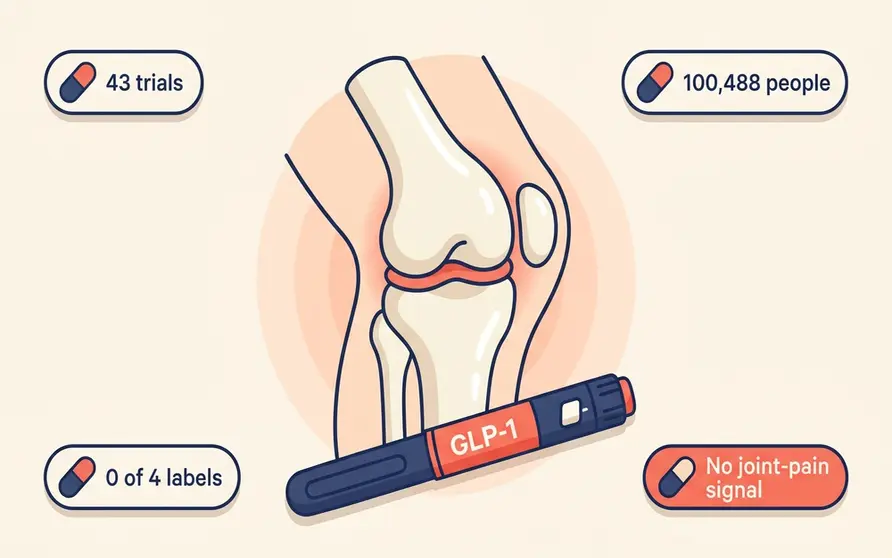
Type "Ozempic joint pain" into a search bar and the autocomplete finishes the thought for you. Forum threads fill in with the same story: aching knees, stiff hips, sore hands that seemed to arrive with the injection pen.
Search the trial evidence for the same claim and the picture reverses. The largest review to date found no increase in joint problems at all. This article sets that gap out in full, including the one place where the drugs genuinely do touch the skeleton.
Why do people blame Ozempic for joint pain?
The claim spreads because the timing feels convincing. Joint aches are extremely common in the exact group taking these drugs: middle-aged and older adults, many carrying extra weight, many becoming newly active as the weight comes off.
When a new ache appears in the same weeks as a new medication, the medication gets the blame. That is an understandable inference, but it is not evidence. To separate a real drug effect from coincidence, you need a control group, which is exactly what randomized trials provide.
There is also a specific worry underneath the general one: that losing fat somehow "uncushions" the joints, or that rapid change stresses them. The best way to test that is to count joint problems in people given the drug against people given a placebo, across as many trials as possible.
What does the largest trial review show?
The most direct answer comes from a systematic review and meta-analysis published in Therapeutic Advances in Musculoskeletal Disease in February 2026, which pooled the musculoskeletal safety data from randomized trials of GLP-1 receptor agonists.1
The authors, Cao and colleagues, searched the literature to June 2025 and included 43 randomized controlled trials covering 100,488 participants. They compared how often joint and bone problems were reported by people on a GLP-1 drug against people on a control.1
The result was a clean null. There was no significant difference between GLP-1 users and controls in reports of gouty arthritis, rheumatoid arthritis, osteoarthritis, osteoporotic fracture, synovitis or intervertebral disc protrusion.1 Across six separate joint and bone outcomes, the drugs did not stand out from placebo.
| Musculoskeletal event | GLP-1 vs control |
|---|---|
| Gouty arthritis | No significant difference |
| Rheumatoid arthritis | No significant difference |
| Osteoarthritis | No significant difference |
| Osteoporotic fracture | No significant difference |
| Synovitis | No significant difference |
| Intervertebral disc protrusion | No significant difference |
The six prespecified musculoskeletal outcomes from the 2026 meta-analysis of 43 randomized trials. None reached statistical significance against control.1
There is one honest limit to sit with. This review counted spontaneously reported adverse events inside trials, meaning symptoms participants happened to mention, not joint symptoms that researchers went looking for with a questionnaire or a scan.1 That makes it strong evidence against a large, obvious effect, but it cannot rule out a small one.
The authors also ran an exploratory analysis and found that trials with more male participants reported slightly fewer osteoarthritis cases.1 That is a hypothesis to test, not a finding to act on, and it is a reminder that most people taking these drugs for weight are women.
Do the drug labels list joint pain?
They do not, and that is worth stating precisely. The current US prescribing information for Ozempic, Wegovy, Mounjaro and Zepbound lists no arthralgia, no arthritis and no gout among its adverse reactions.5678 If joint pain were a common drug effect, it would normally appear in these tables, because the trials behind them recorded adverse events in tens of thousands of people.
There is one exception on the skeleton, and it is about bone rather than joints. The Wegovy label carries a Fractures note. In its cardiovascular outcomes trial, more hip and pelvis fractures were reported on the drug than on placebo in female patients, at 1% against 0.2%, and in patients aged 75 and over, at 2.4% against 0.6%.5
That imbalance is small in absolute terms and comes from a single trial, but it is real and it is on the label, so it belongs in an honest answer. Rapid weight loss itself lowers bone mass, which is the likeliest explanation and is not unique to this drug class.5 It is the same reason our guide to protecting muscle and bone in older adults matters more than the joint-pain rumour does.
Six joint and bone outcomes, 100,488 people, and no drug signal. The claim that these drugs wreck your joints is anecdote, not evidence. Summarising Cao et al., Therapeutic Advances in Musculoskeletal Disease, 2026
Could GLP-1 drugs actually help your joints?
This is the half of the story the "Ozempic wrecks your joints" claim never mentions. Several large datasets point the opposite way, at least for the knee.
A retrospective study published in Regional Anesthesia and Pain Medicine in June 2026 used the TriNetX network to follow adults with knee osteoarthritis diagnosed between 2010 and 2024.2 After careful matching, cohorts ranged up to 42,062 patients. GLP-1 use was associated with a lower rate of eventually needing knee replacement, across every exposure length and follow-up window studied, with larger effects for longer treatment and newer agents.2
The authors are careful, and so should readers be. This is observational data: people prescribed a GLP-1 differ from people who are not, in ways matching cannot fully erase. The effect was real in the numbers but modest, and the researchers state plainly that prospective trials are still needed to prove the drug is the cause.2 Losing weight takes load off the knee, so at least part of any benefit may be the weight loss rather than the drug itself.
Are they safe around joint-replacement surgery?
Many people on these drugs are heading toward hip or knee surgery anyway, which raises a fair question about the operation itself. A systematic review in Arthroplasty in March 2026 gathered 15 studies covering 318,143 joint-replacement patients, of whom 56,132 were on a GLP-1 drug.3
In hip and knee replacement, GLP-1 use was associated with a lower rate of deep prosthetic joint infection, reported as 1.6% against 2.9% at two years for hip replacement, and with fewer 90-day readmissions.3 On the surgical-safety question, the direction of the evidence is reassuring rather than alarming.
The reviewers deliberately did not pool these numbers into a single statistic, because the studies were too varied and some may count the same patients more than once.3 Treat these as consistent signals, not a precise figure. A separate question, whether to pause the drug before anaesthesia, is covered in the labels and in our guide to disclosing GLP-1 use before procedures.
What is still being tested?
The observational hints above are exactly the kind of thing a randomized trial exists to confirm or overturn, and one is now running.
STOP KNEE-OA is a Phase 4 randomized, double-blind, placebo-controlled trial run by the University of Melbourne, with Eli Lilly, which makes tirzepatide, as an industry collaborator.4 It has enrolled a planned 352 adults with obesity and knee osteoarthritis and gives them tirzepatide or placebo.4
What makes it unusually strong is the endpoint. Instead of a pain score, its primary measure is the percentage of patients who actually undergo knee replacement in the target joint within 72 weeks.4 That is a hard surgical outcome, not a questionnaire. The trial began recruiting in November 2024, with primary completion listed for May 2027, so a real answer on whether the drug keeps people off the surgery list is still a couple of years away.4
In one sentence: the biggest review of randomized trials found no increase in joint pain, arthritis, gout or fractures on GLP-1 drugs, none of the four US labels lists joint pain as a side effect, the only skeletal caveat is a small fracture signal on the Wegovy label driven mainly by rapid weight loss, and for knees specifically the evidence leans, cautiously, toward benefit rather than harm.
Frequently asked
Does Ozempic cause joint pain?+
Why do my joints hurt since starting Mounjaro?+
Can GLP-1 drugs cause arthritis or gout?+
Do GLP-1 drugs weaken your bones?+
References
- Cao M, Lin C, Cai X, Lv F, Yang W, Ji L. The association between glucagon-like peptide-1 receptor agonists and reported musculoskeletal adverse events: a systematic review and meta-analysis of randomized controlled trials. Ther Adv Musculoskelet Dis. 2026;18:1759720X261428147. Europe PMC. doi:10.1177/1759720X261428147. PMID: 41782908. PMCID: PMC12953953. Open access. Events were spontaneously reported within trials, so this is stronger evidence against a large effect than proof of none.
- Carter V, Desverreaux E, Amin I, Fogarty AE, Hussain N, D'Souza R, Karri J. Glucagon-like peptide 1 receptor agonist use and risk of arthroplasty for knee osteoarthritis: retrospective database analysis. Reg Anesth Pain Med. Published online 2 June 2026. Europe PMC. doi:10.1136/rapm-2026-107658. PMID: 42229941. Retrospective, propensity-matched cohort using the TriNetX network; association only, not proof of causation.
- Abdelaziz O, Zayed ZG, Khalafallah MA, Hanafy MA, Hadhoud AM, Elmenawi KA. Glucagon-like peptide-1 receptor agonists in total joint arthroplasty: a comprehensive systematic review of what orthopaedic surgeons should know. Arthroplasty. 2026;8:23. Europe PMC. doi:10.1186/s42836-026-00375-w. PMID: 41872949. PMCID: PMC13007374. Open access. Narrative synthesis of 15 retrospective cohort studies; the authors did not pool the data because of heterogeneity and overlapping databases.
- University of Melbourne (with Eli Lilly and Company). Effect of subcutaneous tirzepatide once-weekly in patients with obesity and knee osteoarthritis (STOP KNEE-OA): a randomized, double-blind, placebo-controlled trial. ClinicalTrials.gov identifier NCT06191848. Phase 4; recruiting; estimated enrolment 352; primary endpoint is the percentage undergoing target-knee replacement; primary completion listed for May 2027. Eli Lilly, which makes tirzepatide, is an industry collaborator.
- Novo Nordisk. WEGOVY (semaglutide) injection and tablets: US prescribing information. DailyMed, US National Library of Medicine, accessed August 2026. Adverse-reaction tables list no arthralgia, arthritis or gout; the Warnings and Precautions section carries a Fractures note from the cardiovascular outcomes and MASH trials.
- Novo Nordisk. OZEMPIC (semaglutide) injection, for subcutaneous use: US prescribing information. DailyMed, US National Library of Medicine, accessed August 2026. The adverse-reaction tables list no arthralgia, arthritis or gout.
- Eli Lilly and Company. MOUNJARO (tirzepatide) injection, for subcutaneous use: US prescribing information. DailyMed, US National Library of Medicine, accessed August 2026. The adverse-reaction tables list no arthralgia, arthritis or gout.
- Eli Lilly and Company. ZEPBOUND (tirzepatide) injection, for subcutaneous use: US prescribing information. DailyMed, US National Library of Medicine, accessed August 2026. The adverse-reaction tables list no arthralgia, arthritis or gout.
Evidence current as of August 3, 2026. This article is educational only and is not medical advice. Semaglutide and tirzepatide are prescription-only and should be used under medical supervision. The strongest source counted spontaneously reported adverse events, so it argues against a large joint effect rather than proving none, and the knee and surgery findings are observational and cannot establish cause. Adverse-reaction data quoted from the labels come from different trial populations and are not comparable between drugs. Do not start, stop or change a prescribed medicine because of anything here. Take new or worsening joint pain to a clinician.
Translating new metabolic and obesity research into plain English for people living on GLP-1 therapy. Every claim is traced to its source.