Does Ozempic cause nerve pain, or help it?
The honest answer depends on which nerve problem you mean. In type 2 diabetes, GLP-1 drugs like Ozempic and Mounjaro are linked to less nerve pain and neuropathy. Separately, a rarer nerve injury can follow ultrarapid weight loss or severe vomiting, when vitamin deficiency starves the nerves. Two different stories.
Search "Ozempic and nerve pain" and you find two crowds talking past each other. One is worried the drug is quietly damaging their nerves. The other is asking whether it might calm the burning feet of diabetic neuropathy. Both are asking a real question, and the honest answer is that they are not asking the same one.
The evidence in 2026 points in two directions at once, and keeping them apart is the whole task. In people with type 2 diabetes, GLP-1 drugs are linked to less nerve damage and less nerve pain. Separately, a smaller number of people have developed a serious nerve injury after losing weight very fast on these drugs. This article takes the two apart and says what each one does and does not prove.
Are these two different questions?
Yes, and they involve different mechanisms. Diabetic peripheral neuropathy is nerve damage caused by years of high blood sugar, and it is one of the most common complications of type 2 diabetes. Anything that improves blood sugar and metabolic health could, in principle, protect those nerves over time.
The second problem is different. It is an acute nerve injury that can follow rapid, large weight loss or prolonged vomiting, when the body runs short of the vitamins nerves need to stay healthy. That is not high blood sugar doing the damage; it is a nutrition problem that fast weight loss can trigger. The same drug sits behind both stories, which is why they get blurred together online.
Can GLP-1 drugs ease nerve pain?
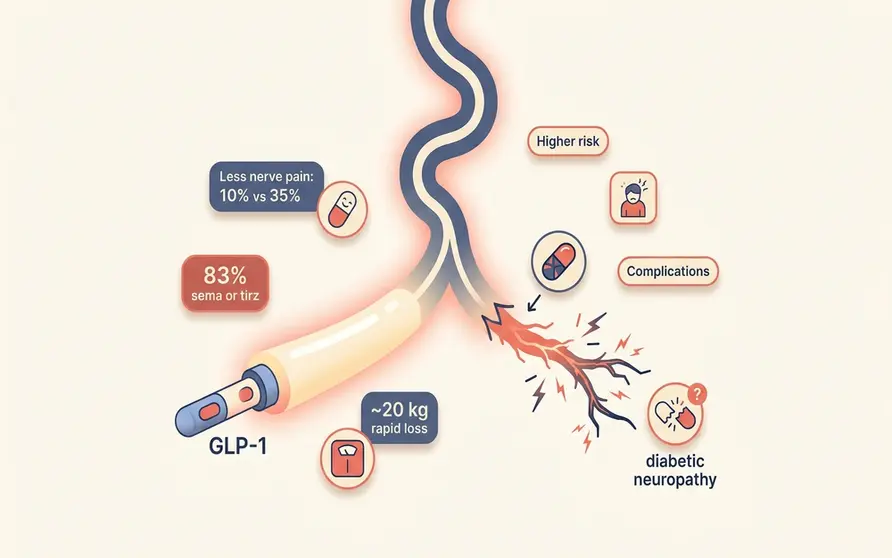
In type 2 diabetes, the recent evidence is encouraging. A 2026 cross-sectional study published in Pain examined 500 adults with type 2 diabetes, comparing those on standard treatment, on SGLT2 inhibitors, and on GLP-1 receptor agonists.1 The people on GLP-1 drugs had diabetic peripheral neuropathy less often: 46.4% versus 60.6% in the standard-treatment group.
The gap was wider for painful neuropathy. Painful diabetic neuropathy affected 10.1% of the GLP-1 group, against 35.1% on standard treatment and 28.3% on SGLT2 inhibitors.1 After adjusting for clinical and metabolic differences, GLP-1 treatment was independently associated with lower odds of neuropathy (odds ratio 0.60, 95% confidence interval 0.37 to 0.96) and of painful neuropathy (odds ratio 0.32, 95% confidence interval 0.15 to 0.65).
One caution decides how much weight to put on this. The study was cross-sectional, meaning it photographed people at a single moment rather than following them over time.1 It can show that GLP-1 use and less neuropathy travel together, but it cannot prove the drug caused the difference. The authors say exactly that: their findings are suggestive of potential neuroprotective and antinociceptive effects, and longitudinal studies are needed to establish causality.
Can GLP-1 drugs harm your nerves?
The other side of the ledger is real but rarer. A 2026 systematic review in the Journal of Neurology gathered every reported case of peripheral nerve complications tied to weight-loss medication, finding 19 studies covering 31 individual cases plus one cohort of 103 people.2 Semaglutide or tirzepatide was implicated in 83% of them, and almost all the reports appeared from 2024 onward, as use of these drugs surged.
The pattern was consistent. Among the individual cases, the median weight loss was 20.4 kg, about 21.8% of starting body weight, at a median rate of 3.7 kg per month, with nerve symptoms appearing around 150 days in.2 The injuries included fibular neuropathy (10 cases), lumbosacral radiculoplexus neuropathy (9 cases), and distal symmetric polyneuropathy (7 cases). The common thread was speed: the weight came off fast.
It matters that this is a collection of case reports, not a rate. A systematic review of 31 cases tells you the problem exists and what it looks like, but it cannot tell you how often it happens among the millions of people taking these drugs.2 The review's own conclusion is measured: there is a recent increase in these nerve disorders, and the way to reduce the risk is to ensure adequate nutrition and avoid ultrarapid weight and blood-sugar loss.
How do the two sides compare?
Laying the benefit and the harm side by side is the clearest way to see why both can be true at once. They describe different injuries, in different people, measured by different kinds of study.
| Diabetic nerve pain (the benefit) | Nutritional nerve injury (the harm) | |
|---|---|---|
| What it is | Long-term nerve damage from high blood sugar | Acute nerve injury from vitamin deficiency |
| The 2026 signal | Less common in GLP-1 users (odds ratio 0.60) | 31 cases plus one cohort of 103 reported |
| Who is affected | Adults with type 2 diabetes | People losing weight very fast, or with severe vomiting |
| Type of evidence | Cross-sectional cohort (association) | Case reports (no incidence rate) |
| The lever that matters | Better blood-sugar control | Adequate nutrition, avoid ultrarapid loss |
Benefit column from the 2026 Pain cohort; harm column from the 2026 Journal of Neurology review. The two describe different conditions and are not two measures of the same thing.12
In type 2 diabetes these drugs are linked to less nerve pain. Losing weight too fast, on the same drugs, can rarely injure the nerves. Both are true. Reading the nerve evidence honestly
What causes the rare nerve injury?
A 2026 case report in Case Reports in Neurology shows the mechanism in one person. A 65-year-old woman with type 2 diabetes and obesity lost 120 pounds over months of semaglutide treatment, but with persistent nausea and vomiting the whole time.3 She developed severe weakness, difficulty swallowing, and a serious sensorimotor polyneuropathy.
The cause was not the drug attacking her nerves directly. Her blood levels of thiamine (vitamin B1), folate, and vitamin B12 were all below normal, starved by months of poor intake.3 These vitamins are essential for healthy nerves, and running short of them can cause the type of injury doctors call acute nutritional axonal neuropathy. Within five days of receiving those vitamins, her strength and thinking began to recover, and she regained function over the following week.
That recovery is the reassuring part of a frightening story, and it points to where the risk actually sits: not in the medicine itself, but in eating too little for too long while it works. The nutrition side of GLP-1 therapy is a topic in its own right, and our guide to eating well enough to protect the body during rapid weight loss covers the same ground for muscle.
Should you stop the drug?
Neither study says so, and that distinction is the point. The review that catalogued the nerve injuries did not recommend avoiding GLP-1 drugs; it recommended adequate nutrition and avoiding ultrarapid weight and HbA1c loss.2 The risk it describes is largely preventable, and it is tied to how fast the weight comes off, not to the drug being inherently toxic to nerves.
It is also worth being clear about what GLP-1 drugs are not. They are not painkillers. A 2026 narrative review in the Journal of Clinical Medicine looked at whether these drugs relieve pain directly and concluded they are not established analgesics; the pain improvements seen in trials are best explained by weight loss and better metabolic health rather than a direct effect on nerves.4 No GLP-1 drug is approved to treat neuropathy or nerve pain, so easing nerve pain is not a medically approved reason to start one.
What are the warning signs?
The practical takeaway from the case literature is to treat new nerve symptoms during fast weight loss as a reason to check in, not to wait out. Numbness, tingling, burning, new weakness, or trouble walking that appears while losing weight quickly, especially alongside weeks of poor eating or vomiting, is worth reporting to a doctor promptly.3 Caught early, nutritional nerve injury can often be reversed with vitamin repletion; left too long, some nerve damage can become permanent.
For most people with type 2 diabetes, the fuller picture is reassuring rather than alarming: on current evidence these drugs are associated with less nerve pain, not more. The rare harm is real, preventable, and worth knowing the shape of, which is not the same as being a reason to fear the medicine.
In one sentence: in type 2 diabetes, GLP-1 drugs like Ozempic and Mounjaro are linked to less nerve pain and neuropathy, while a rarer, largely preventable nerve injury can follow ultrarapid weight loss or severe vomiting through vitamin deficiency, and no GLP-1 drug is approved to treat nerve pain.
Frequently asked
Does Ozempic cause nerve pain?+
Can Ozempic or Mounjaro help diabetic nerve pain?+
What is nutritional neuropathy from weight-loss drugs?+
Are GLP-1 drugs approved to treat nerve pain?+
References
- Falco P, Di Flaviani A, Galosi E, et al. Glucagon-like peptide-1 receptor agonist treatment is associated with lower frequency of diabetic peripheral neuropathy and neuropathic pain in type 2 diabetes. Pain. 2026 Aug 20 (online ahead of print). PubMed. doi:10.1097/j.pain.0000000000004104. PMID: 42663556. Cross-sectional study of 500 adults with type 2 diabetes (208 standard treatment, 152 SGLT2 inhibitors, 140 GLP-1 receptor agonists). Diabetic peripheral neuropathy 46.4% on GLP-1 versus 60.6% on standard treatment; painful neuropathy 10.1% versus 35.1% (standard) and 28.3% (SGLT2 inhibitors); adjusted odds ratio 0.60 (95% CI 0.37-0.96) for neuropathy and 0.32 (95% CI 0.15-0.65) for painful neuropathy. Authors note the cross-sectional design cannot establish causality.
- O'Gorman C, O'Gorman M, Warren N. Peripheral nerve complications from medications utilised for weight loss: a systematic review. J Neurol. 2026 Aug 3;273(8):503. PubMed. doi:10.1007/s00415-026-14048-w. PMID: 42547656. PMCID: PMC13433482. 19 studies, 31 individual cases plus one cohort of 103 people; semaglutide or tirzepatide implicated in 83%; median weight loss 20.4 kg (21.8% of body weight) at 3.7 kg/month, symptom onset around 150 days; presentations included fibular neuropathy (10), lumbosacral radiculoplexus neuropathy (9) and distal symmetric polyneuropathy (7). Authors recommend ensuring adequate nutrition and avoiding ultrarapid weight and HbA1c loss. Authors declare no competing interests.
- Cohan CJ, Townley L, Ortega E. Acute nutritional axonal neuropathy in the setting of semaglutide-associated gastrointestinal intolerance: a case report. Case Rep Neurol. 2026 Jun 16;18(1):402-412. PubMed. doi:10.1159/000552961. PMID: 42549476. PMCID: PMC13432944. A 65-year-old woman with type 2 diabetes and obesity lost 120 pounds over months of semaglutide with persistent nausea and vomiting, developed a severe sensorimotor polyneuropathy, and was found deficient in thiamine, folate and vitamin B12; strength and cognition improved within 5 days of vitamin supplementation, with partial functional recovery over a week. Authors declare no conflicts of interest.
- Hyung SW, Park UJ, Ryu JH, Chung S. Glucagon-like peptide-1 receptor agonists and chronic pain: preclinical antinociceptive mechanisms, indirect metabolic-functional effects, and clinical considerations - a narrative review. J Clin Med. 2026 Jul 29;15(15):5932. PubMed. doi:10.3390/jcm15155932. PMID: 42590035. PMCID: PMC13466897. Structured narrative review concluding that GLP-1 receptor agonists are not established analgesics, that direct analgesic efficacy at systemic clinical doses has not been demonstrated, and that current human pain signals are best interpreted as indirect metabolic-functional or disease-specific effects. Authors declare no conflicts of interest.
Evidence current as of September 4, 2026. This article is educational only and is not medical advice. GLP-1 receptor agonists such as Ozempic (semaglutide) and Mounjaro (tirzepatide) are not approved to treat neuropathy or nerve pain. The benefit finding comes from a cross-sectional study, which shows association, not proof of cause. The harm finding comes from case reports, which show that a problem exists but not how often it occurs. Individual results vary. If you develop numbness, tingling, weakness, or trouble walking, speak with a doctor; do not start, stop, or change a prescribed medicine because of anything you read here.
Translating new metabolic and obesity research into plain English for people living on GLP-1 therapy. Every claim is traced to its source.