Does Ozempic cause pancreatic cancer?
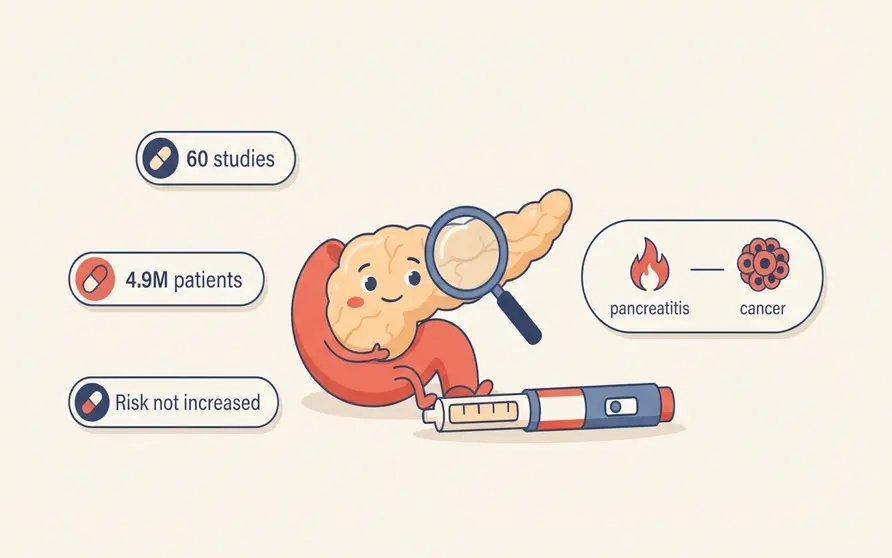
No. The largest evidence review so far pooled 60 studies and nearly 5 million patients, and found GLP-1 drugs were not linked to a higher risk of pancreatic cancer. The reassuring signal is real, but much of it comes from observational data, so it reads as no sign of harm rather than proof the drugs prevent cancer.
Type "Ozempic" and "pancreatic cancer" into a search engine and the first page is mostly law firms. That is not because the science points to a cancer link. It is because pancreatic cancer is one of the most feared diagnoses in medicine, and fear is what injury-lawsuit pages are built to catch.
In April 2026 the largest evidence review on this exact question was published, in the journal of the International Association of Pancreatology. Its answer is clear, and it is not the answer the lawsuit pages want.
Pancreatitis and pancreatic cancer are not the same
Most of the confusion starts here, so it is worth being precise. Acute pancreatitis is a sudden inflammation of the pancreas. It hurts, it can be serious, and it is a listed warning on every GLP-1 label.
The current US prescribing information for Ozempic lists acute pancreatitis under warnings and tells prescribers to stop the drug if it is suspected. Pancreatic cancer is a different condition, a tumour rather than inflammation, and it does not appear on the Ozempic label at all.5
So the drug does carry a pancreas-related caution. That caution is about inflammation, not cancer. Merging the two is how a real but manageable side effect turns into a cancer scare.
What did the largest review find?
The review, led by Lauri and colleagues, pooled 60 studies: 49 randomised trials and 11 observational cohorts. Together they covered 4,932,290 patients, of whom 2,281,546 were taking a GLP-1 drug and 2,650,744 were not.1
GLP-1 use was not associated with a higher risk of pancreatic ductal adenocarcinoma, the main form of the disease. The pooled odds ratio was 0.688, with a 95% confidence interval of 0.575 to 0.824.1
Because that whole interval sits below 1, the pooled result actually points the other way, toward slightly fewer cancers in drug users. A formal test for publication bias came back clean, with an Egger's test p-value of 0.829.1
Does that mean Ozempic prevents cancer?
No, and the authors are careful not to claim it does. The lower-risk signal was strongest in the observational cohorts, in overweight and obese patients with diabetes, and with longer drug exposure and follow-up.1
That pattern is a warning sign for a trap called confounding by indication. People who stay on a GLP-1 drug for years tend to be healthier, better monitored, and more engaged with their care than people who never start one, and all of those things independently lower cancer risk.
The pooled studies were also very mixed, with a heterogeneity figure of 69%, which means they did not all measure the same thing in the same way. The honest reading is no sign of harm, not proof of protection.1
How the evidence stacks up
The table below sets the two published studies beside the trial now being run to settle the question. Each answers a slightly different piece of it, and none of them is the final word.
| Study | Who | Pancreatic cancer finding | Main limitation |
|---|---|---|---|
| Lauri 2026, meta-analysis | 60 studies, 4.9M patients | Not increased: OR 0.688 (0.575 to 0.824) | High heterogeneity; mostly short trials |
| Dhali 2026, cohort | 10,625 with chronic pancreatitis | Lower: 2.0% vs 3.9% over 3 years (RR 0.498) | Observational; sickest patients differ |
| EXCEED (ongoing) | 24,000, exenatide vs others | Reports from late 2026 | Maker-funded; exenatide only |
Sources: Lauri et al. 20261, Dhali et al. 20262 and the EXCEED safety study4. These studied different populations and are not directly comparable with one another.
What about people who already have pancreatitis?
This is where the older caution came from. Chronic pancreatitis raises the risk of pancreatic cancer on its own, so these patients are exactly the group a cancer signal would show up in first.
A 2026 real-world study using US health-record data looked at 10,625 people with chronic pancreatitis on a GLP-1 drug, matched to 10,625 similar people who were not. Over three years, the GLP-1 group had fewer pancreatic cancers, 2.0% against 3.9%, and far lower all-cause mortality, 6.9% against 16.4%.2
Those numbers look striking, but the same confounding caution applies with even more force: the sickest patients are the least likely to be started on a GLP-1 in the first place. The value of the study is direction, not proof. In the highest-risk group anyone could pick, the drug users did not fare worse.
A protective-looking number from observational data is usually a story about who gets the drug, not about what the drug does to the pancreas. The caution the Pancreatology review builds into its own conclusion, which calls for further high-quality studies.
Is anyone studying this properly?
Yes. The cleanest test is a study designed from the start to measure pancreatic cancer, rather than one that counts cancers as a side note.
EXCEED is a pan-European safety study, run by AstraZeneca with IQVIA, that is following about 24,000 people with type 2 diabetes. It compares those who started exenatide, an older GLP-1 drug, against those who started non-GLP-1 glucose-lowering drugs, and its main outcome is the rate and hazard ratio of a first pancreatic-cancer diagnosis.4
Two caveats matter. The study is funded by AstraZeneca, the maker of the exact drug it is testing, so its conclusions will need independent scrutiny. And it studies exenatide, not the semaglutide or tirzepatide that most readers are actually asking about. It is recruiting now, with first results due from late 2026.4
A separate analysis limited to randomised semaglutide trials was published in mid-2026, but its full results were not available in the record we could verify, so we do not quote a figure from it here.3
Should the cancer worry change your decision?
On the current evidence, no. Nothing in the largest review, or in the highest-risk cohort study, supports avoiding a GLP-1 drug specifically out of pancreatic-cancer fear.
The caution that is real, and on the label, is acute pancreatitis. If you get severe, lasting abdominal pain that spreads to your back, stop the drug and get checked. That is a different and far more immediate thing than the cancer headlines. This is the same gap between the label and the lawsuit pages that we found with the thyroid-cancer warning.
Most people who stop a GLP-1 drug do so over ordinary early side effects, not cancer. Our guide to managing GLP-1 nausea covers what most people actually run into in the first weeks.
In one sentence: the largest review to date, covering 60 studies and nearly 5 million patients, found no increased risk of pancreatic cancer with GLP-1 drugs and a pooled odds ratio slightly below 1, but because most of that reassurance comes from observational data it should be read as no sign of harm rather than proof of protection, and the pancreas warning that is actually on the label is acute pancreatitis, not cancer.
Frequently asked
Does Ozempic cause pancreatic cancer?+
Is pancreatitis the same as pancreatic cancer?+
Can you take a GLP-1 if you have had pancreatitis?+
What pancreatitis symptoms should I watch for?+
References
- Lauri G, Arcidiacono PG, Facciorusso A, Capurso G, Tacelli M. Glucagon-like Peptide-1 receptor agonists are not associated with increased risk of pancreatic cancer: a systematic review and meta-analysis. Pancreatology. 2026. Europe PMC. doi:10.1016/j.pan.2026.04.005. PMID: 41991368. Official journal of the International Association of Pancreatology.
- Dhali A, Maity R, Khan F, Biswas J, Faisal AR. Glucagon-like peptide-1 receptor agonists and pancreatic outcomes in chronic pancreatitis: a real-world cohort study. BMC Gastroenterology. 2026. BMC Gastroenterology. doi:10.1186/s12876-026-05125-5. PMID: 42458277. Retrospective TriNetX cohort; observational.
- Chiang CH, Bahar F, Chang YC, Wang TH, Hsia YP, Chiang CH. Semaglutide and risk of pancreatic cancer: a meta-analysis of randomised trials. Diabetes, Obesity and Metabolism. 2026. Europe PMC. doi:10.1111/dom.70980. PMID: 42297743. Cited for its existence; no result figure is quoted, because none was available in the bibliographic record checked.
- AstraZeneca (collaborator: IQVIA). EXCEED - a pan-European post-authorisation safety study: risk of pancreatic cancer among type 2 diabetes patients who initiated exenatide compared with other non-GLP-1 glucose-lowering drugs. ClinicalTrials.gov NCT05663515. Observational cohort, estimated enrolment 24,000, recruiting, primary completion estimated October 2026. Industry-funded by the maker of exenatide.
- Novo Nordisk. OZEMPIC (semaglutide) injection, for subcutaneous use: US prescribing information. DailyMed, US National Library of Medicine, accessed August 2026. Section 5.2 lists acute pancreatitis as a warning; the label contains no mention of pancreatic cancer.
Evidence current as of August 18, 2026. This article is educational only and is not medical advice. Semaglutide and other GLP-1 drugs are prescription-only and should be used under medical supervision. The meta-analysis described above pooled studies with high heterogeneity, and its inverse association was driven mainly by observational data, so it shows no signal of harm rather than a proven protective effect. Do not start, stop or change a prescribed medicine based on this article. Decisions about GLP-1 therapy, especially with any history of pancreatitis, belong with your own clinician.
Translating new metabolic and obesity research into plain English for people living on GLP-1 therapy. Every claim is traced to its source.