Does Ozempic cause thyroid cancer?
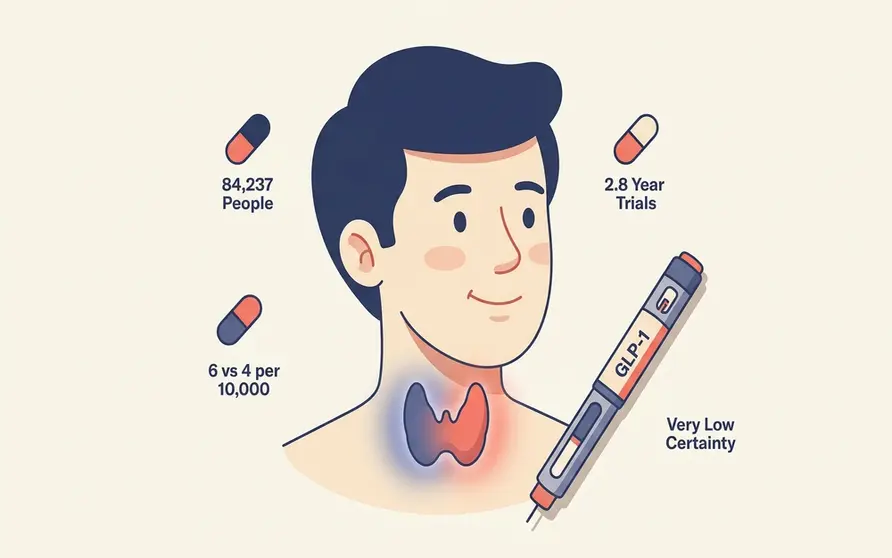
The best evidence is 15 randomised trials in 84,237 people. Thyroid cancer occurred in roughly 6 per 10,000 patients on the drugs against 4 per 10,000 on control, a difference that is not statistically significant. But those trials ran a median of 2.8 years, and thyroid cancer can take 5 to 20 years to appear.
Every box of Ozempic, Wegovy, Mounjaro and Zepbound carries the same warning in a black frame on the first page. It is usually the first thing a cautious patient reads, and it mentions thyroid cancer.
In March 2026 the largest analysis of randomised trial data on that question was published. The answer it gives is genuinely useful and genuinely uncomfortable, and it is not the answer either side of this argument wants.
What does the boxed warning say?
The warning is about rodents. The US prescribing information for Ozempic states that semaglutide causes thyroid C-cell tumours in rats and mice at clinically relevant exposures, and that it is unknown whether the drug causes such tumours in humans, because the human relevance of the rodent finding has not been determined.4
The reason is anatomical. Eisa and Barood note that human thyroid C-cells express GLP-1 receptors at much lower levels than rodent C-cells do, which is why the theoretical risk has never translated into a confirmed human one.1
The part of the warning that does change what you should do is the contraindication. All four US labels state that the drug is contraindicated in patients with a personal or family history of medullary thyroid carcinoma, or with Multiple Endocrine Neoplasia syndrome type 2.4567
Medullary thyroid carcinoma is an uncommon cancer of the thyroid's C-cells, the same cells affected in the rodent studies. It is a different disease from the far more common papillary thyroid cancer, and the distinction matters below.
What did the largest analysis find?
Eisa and Barood, publishing in AACE Endocrinology and Diabetes in March 2026, searched PubMed, EMBASE and ClinicalTrials.gov for every randomised trial of an approved incretin drug that ran at least 26 weeks and reported thyroid cancer events.1
They found 15 trials enrolling 84,237 participants. Across all of them, 28 thyroid cancers occurred in the treatment groups and 15 in the control groups.1
The pooled odds ratio was 1.52, with a 95% confidence interval running from 0.86 to 2.68.1 Because that interval crosses 1, the result is not statistically significant. There was no heterogeneity between trials at all, and no sign of publication bias.1
This is also the first such analysis to include tirzepatide, the dual GIP and GLP-1 drug sold as Mounjaro and Zepbound. The authors found no significant difference in risk between the drug subgroups, which suggests the question is class-wide rather than specific to any single agent.1
How big is the risk in real numbers?
Small, in both groups. The authors translate their own result plainly: approximately 6 cases per 10,000 patients in the incretin group against 4 per 10,000 in the control group, over a median of 2.8 years.1
That framing matters more than the odds ratio, because a 52% relative increase on a very rare event is still a very rare event. The authors conclude that for the vast majority of patients, the proven cardiovascular and metabolic benefits are likely to far outweigh the small and as yet unproven cancer risk.1
That is the reassuring half of the paper. The other half is why the same authors rated their own work as very low certainty.
Why is the certainty rated very low?
Three reasons, and the authors are explicit about all three.
The first is arithmetic. With only 43 thyroid cancers in total across 84,237 people, the statistical power to detect a rare outcome is low, which is what produces a confidence interval wide enough to include both no effect and a more than 2.5-fold increase in risk.1
The second is the clock, and it is the most important limitation in the paper. Median follow-up across the included trials was 2.8 years. Papillary thyroid cancer often has a latency of 5 to 20 years or more between exposure and clinical detection.1
The third is a design detail almost nobody reports. Every included trial was rated as raising "some concerns" on risk of bias, not because of flawed randomisation, but because thyroid cancer was never a prespecified, adjudicated endpoint in any of them. Cases were captured through routine adverse-event reporting, which the authors say may under-ascertain them.1
There is a fourth thing worth knowing that the paper records without comment. Reading the table of included trials, all 15 were funded by a drug manufacturer: Novo Nordisk, Eli Lilly, AstraZeneca, GlaxoSmithKline or Sanofi.1 The meta-analysis authors themselves declare no conflicts of interest.1
These trials were designed to measure heart attacks and weight over a few years. They were never designed to catch a cancer that takes decades to surface. Paraphrasing the limitations section of Eisa and Barood, AACE Endocrinology and Diabetes, 2026
Do the observational studies agree?
No, and the disagreement is the reason this question stays open. Eisa and Barood set out the conflict directly.1
They report that a Scandinavian cohort study and a French nationwide cohort study each found a small but statistically significant increase in thyroid cancer risk among GLP-1 users, while a large recent study of US Medicare beneficiaries found no increased three-year risk compared with a different class of diabetes drug.1
The authors attribute the split to detection bias and confounding by indication in the observational studies, set against the short follow-up in the randomised ones.1 Detection bias is the plausible one for a lay reader: people who start a new drug see doctors more often, and thyroid cancer is frequently found by accident.
A separate systematic review by Salama and colleagues, published in Cureus in April 2026, looked at six studies covering 900,225 participants and reached a compatible conclusion: the large cohort studies showed no increased risk of thyroid tumours or thyroid cancer.2
That review's real finding, though, is an absence. Only one of its six included studies directly assessed thyroid function at all, and the authors state that their primary objective became characterising the evidence gap itself.2
How does the evidence compare?
The table below sets the three human evidence sources side by side, because each answers a different question and none of them answers all of it.
| Evidence | What it measured | What it found | Main limitation |
|---|---|---|---|
| 15 trials, 84,237 people | Thyroid cancer events | OR 1.52 (0.86 to 2.68); not significant | 43 events; median 2.8 years |
| 6 studies, 900,225 people | Thyroid function tests | No increased tumour or cancer risk | Only 1 of 6 measured thyroid function |
| 58 adults, 12 weeks | Serum calcitonin on tirzepatide | 2.7 to 3.2 pg/mL; none above threshold | Small, short, no control group |
Sources: Eisa and Barood 20261, Salama et al. 20262 and Angelopoulos et al. 20263. These studies measured different outcomes in different populations and are not directly comparable with one another.
What did the calcitonin study find?
Calcitonin is the blood marker that medullary thyroid carcinoma raises, so it is the closest thing to a direct measurement of the mechanism the warning describes.
Angelopoulos and colleagues, publishing in Endocrine in May 2026, measured serum calcitonin in 58 adults with obesity and no known thyroid disease, at baseline and after 12 weeks of tirzepatide.3
Mean calcitonin rose from 2.7 pg/mL to 3.2 pg/mL. The change was statistically significant at p = 0.003, with a moderate effect size, despite the small absolute increase.3
Two findings sit alongside that one and matter more. No participant exceeded the clinical calcitonin threshold of 20 pg/mL, and no thyroid nodules were detected on ultrasound.3
The authors' conclusion is deliberately narrow: the findings support the short-term safety of tirzepatide in appropriately selected patients without known thyroid disease or risk factors for medullary thyroid carcinoma.3 Twelve weeks in 58 people says nothing about cancer risk over decades.
Should you get your thyroid tested?
Here is the part that surprises most people, and it comes straight from the labels rather than from any study.
All four US prescribing documents state, in identical wording, that routine monitoring of serum calcitonin or using thyroid ultrasound is of uncertain value for early detection of medullary thyroid carcinoma in patients treated with these drugs.4567
So if your prescriber wants a thyroid check before you start, that is a reasonable clinical judgement, but it is not something the label establishes as a screen. What the label does gate on is your history: a personal or family history of medullary thyroid carcinoma, or MEN 2.4
In practice the useful conversation before starting is about your family, not your bloodwork. This is the same pattern we found when reviewing the eye-damage signal: what the label says and what gets repeated online have drifted apart.
What symptoms should you watch for?
The labels instruct prescribers to counsel patients on the symptoms of thyroid tumours, and name four: a mass in the neck, difficulty swallowing, difficulty breathing and persistent hoarseness.46
None of these is specific to cancer, and all four have common causes that have nothing to do with the thyroid. Persistent is the operative word. Report them to your prescriber rather than waiting for a scheduled review.
If you are weighing up starting treatment at all, side effects that show up in the first weeks are a far more likely reason to stop than this one. Our guide to managing GLP-1 nausea covers what most people actually run into.
In one sentence: the largest trial evidence to date finds no statistically significant increase in thyroid cancer with GLP-1 and dual-agonist drugs, and puts the absolute risk at roughly 6 cases per 10,000 against 4 per 10,000, but 43 cancers over a median 2.8 years cannot rule out a real increase in a disease that takes decades to appear, which is why the authors call for long-term surveillance rather than declaring the question closed.
Frequently asked
Does Ozempic cause thyroid cancer?+
Who should not take a GLP-1 drug?+
Should I get a calcitonin test before starting?+
What thyroid symptoms should I report?+
References
- Eisa N, Barood O. Incretin-based therapy and thyroid cancer risk: a systematic review and meta-analysis of randomized controlled trials. AACE Endocrinol Diabetes. 2026;13(3):400-409. Europe PMC. doi:10.1016/j.aed.2026.03.003. PMID: 42221413. PMCID: PMC13221932. Open access. The authors declare no conflicts of interest; no funding statement was returned in the bibliographic record.
- Salama S, Elfaki Omer EO, Mahmoud A, et al. Glucagon-like peptide-1 (GLP-1) receptor agonists and thyroid function tests: a systematic review identifying a critical evidence gap. Cureus. 2026;18(4):e108005. Europe PMC. doi:10.7759/cureus.108005. PMID: 42220875. PMCID: PMC13221614. Open access. No grants were returned in the bibliographic record.
- Angelopoulos N, Simeakis G, Androulakis I, et al. Short-term effect of tirzepatide on serum calcitonin in adults with obesity. Endocrine. 2026;91(1):180. PubMed. doi:10.1007/s12020-026-04655-y. PMID: 42081121. Prospective observational study. No funding was returned in the bibliographic record.
- Novo Nordisk. OZEMPIC (semaglutide) injection, for subcutaneous use: US prescribing information, revised May 2026. DailyMed, US National Library of Medicine. The boxed warning, section 4 and section 5.1 were checked.
- Novo Nordisk. WEGOVY (semaglutide) injection, for subcutaneous use: US prescribing information, revised June 2026. DailyMed, US National Library of Medicine. The boxed warning and section 4 were checked.
- Eli Lilly and Company. MOUNJARO (tirzepatide) injection, for subcutaneous use: US prescribing information, revised April 2026. DailyMed, US National Library of Medicine. The boxed warning and section 4 were checked.
- Eli Lilly and Company. ZEPBOUND (tirzepatide) injection, for subcutaneous use: US prescribing information, revised April 2026. DailyMed, US National Library of Medicine. The boxed warning and section 4 were checked.
Evidence current as of July 31, 2026. This article is educational only and is not medical advice. Semaglutide and tirzepatide are prescription-only and should be used under medical supervision. The meta-analysis described above rated its own certainty of evidence as very low, and the trials it pooled were largely conducted in adults with type 2 diabetes or obesity and cardiovascular risk, so the figures may not apply to other groups. Do not start, stop or change a prescribed medicine based on this article. Decisions about GLP-1 therapy, thyroid screening and family history belong with your own clinician.
Translating new metabolic and obesity research into plain English for people living on GLP-1 therapy. Every claim is traced to its source.