Does Ozempic lower blood pressure and raise heart rate?
Yes to both, but gently. A 2026 state-of-the-art review in the American Journal of Hypertension found GLP-1 drugs like Ozempic lower systolic blood pressure by about 2 to 5 mm Hg, driven mostly by weight loss, while nudging resting heart rate up by about 2 to 5 beats per minute.
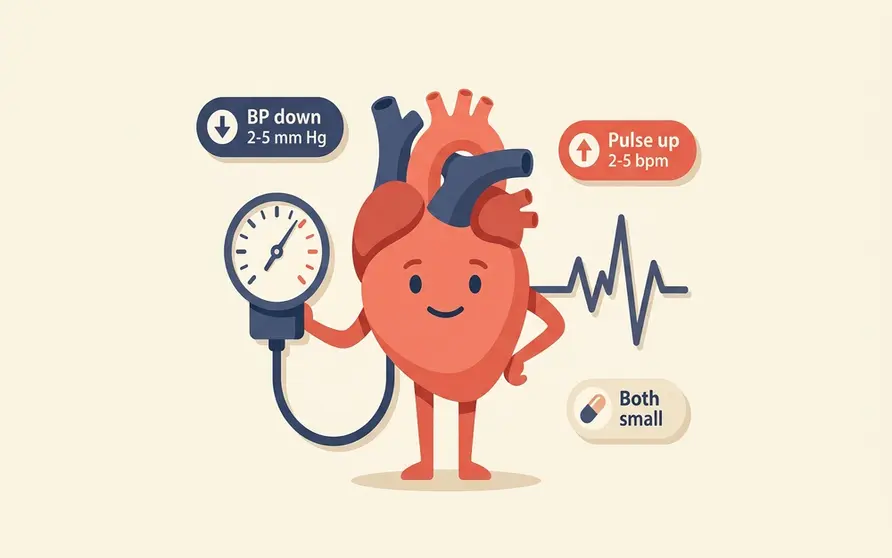
Two things happen to your circulation on a GLP-1 drug, and they pull in opposite directions. Your blood pressure usually drifts down a little. Your resting pulse usually drifts up a little. Both changes are real, both are small, and neither is a reason to panic.
That two-way effect confuses people. One person sees a lower blood-pressure reading and wonders whether they can drop a pill. Another feels a faster heartbeat and worries the drug is straining the heart. This article gives the actual numbers for both, drawn from a 2026 evidence review and the four US drug labels.
Does Ozempic lower blood pressure?
Yes, by a modest amount. A 2026 state-of-the-art review in the American Journal of Hypertension pooled the trial evidence and found that GLP-1 receptor agonists lower systolic blood pressure by about 2 to 5 mm Hg.1
That reduction held across different groups: people with type 2 diabetes, people with obesity, and people at high cardiovascular risk.1 It is smaller than the drop a dedicated blood-pressure medicine produces, but the review notes it adds useful benefit on top of standard treatment and, at a population level, can translate into lower cardiovascular risk.1
Why does the pressure drop?
Most of the fall comes from weight loss. As body weight comes down, the heart and blood vessels work under less strain, and blood pressure eases.1
The review describes smaller, weight-independent effects as well. GLP-1 drugs appear to promote mild salt and water excretion (natriuresis), improve the function of the blood-vessel lining, and reduce inflammation in the vessel wall.1 These effects add to the weight-loss benefit rather than replacing it.
Does Ozempic raise your heart rate?
Yes, and this is one of the most consistent effects of the whole drug class. The same 2026 review describes a modest, dose-dependent rise in resting heart rate of about 2 to 5 beats per minute, seen most clearly with the long-acting agents.1
This is not only a research finding. All four US labels report the same rise from their own trials: Ozempic lists a mean increase of 2 to 3 beats per minute, Wegovy 1 to 4, Mounjaro 2 to 4, and Zepbound 1 to 3.3456
| US label | Mean resting heart-rate increase |
|---|---|
| Ozempic (semaglutide) | 2 to 3 bpm |
| Wegovy (semaglutide) | 1 to 4 bpm |
| Mounjaro (tirzepatide) | 2 to 4 bpm |
| Zepbound (tirzepatide) | 1 to 3 bpm |
Mean resting heart-rate increase versus placebo, taken from each drug's current US prescribing information. The populations differ (diabetes trials for Ozempic and Mounjaro, weight-management trials for Wegovy and Zepbound), so these figures are not a head-to-head comparison.3456
Should a faster pulse worry you?
For most people, no. Large cardiovascular outcome trials have not found that this small heart-rate rise leads to more heart attacks or strokes.1
The labels treat the rise as worth watching rather than alarming. The Wegovy label carries a specific instruction to monitor heart rate at regular intervals and to stop the drug if a patient has a sustained increase in resting heart rate.3 The Mounjaro label states plainly that the clinical relevance of the heart-rate increase is uncertain.5
The rise matters more in some people than others. The review flags a theoretical concern for people with ischemic heart disease or an arrhythmia, where a higher resting pulse is less welcome.1 In one small heart-failure trial (LIVE), liraglutide raised heart rate by about 7 beats per minute, more than the class average, which is why people with heart failure need individual medical advice.1
Blood pressure usually drifts down a little. Resting pulse usually drifts up a little. Both effects are small, and neither is a reason to change a prescription on your own. Summarising the 2026 American Journal of Hypertension review
Can you cut your blood pressure pills?
This is the question with a real safety risk attached, so the answer is firm: do not adjust a prescribed blood-pressure medicine on your own.1
A GLP-1 drug can lower blood pressure enough that an existing antihypertensive or diuretic becomes too strong for you. The review specifically warns about interactions with volume-regulating medicines and about low blood pressure on standing (orthostatic hypotension), especially in older or frail adults and in people taking diuretics or an SGLT2 inhibitor.1 The Zepbound label lists decreased blood pressure and orthostatic hypotension among its reported reactions.6
The practical point is simple. A lower reading is good news, but it is a reason to see your doctor, who can measure your blood pressure over time and decide whether any medicine should change. Cutting or halving a pill yourself can send your pressure the wrong way.
What does real-world use show?
Trial averages describe the typical person, but routine care is messier. A 2026 real-world study from a hospital in the United Arab Emirates followed 143 adults on GLP-1-based therapy for about seven months and measured their blood pressure.2
On average, systolic blood pressure fell by 3.59 mm Hg, landing squarely inside the review's 2 to 5 mm Hg range.2 But the responses varied widely: about half of patients showed little change, roughly a third improved, and a smaller group actually went up.2 That spread is the honest picture. The average is a small drop, but your own number can move either way.
In one sentence: GLP-1 drugs like Ozempic usually lower systolic blood pressure by about 2 to 5 mm Hg and raise resting heart rate by about 2 to 5 beats per minute, both effects are small and generally well tolerated, the heart-rate rise deserves attention if you have heart disease or an arrhythmia, and you should never change a blood-pressure medicine without your doctor.
Frequently asked
Does Ozempic lower your blood pressure?+
Does Ozempic make your heart rate go up?+
Is a faster pulse on Ozempic dangerous?+
Can I lower my blood pressure medication on Ozempic?+
References
- Moiz A, Zolotarova T, Filion KB, Eisenberg MJ. GLP-1 receptor agonists and blood pressure: a state-of-the-art review of mechanisms, evidence, and clinical implications. Am J Hypertens. 2026. Europe PMC. doi:10.1093/ajh/hpaf205. PMID: 41128495. PMCID: PMC13080269. Open access. The authors report no conflicts of interest; the work was supported by academic awards (Fond de recherche du Quebec-Sante and McGill University) that had no role in it.
- Almemari S, Almulla N, Alsarraf Y, Badri G, Khan NS. Real-world prescribing patterns and early weight and blood pressure outcomes of GLP-1-based therapies: a retrospective observational study in the United Arab Emirates. BMC Endocr Disord. 2026. Europe PMC. doi:10.1186/s12902-026-02273-3. PMID: 41968307. PMCID: PMC13181871. Open access. Single-centre retrospective cohort; observational, no control group; blood-pressure results are from 143 patients with paired follow-up.
- Novo Nordisk. WEGOVY (semaglutide) injection and tablets: US prescribing information. DailyMed, US National Library of Medicine, accessed August 2026. Reports mean resting heart-rate increases of 1 to 4 bpm and carries a Warnings and Precautions instruction to monitor heart rate and discontinue if a sustained increase in resting heart rate occurs.
- Novo Nordisk. OZEMPIC (semaglutide) injection, for subcutaneous use: US prescribing information. DailyMed, US National Library of Medicine, accessed August 2026. Reports a mean heart-rate increase of 2 to 3 bpm at the 0.5 mg and 1 mg doses in placebo-controlled trials.
- Eli Lilly and Company. MOUNJARO (tirzepatide) injection, for subcutaneous use: US prescribing information. DailyMed, US National Library of Medicine, accessed August 2026. Reports a mean heart-rate increase of 2 to 4 bpm versus 1 bpm on placebo and states that the clinical relevance of heart-rate increases is uncertain.
- Eli Lilly and Company. ZEPBOUND (tirzepatide) injection, for subcutaneous use: US prescribing information. DailyMed, US National Library of Medicine, accessed August 2026. Reports a mean heart-rate increase of 1 to 3 bpm and lists decreased blood pressure and orthostatic hypotension among reported reactions.
Evidence current as of August 5, 2026. This article is educational only and is not medical advice. Semaglutide and tirzepatide are prescription-only and should be used under medical supervision. The blood-pressure and heart-rate figures are averages from clinical trials and routine care; individual results vary. The label figures come from different trial populations and are not directly comparable between drugs. Never start, stop, or change a prescribed medicine, including any blood-pressure medicine, because of anything you read here. Talk to your doctor about a lower blood-pressure reading, and seek prompt care for a persistently fast or pounding heartbeat, chest pain, fainting, or severe dizziness.
Translating new metabolic and obesity research into plain English for people living on GLP-1 therapy. Every claim is traced to its source.