Does Ozempic or Mounjaro cause blood clots?
There is no good evidence that Ozempic or Mounjaro cause blood clots. The largest 2026 study found fewer clots, not more, in high-risk vein patients taking GLP-1 drugs, most likely because they lost weight. But that study is observational, it is in one specific group, and haematologists still call the question unresolved. No GLP-1 is approved to prevent clots.
Blood clots are a frightening thing to read about, and obesity is itself one of the biggest risk factors for them, so it is natural for someone on Ozempic, Wegovy or Mounjaro to wonder whether the drug adds to that risk. The honest short answer is reassuring: there is no good evidence that GLP-1 drugs cause blood clots, and the largest 2026 study points the other way, toward fewer clots in people taking them.
The catch is that the reassuring study is observational, it looked at one specific high-risk group, and specialists who manage clots still call the question unresolved. So this article holds two things at once: the drugs are not shown to cause clots and may track with fewer, but the evidence is not strong enough to say a GLP-1 prevents them. Nothing here is a reason to start, stop or switch a medicine.
What are DVT and PE?
A deep vein thrombosis (DVT) is a blood clot that forms in a deep vein, usually in the leg. It can cause a hot, swollen, painful calf or thigh. The danger is that part of the clot can break off and travel to the lungs.
When a clot lodges in the lungs, it is called a pulmonary embolism (PE), which can cause sudden breathlessness, chest pain and, in severe cases, death. DVT and PE together are known as venous thromboembolism (VTE). Obesity, poor blood flow in the leg veins, immobility and dehydration all raise the risk of these clots, which is exactly why the GLP-1 question matters here.
Do GLP-1 drugs cause blood clots?
The best available evidence says no, and if anything points the opposite way. A 2026 retrospective study in the Journal of Vascular Surgery: Venous and Lymphatic Disorders used the TriNetX US research network to follow 138,853 obese adults aged 40 or over who had chronic venous insufficiency, a condition of poor vein flow that already raises clot risk.1 People with a prior DVT or PE were excluded, and the researchers compared those who started a GLP-1 with matched people who did not.1
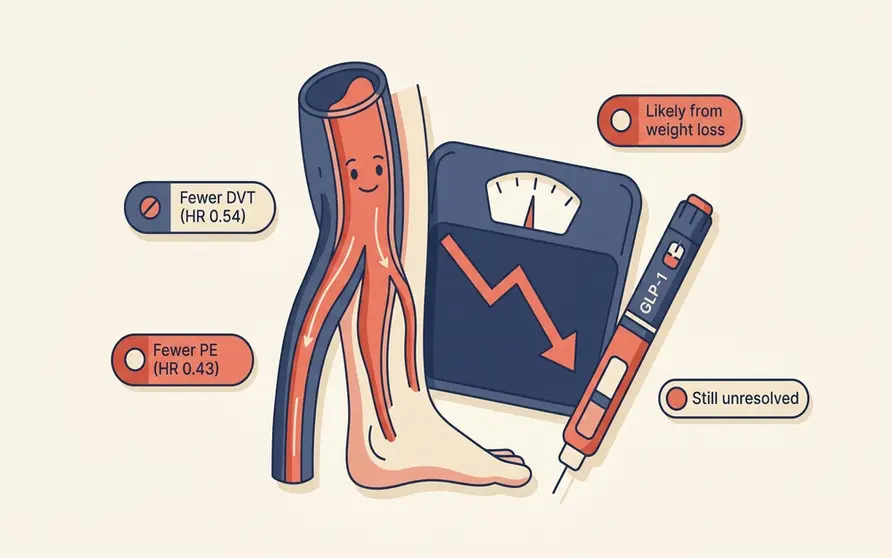
After 1:1 propensity-score matching left 12,379 patients in each group, GLP-1 therapy was associated with a lower one-year risk of deep vein thrombosis (hazard ratio 0.54), pulmonary embolism (hazard ratio 0.43), venous leg ulcers (hazard ratio 0.47) and soft-tissue infections (hazard ratio 0.61), and those associations held at three years.1 A hazard ratio below 1 means lower risk in the GLP-1 group, so these numbers describe fewer clots, not more.1
The table below shows the one-year figures exactly as the study reported them, with their 95% confidence intervals.
| Outcome at 1 year | Hazard ratio | 95% CI |
|---|---|---|
| Deep vein thrombosis (DVT) | 0.54 | 0.42-0.71 |
| Pulmonary embolism (PE) | 0.43 | 0.27-0.66 |
| Venous leg ulcers | 0.47 | 0.33-0.66 |
| Soft-tissue infections | 0.61 | 0.52-0.72 |
Why might GLP-1s lower clot risk?
The most likely explanation is weight loss, not any clot-specific action of the drug. Obesity and sluggish blood flow in the leg veins are two of the largest drivers of venous clots, and both improve when a person loses a substantial amount of weight.1 Because GLP-1 drugs cause weight loss, the reduced clot risk in this study fits the pattern you would expect from losing weight, whatever the route.
That framing matters for how you read the result. The honest way to state it is that losing weight lowers clot risk, and GLP-1 drugs cause weight loss, rather than that the molecule itself protects the veins. The study can show that GLP-1 use and fewer clots occurred together, but it cannot prove the drug was the cause.1
The signal is that GLP-1 users had fewer clots, not that the drug thins the blood. Weight loss is the most likely reason, and a database study cannot prove cause.
Do these drugs thin the blood?
No. GLP-1 drugs are not anticoagulants, and nothing in the evidence suggests they act like a blood thinner such as warfarin or apixaban. They do not stop clots from forming in the way a prescribed anticoagulant does. Where a study found fewer clots, the plausible reason is weight loss and better metabolic health, not a direct effect on how the blood clots.1
This distinction protects you from two mistakes. It means you should not treat a GLP-1 as clot protection, and it also means you should not expect the drug to interfere with a real blood thinner in the way another anticoagulant might. Any question about combining medicines belongs with a doctor or pharmacist who can see your full list.
Why do experts call it unresolved?
Because a single observational study, however large, is not the last word. In 2026, three haematologists published a correspondence in the Internal Medicine Journal titled "Glucagon-like peptide-1 receptor agonists and venous thromboembolism: an unresolved question for Australian prescribers."2 These are specialists who manage clots for a living, and they flagged that the relationship between GLP-1 drugs and clots is still an open question, not a settled protective effect.2
Several limitations sit behind that caution. The reassuring study was observational, so healthy-user bias and other hidden differences between the groups can inflate a benefit.1 It also reported a large three-year survival gap, which is a very big effect for a database study and should be read as likely amplified by who qualifies for these drugs, not as proof they help you live longer.1 The results are specific to obese people with chronic venous insufficiency, not the average person taking Ozempic for weight loss, and there is no randomized trial or dedicated GLP-1 clot trial to settle the matter.
Could a GLP-1 ever raise clot risk?
The drug itself is not a known clot cause, but two general situations raise clot risk for anyone, and they can overlap with GLP-1 treatment. This is general safety information, not a finding from the studies above. First, the drugs can cause severe vomiting or diarrhoea, and heavy fluid loss leads to dehydration, which thickens the blood and can make clots more likely.
Second, any serious illness or an operation with a long recovery means more time spent immobile, and immobility is a well-known clot trigger for everyone. If you are having surgery, this connects to the separate question of whether to stop Ozempic before a procedure, which your surgical team will guide. Sensible general steps are to stay well hydrated, keep moving when you can, and tell your care team you are on a GLP-1 before any operation.
In one sentence: there is no evidence that Ozempic or Mounjaro cause blood clots, the largest 2026 study found fewer DVT and PE clots in high-risk vein patients on GLP-1 drugs, most likely through weight loss, but that finding is observational and population-specific, no GLP-1 is approved to prevent clots, and haematologists still call the question unresolved.12
Frequently asked
Do Ozempic and Mounjaro cause blood clots?+
Can GLP-1 drugs lower the risk of a DVT or PE?+
Do GLP-1 drugs thin the blood?+
Should I worry about blood clots on Ozempic?+
References
- Micalo L, Archie M, Rowe VL, Adewale AP, Pham NV, Li A, Jimenez JC. Glucagon-like peptide-1 receptor agonists are associated with fewer venous thromboembolic events and limb complications in obese patients with chronic venous insufficiency. Journal of Vascular Surgery: Venous and Lymphatic Disorders. 2026 Sep;14(5):102557. DOI: 10.1016/j.jvsv.2026.102557. PMID: 42323127. A retrospective multicenter TriNetX cohort of 138,853 obese adults (aged 40 or over) with chronic venous insufficiency, prior DVT and PE excluded; after 1:1 propensity-score matching (12,379 per group), GLP-1 therapy was associated with lower one-year risk of DVT (HR 0.54, 95% CI 0.42-0.71), PE (HR 0.43, 95% CI 0.27-0.66), venous leg ulcers (HR 0.47, 95% CI 0.33-0.66) and soft-tissue infections (HR 0.61, 95% CI 0.52-0.72), sustained at three years. Association, not causation. Senior author J.C. Jimenez is an advisory board member for Boston Scientific (states 100% of earnings donated to charitable foundations); the remaining authors report no conflicts.
- Kamel KS, Chan D, Hovelroud R. Glucagon-like peptide-1 receptor agonists and venous thromboembolism: an unresolved question for Australian prescribers. Internal Medicine Journal. 2026 Aug;56(8):1466-1467. DOI: 10.1111/imj.70522. PMID: 42444392. A haematology correspondence from the Townsville Hospital and Health Service and the University of Sydney flagging that the relationship between GLP-1 receptor agonists and venous thromboembolism remains an open question for prescribers; cited here for its stance that the question is unresolved, not for any numeric result.
Evidence current as of September 25, 2026. The clot-reduction figures here come from a single observational cohort of obese adults with chronic venous insufficiency; they show association, not causation, apply to that specific high-risk group, and are most plausibly explained by weight loss rather than a direct drug effect. There is no completed randomized trial and no dedicated GLP-1 clot trial, and specialists still describe the question as unresolved. No GLP-1 or GLP-1/GIP drug is approved to prevent or treat blood clots. This content is educational only, not medical advice. Do not start, stop or change any medicine based on this article. Anyone with symptoms of a clot, such as a hot, swollen, painful leg or sudden breathlessness or chest pain, needs urgent medical care.
Translating new metabolic and obesity research into plain English for people living on GLP-1 therapy. Every claim is traced to its source.