Does Ozempic or Mounjaro help gout?
The honest answer is split. A GLP-1 or GLP-1/GIP drug like Ozempic or Mounjaro usually lowers your uric-acid number, mostly as a by-product of weight loss. But a lower number is not the same as fewer gout attacks, and the best real-world data did not show these drugs actually preventing gout. No GLP-1 is approved for gout.
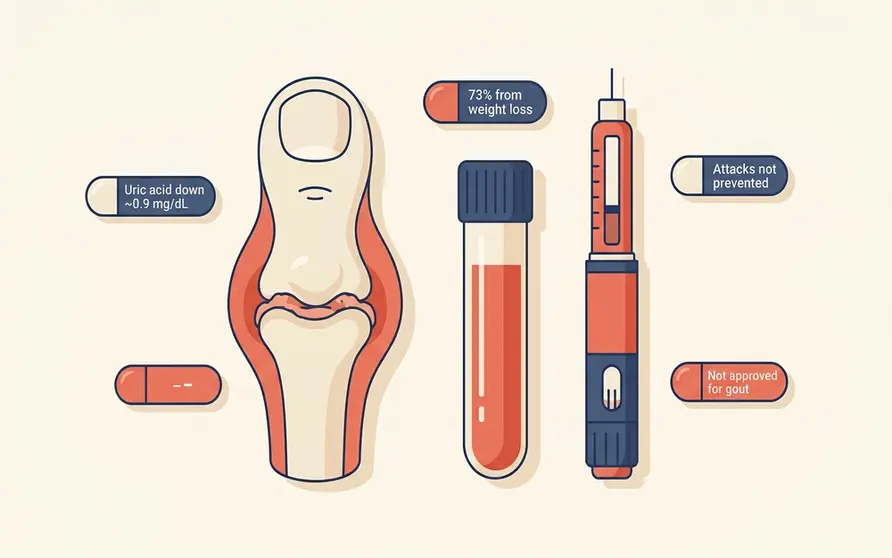
If you have gout or a high uric-acid reading and you take, or are considering, a GLP-1 drug such as Ozempic, Wegovy or Mounjaro, the hopeful question is whether the medicine will help your gout and push your uric acid down. The honest answer has two halves that pull in different directions, and keeping them apart is the whole point of this article.
The short version: the uric-acid number usually falls, mostly because you lose weight, but the best evidence so far did not show GLP-1 drugs actually preventing gout attacks. A different class of diabetes drug, the SGLT2 inhibitors, does have that outcome evidence. No GLP-1 drug is approved to treat or prevent gout, so nothing here is a reason to start, stop or switch a medicine on your own.
Uric acid versus gout, what is the difference?
Uric acid is a waste product that circulates in your blood, and when the level climbs too high it can form sharp crystals inside joints. Gout is the disease those crystals cause: sudden, severe attacks of joint pain and swelling, often starting in the big toe, and joint damage over time. Gout is a common and painful form of inflammatory arthritis, and it is tightly linked to obesity and type 2 diabetes.
Here is the trap to avoid. A high uric-acid number raises the risk of gout, but plenty of people with a high number never have an attack, so the number and the disease are not the same thing. That means a drug can move your uric-acid reading without necessarily changing how often you get a gout flare. Every claim below sits on one side of that line or the other.
Does Ozempic or Mounjaro lower uric acid?
Yes, on average the number goes down. The clearest data come from a post hoc analysis of the SURMOUNT-1 trial (Annals of the Rheumatic Diseases, 2026), which looked at 2,539 adults with obesity or overweight who took tirzepatide, the GLP-1/GIP drug sold as Mounjaro and Zepbound, or placebo for 72 weeks.1 Serum uric acid fell by -0.69 mg/dL on the 5 mg dose, -0.92 mg/dL on 10 mg and -0.95 mg/dL on 15 mg, versus only -0.18 mg/dL on placebo, and every drop was statistically significant (P<0.001).1
Two details matter. First, the reduction held regardless of a person's starting uric-acid level or starting weight, so it was not limited to people who began with a high reading.1 Second, a mediation analysis attributed 72.7% of the uric-acid reduction to the weight loss itself, which means the effect is largely indirect, driven by losing weight rather than by a dedicated urate-lowering action of the drug.1
| Group | Uric-acid change at 72 weeks |
|---|---|
| Tirzepatide 5 mg | -0.69 mg/dL |
| Tirzepatide 10 mg | -0.92 mg/dL |
| Tirzepatide 15 mg | -0.95 mg/dL |
| Placebo | -0.18 mg/dL |
Mean serum uric-acid change over 72 weeks in the SURMOUNT-1 post hoc analysis; all tirzepatide doses P<0.001 versus placebo. This was a secondary uric-acid analysis, not a gout-attack trial.1
Do GLP-1 drugs actually prevent gout?
This is where the story turns, and where a lower number stops translating into a better disease. The largest real-world test of whether these drugs cut gout is a TriNetX cohort study (Clinical Therapeutics, 2024) that followed people with type 2 diabetes for 5 years and counted new gout diagnoses.2 GLP-1 receptor agonists showed no significant reduction in new gout versus matched comparison groups.2
SGLT2 inhibitors, a separate class of diabetes drug, were a different story. They were linked to clearly fewer new gout diagnoses: a hazard ratio of 0.75 (95% CI 0.69 to 0.82) versus metformin and 0.83 (95% CI 0.74 to 0.92) versus insulin.2 The study spelled the contrast out in its own title: SGLT2 inhibitors, but not GLP-1 receptor agonists, reduced gout incidence.2
Read this carefully. This is observational, propensity-matched real-world data, so it shows association rather than proof, and residual differences between the groups are possible. It means GLP-1 drugs did not show a gout-prevention benefit here, not that they raise gout risk.2
A lower uric-acid number is reassuring, but the drugs that lowered it were not the drugs that actually cut gout attacks.
Which is better for gout, GLP-1 or SGLT2 drugs?
For the specific goal of preventing gout, the outcome evidence points to SGLT2 inhibitors. In the same cohort's head-to-head subgroups, SGLT2 inhibitors beat GLP-1 drugs for gout prevention, with a hazard ratio of 0.77 (95% CI 0.70 to 0.86) among people also on metformin and 0.82 (95% CI 0.73 to 0.91) among those on insulin.2
This is a case of different tools for different jobs, not a mark against GLP-1 drugs. GLP-1 and GLP-1/GIP medicines do many things well, including strong weight loss and, for some, heart and kidney benefits. But if gout is the priority in someone who also has type 2 diabetes, the class with the gout-outcome evidence is the SGLT2 inhibitors, and that is a conversation for a doctor, not a reason to change anything on your own.
Can starting a GLP-1 trigger a gout flare?
It can, but not because of the drug itself. Rapid weight loss and calorie restriction can briefly raise uric acid, and that is a long-recognised trigger for gout flares in the early phase of any weight-loss effort, whether the weight comes off through dieting or a GLP-1 drug. This is a general clinical caution rather than a measured GLP-1 statistic, and no specific number attaches to it here.
The practical takeaway is not to avoid losing weight, which helps gout in the long run, but to plan for it. Anyone with gout who is starting a GLP-1 drug should raise flare prevention with their doctor, who may adjust gout treatment during the early months, rather than stopping either medicine alone.
How strong is this evidence?
It is worth being blunt about the limits, because there is no dedicated GLP-1 gout-outcome trial anywhere. The uric-acid data are post hoc and biomarker-only: SURMOUNT-1 was a weight-loss trial, the uric-acid analysis was a secondary look with no gout-attack endpoint, and the authors themselves only call for further investigation into a possible role in gout, not a treatment claim.1 The gout-outcome data are observational, so they describe associations rather than cause and effect.2
Funding and interests are worth naming too. The SURMOUNT-1 analysis is based on Eli Lilly's tirzepatide trial and includes Lilly-affiliated co-authors, so industry involvement should be assumed.1 In the cohort study, some authors report payments or research funding from companies that market these drug classes, including Procter & Gamble, Sanofi, AstraZeneca and Novo Nordisk.2 None of this makes the numbers wrong, but it is context to weigh.
What should I do?
Do not start, stop or switch a GLP-1 drug, an SGLT2 inhibitor or any gout medicine based on anything you read here. If gout is a priority for you and you have type 2 diabetes, the gout-outcome evidence currently favours SGLT2 inhibitors, and that is a discussion for your doctor about your specific situation. GLP-1 drugs remain valuable for weight and diabetes, and losing weight helps gout over time.
One more point of confusion worth clearing up. This article is about whether GLP-1 drugs help gout, which is a different question from whether they cause joint pain as a side effect, a topic the Academy covers in its piece on whether Ozempic causes joint pain. In that safety research, gout appeared only as a non-side-effect, meaning studies did not find extra gout caused by the drugs.
In one sentence: Ozempic and Mounjaro usually lower your uric-acid number, mostly through weight loss, but a lower number is not the same as fewer gout attacks, the best real-world data did not show GLP-1 drugs preventing gout while SGLT2 diabetes drugs did, no GLP-1 is approved for gout, and any change belongs with your doctor.12
Frequently asked
Does Ozempic or Mounjaro help gout?+
Does Ozempic raise or lower uric acid?+
Are GLP-1 drugs or SGLT2 inhibitors better for preventing gout?+
Can starting a GLP-1 drug trigger a gout attack?+
References
- Sattar N, Scilletta S, Stefanski A, Wang H, Daly JW, Linetzky B. Tirzepatide and change in uric acid and its association with weight reduction: post hoc analyses of the SURMOUNT-1 randomised placebo-controlled trial. Annals of the Rheumatic Diseases. 2026 Mar. DOI: 10.1016/j.ard.2025.10.009. PMID: 41198460. A post hoc analysis of Eli Lilly's SURMOUNT-1 tirzepatide trial with Lilly-affiliated co-authors, so industry involvement should be assumed; serum uric acid was a secondary biomarker, not a gout-attack endpoint.
- Preston FG, Anson M, Riley DR, Ibarburu GH, Henney A, Lip GYH, Cuthbertson DJ, Alam U, Zhao SS. SGLT2 Inhibitors, but Not GLP-1 Receptor Agonists, Reduce Incidence of Gout in People Living With Type 2 Diabetes Across the Therapeutic Spectrum. Clinical Therapeutics. 2024 Nov. DOI: 10.1016/j.clinthera.2024.06.021. PMID: 39068059. A propensity-matched TriNetX cohort reporting associations, not proof of cause and effect. Disclosures: one author reports honoraria from Procter & Gamble, Viatris, Grunenthal and Sanofi and investigator-led funding from Procter & Gamble; another reports investigator-led funding and conference support from AstraZeneca, Novo Nordisk and Perspectum.
Evidence current as of September 21, 2026. The uric-acid figures come from a post hoc, biomarker-only analysis with no gout-attack endpoint, and the gout-incidence figures come from an observational cohort, which reports average associations rather than a guarantee for any individual and cannot prove cause and effect; there is no dedicated GLP-1 gout-outcome trial. No GLP-1 or GLP-1/GIP drug is approved to treat or prevent gout or to lower uric acid. This content is educational only, not medical advice. Do not start, stop or change a GLP-1 drug, an SGLT2 inhibitor or any gout medicine based on this article. Anyone with gout or high uric acid who is considering these drugs should discuss it with their doctor first.
Translating new metabolic and obesity research into plain English for people living on GLP-1 therapy. Every claim is traced to its source.