Does Ozempic or Mounjaro make you tired?
There is no single answer. A 2026 study of nearly 119,000 GLP-1 users found only a small rise in daytime sleepiness, while stronger trial evidence shows these drugs ease sleep apnea, a major cause of tiredness. Most fatigue on Ozempic or Mounjaro traces to fixable causes like low iron, too little food or dehydration.
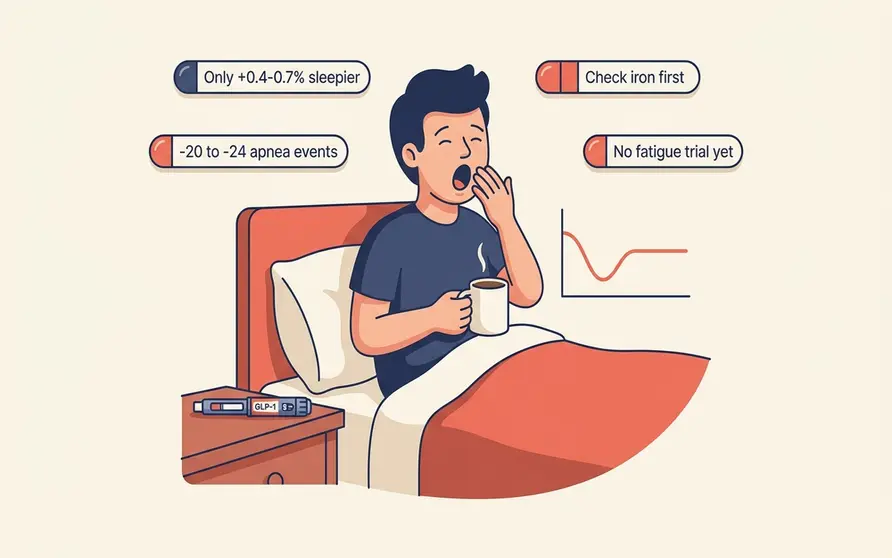
Feeling wiped out after starting Ozempic, Wegovy or Mounjaro is one of the most common complaints people report, and it is easy to blame the drug. Tiredness has many possible sources, though, and the 2026 evidence splits into two directions worth separating: a small, direct signal, and a set of everyday causes you can usually check and fix.
The short version is that these drugs appear to nudge daytime sleepiness up by a small amount, while at the same time strongly improving sleep apnea, which is itself a major cause of exhaustion. So there is no single answer to "does Ozempic make you tired." The most useful move is to separate the drug's tiny direct effect from the common causes of fatigue that come with eating far less.
Does Ozempic make you sleepy?
A large 2026 study found GLP-1 drugs were linked to a small increase in daytime sleepiness, but the effect was minor. Researchers used the TriNetX network to compare 118,993 GLP-1 users against 118,993 matched non-users, all adults aged 18 to 50 with type 2 diabetes or obesity who had undergone a sleep study.1
People taking a GLP-1 drug had a modestly higher risk of new hypersomnolence, the medical term for excessive daytime sleepiness, at both 1 year (hazard ratio 1.21) and 5 years (hazard ratio 1.23).1 Two details keep this in perspective. The absolute increase was tiny: about 0.4% more people at 1 year and 0.7% more at 5 years.1 And the same study found no significant rise in disturbed sleep, restless legs syndrome, parasomnia or narcolepsy, so the signal is specific to daytime sleepiness rather than broken sleep across the board.1
Can these drugs improve sleep apnea?
Yes, and this is the side of the story that pulls toward more energy, not less. Obstructive sleep apnea, where the airway repeatedly collapses during sleep, is one of the biggest drivers of daytime sleepiness, and it affects a large share of people with obesity.2 A 2026 review in JAMA Otolaryngology-Head and Neck Surgery pooled six meta-analyses showing GLP-1 drugs lowered the apnea-hypopnea index, a count of breathing interruptions per hour, by 5.7 to 21.9 events an hour.2
The strongest evidence comes from the SURMOUNT-OSA phase 3 trials, run by Eli Lilly, in which tirzepatide cut the apnea-hypopnea index by 20 to 24 events an hour compared with placebo and put 42% to 50% of patients into disease remission.2 On the strength of those results, tirzepatide, sold as Zepbound, became the first drug approved for moderate-to-severe sleep apnea in adults with obesity in December 2024.2
| Possible cause | Why it can leave you tired |
|---|---|
| Eating too little | Too few calories means too little fuel for the day |
| Too little protein | Low protein speeds muscle loss and weakness |
| Dehydration | Nausea, vomiting or diarrhea drain fluids and energy |
| Low iron | Iron carries oxygen; a shortage causes fatigue |
| Low blood sugar | Common with added insulin or a sulfonylurea |
| Untreated sleep apnea | Broken night-time breathing wrecks daytime energy |
The benefit has limits worth naming. The same review notes GLP-1 drugs did not match CPAP, the mask-based standard treatment, which reduces breathing interruptions more (roughly 31 versus 22 events an hour), and the gains come mainly from weight loss, so they fade if the weight returns.2 Even so, for someone with untreated sleep apnea, a GLP-1 drug may leave them less sleepy over time, not more.
Why am I so tired on Ozempic?
Most fatigue on a GLP-1 drug is not a mystery and traces to a handful of common, checkable causes. When appetite drops sharply, it is easy to eat too little overall, take in too little protein, or become mildly dehydrated from nausea, vomiting or diarrhea, and each of those can leave you flat. These are general effects of eating far less, not findings of the sleepiness study.
Low iron is a different case: it is a classic, treatable cause of tiredness, and the 2026 cohort did find a small but real rise in iron deficiency among GLP-1 users over 5 years.1 In people who also take insulin or a sulfonylurea, low blood sugar can feel like sudden exhaustion too. The table above sets out these causes and why each one saps energy.
Two of these are worth acting on early. Eating enough protein protects against the muscle loss that comes with rapid weight change, covered in our guides to whether high-protein diets can slow GLP-1 muscle loss and how much muscle you lose on a GLP-1. If tiredness is persistent, a simple blood test for iron and blood sugar is a reasonable first step to raise with your doctor.
The drug seems to add a little sleepiness, and take away a lot from sleep apnea. For most people, the bigger lever is the everyday causes of tiredness that come with eating far less.
When should tiredness be checked?
New, severe or lasting daytime sleepiness deserves a medical review rather than self-diagnosis from an article. That is especially true if the sleepiness comes with loud snoring or witnessed pauses in breathing at night, which point to untreated sleep apnea, or with dizziness, a very low appetite or signs of low blood sugar. A doctor can check simple, fixable causes like iron and blood sugar, and decide whether a sleep study is needed.
None of this is a reason to start, stop or change a dose on your own. There is no randomized trial testing GLP-1 drugs for fatigue, so the evidence here shows an association, not proof, and the sleepiness study looked only at adults aged 18 to 50 who had already had a sleep study, a specific group rather than every user. Any change to treatment belongs with the doctor who prescribed it.
In one sentence: there is a small, observational signal that GLP-1 drugs like Ozempic and Mounjaro can nudge daytime sleepiness up, set against stronger evidence that they ease sleep apnea, and most fatigue on these drugs traces to fixable causes such as low iron, too little food and dehydration.12
Frequently asked
Does Ozempic make you tired?+
Why am I so tired since starting Mounjaro?+
Can Ozempic or Mounjaro help sleep apnea?+
When should I see a doctor about tiredness on Ozempic?+
References
- Kamel-Abusalha L, Afifi AM, Dawoud A, Hayath Z, Bouso MF, Aguillon A, Assaly R. Association of GLP-1 Receptor Agonist Use with Hypersomnolence: A Real-world Cohort Analysis. Journal of Diabetes & Metabolic Disorders. 2026 Mar 18;25(1):117. DOI: 10.1007/s40200-026-01929-0. PMID: 41867417. A retrospective TriNetX cohort of adults aged 18 to 50 with type 2 diabetes or obesity who had undergone polysomnography, with prior antidepressant users excluded, giving two 1:1 propensity-matched groups of 118,993. GLP-1 use was associated with higher new-onset hypersomnolence at 1 year (HR 1.21, 95% CI 1.10-1.32) and 5 years (HR 1.23, 95% CI 1.14-1.32), an absolute increase of about 0.4% and 0.7%, plus a small rise in iron deficiency at 5 years (HR 1.11, 95% CI 1.06-1.16). A decreased hazard of Parkinsonism (HR 0.26, 95% CI 0.08-0.80) was seen on low event counts. No significant association was found with parasomnia, disturbed sleep, restless legs syndrome or narcolepsy/cataplexy. The authors declare no competing interests.
- Harris A, Kaffenberger T. Glucagon-Like Peptide-1 Receptor Agonists for Obstructive Sleep Apnea: A Review. JAMA Otolaryngology-Head & Neck Surgery. 2026 Sep 3 (online ahead of print). DOI: 10.1001/jamaoto.2026.2266. PMID: 42690639. A review reporting that six meta-analyses showed apnea-hypopnea index reductions of 5.7 to 21.9 events per hour with GLP-1 receptor agonists, and that the SURMOUNT-OSA phase 3 trials (an Eli Lilly programme) showed tirzepatide reduced the index by 20 to 24 events per hour versus placebo, with 42% to 50% of patients reaching disease remission. Tirzepatide was approved by the US FDA in December 2024 as the first drug for moderate-to-severe obstructive sleep apnea in adults with obesity. The review notes GLP-1 drugs did not match CPAP (about 22 versus 31 events per hour of reduction) and that benefits are driven mainly by weight loss.
Evidence current as of September 30, 2026. The daytime-sleepiness finding comes from a single retrospective cohort and shows association, not proof that GLP-1 drugs cause tiredness; the absolute effect was small (about 0.4% to 0.7%) and the study looked only at adults aged 18 to 50 who had had a sleep study. No randomized trial has tested these drugs for fatigue or hypersomnolence. The sleep apnea benefit is stronger and trial-backed, but comes mainly from weight loss and can fade if weight returns. This content is educational only, not medical advice. Do not start, stop or change any medicine based on this article; new, severe or persistent daytime sleepiness, especially with loud snoring or witnessed pauses in breathing, should be assessed by a clinician.
Translating new metabolic and obesity research into plain English for people living on GLP-1 therapy. Every claim is traced to its source.