Does the Ozempic mouse lifespan study apply to humans?
A September 2026 Nature study found that starting semaglutide late in life extended lifespan in aged female mice and copied many effects of calorie restriction. This is animal evidence. No human trial has shown any GLP-1 drug extends human lifespan, so it is a research signal, not a reason to take one for anti-aging.
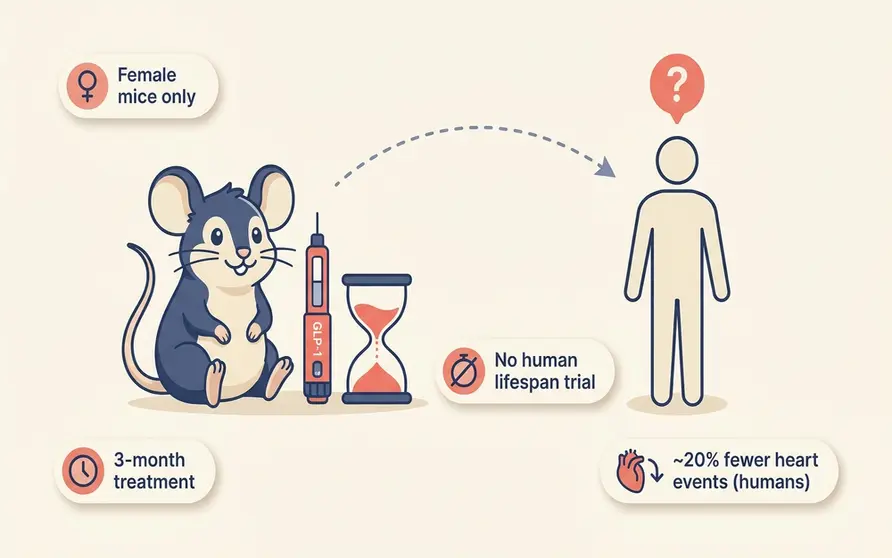
The headline wrote itself: a drug millions already inject for weight loss made animals live longer. In early September 2026 the journal Nature published a study reporting that semaglutide, the molecule in Ozempic and Wegovy, extended lifespan in old mice. Within days the framing had jumped from "in mice" to "does Ozempic make you live longer", and the honest answer to that jump is the point of this article.
The study is real, it is high quality, and it is genuinely interesting. It is also a mouse study. Those two facts are not in tension, and understanding why is the difference between reading the science and reading the hype.
What did the Nature study find?
Researchers treated 20-month-old female C57BL/6 mice, roughly the equivalent of older age in people, with semaglutide for three months.1 The treated mice showed improved physiological function, slowing of several recognised hallmarks of ageing, and changes in the nutrient-sensing pathways and conserved genes that biologists use to track how an animal ages.
When treatment continued, the mice lived longer. The authors then ran a longitudinal arm comparing semaglutide directly against matched calorie restriction, the practice of feeding animals fewer calories, which is the most reliable way known to extend lifespan in the laboratory.1 Semaglutide reproduced many of calorie restriction's benefits, and on a few specific measures, exploratory drive, spatial memory, and glucose control, the treated mice did better than the calorie-restricted ones.
That is a strong result for an animal study. The senior authors are established ageing researchers, and the work was funded by the US National Institute on Aging, a public funder rather than a drug company.1 None of that changes the species the experiment was run in.
Why does "in mice" matter so much?
Because most things that extend a mouse's life do not go on to extend a human's. Animal lifespan studies are where longevity ideas begin, not where they are proven. A result in a 20-month-old mouse is a well-founded hypothesis about human ageing; it is not a measurement of human ageing.
Two limits sit right inside this study. First, every mouse was female.1 The finding does not even establish the effect across both sexes of the same species, let alone across species. Second, mice and humans differ enormously in how they age, how they metabolise drugs, and how long the experiment has to run: three months of treatment in a mouse is a large fraction of its life, while the human equivalent would be years.
There is also a number worth flagging. Much of the coverage quoted a specific figure for how much longer the treated mice lived, often around a tenth of their lifespan. That precise percentage is not stated in the study's peer-reviewed abstract, which reports that lifespan was extended without pinning it to one headline number.1 Extended lifespan in mice is the verified claim. A tidy percentage attached to your own future is not.
What is a calorie restriction mimetic?
A calorie restriction mimetic is a drug that copies some of the biology of eating far less, without the person or animal actually having to starve. Calorie restriction has slowed ageing and extended lifespan across yeast, worms, flies, and rodents for decades, which is why matching it is such a notable benchmark.
The Nature authors argue that semaglutide behaves like one: by reducing food intake and shifting the same nutrient-sensing pathways that calorie restriction acts on, it recreated much of the effect in their mice.1 This gives a plausible mechanism for why GLP-1 drugs seem to help so many different organs at once. A plausible mechanism in mice is a reason to keep studying the drug, not a reason to prescribe it for ageing.
How does the mouse result compare to human data?
Laying the two side by side shows why a strong mouse study still leaves the human question open. The animal work and the best human trial measure different outcomes, in different species, and neither was designed to prove that semaglutide makes a person live longer.
| Nature mouse study (2026) | SELECT human trial (2023) | |
|---|---|---|
| Who was studied | 20-month-old female mice | 17,604 adults with obesity and heart disease |
| Main result | Extended lifespan, slowed ageing markers | About 20% fewer heart attacks and strokes |
| Did it measure lifespan? | Yes, in mice | No, it measured heart events |
| Proves longer human life? | No | No |
| Approved for anti-aging? | Not applicable (lab study) | No |
Mouse column from the 2026 Nature study; human column from the 2023 New England Journal of Medicine SELECT trial. A lifespan result in mice and a heart-event result in humans are different claims, not two readings of the same one.12
A lifespan result in mice is a hypothesis about people, not a demonstration. The gap between the two is the whole story here. Reading the longevity headlines honestly
What has it shown in humans?
The strongest human evidence on semaglutide and hard outcomes comes from the SELECT trial, published in the New England Journal of Medicine in 2023.2 SELECT enrolled 17,604 adults aged 45 or older who had established cardiovascular disease and a body-mass index of 27 or higher, but no diabetes, and randomly assigned them to weekly semaglutide 2.4 mg or placebo.
Over a mean follow-up of about 40 months, a major cardiovascular event, defined as cardiovascular death, non-fatal heart attack, or non-fatal stroke, occurred in 6.5% of the semaglutide group versus 8.0% on placebo, a hazard ratio of 0.80.2 That is roughly a 20% relative reduction in major heart events, and it is the real, human, hard-outcome benefit these drugs have earned.
Notice what SELECT is and is not. It is proof that semaglutide prevents heart attacks and strokes in a high-risk group. It is not a longevity trial, it did not enrol healthy people to see if they aged more slowly, and it does not measure lifespan. The honest human headline is "fewer heart attacks in sick patients", which is valuable and completely different from "live longer".
There is early human interest in the ageing question itself. A small trial is testing whether semaglutide or tirzepatide can slow biological ageing measured by an epigenetic clock, which the Academy covers in what the epigenetic-clock data shows. That work is a first look at a biomarker, not lifespan, and it too is far from proving anyone lives longer.
Is Ozempic approved for anti-aging?
No. This is the fixed point that the excitement tends to skip over. The current US prescribing information for Ozempic lists three uses: improving glycemic control in type 2 diabetes, reducing major adverse cardiovascular events in people with type 2 diabetes and established heart disease, and reducing the risk of kidney decline and cardiovascular death in type 2 diabetes with chronic kidney disease.3
Slowing ageing and extending lifespan appear nowhere on the label. Prescribing or taking a GLP-1 drug to live longer is off-label and unproven, and it would mean accepting the drug's real, documented side effects, such as nausea and the risk of muscle loss, in exchange for a benefit that has only been shown in mice.
Should you take a GLP-1 for longevity?
On today's evidence, no. There is no human data showing a GLP-1 drug extends lifespan, and the animal result, however striking, cannot carry that decision. If you already take semaglutide for diabetes, weight, or heart-risk reasons, this study is a reason for cautious optimism about the biology, not a reason to change anything.
What the Nature study does earn is serious scientific attention. It gives longevity researchers a concrete, testable mechanism and a strong reason to design human ageing trials of GLP-1 drugs. Those trials, if they happen, are what could one day turn a mouse result into a human answer. Until then, the calorie-restriction-mimetic idea is a promising hypothesis wearing a very loud headline.
In one sentence: a landmark Nature study showed semaglutide extended lifespan in aged female mice and mimicked calorie restriction, but no human trial has shown any GLP-1 drug extends human lifespan, and none is approved for anti-aging.
Frequently asked
Did the Nature study test Ozempic in people?+
Does semaglutide extend human lifespan?+
What is a calorie restriction mimetic?+
Is Ozempic approved to slow aging?+
References
- Feng Y, Barthez M, Wang Y, Chen Y, Qiu H, Wang CL, Heydari K, Delcroix M, Rasmussen LJ, Bohr VA, Chen D. Late-life semaglutide treatment slows ageing and extends lifespan in female mice. Nature. 2026 Sep 2 (online ahead of print). PubMed. doi:10.1038/s41586-026-10940-7. PMID: 42686906. Treatment of 20-month-old female C57BL/6 mice with the GLP-1 receptor agonist semaglutide for three months improved physiological function, attenuated hallmarks of ageing, and modulated conserved ageing regulators; continued treatment extended lifespan. In a longitudinal comparison with matched calorie restriction, semaglutide recapitulated many functional benefits and, on exploratory drive, spatial memory, and glucose control, produced more favourable trajectories. Funded by the US National Institute on Aging (NIA/NIH).
- Lincoff AM, Brown-Frandsen K, Colhoun HM, et al. Semaglutide and cardiovascular outcomes in obesity without diabetes. N Engl J Med. 2023 Dec 14;389(24):2221-2232. PubMed. doi:10.1056/NEJMoa2307563. PMID: 37952131. The SELECT trial: multicenter, double-blind, randomised, placebo-controlled trial of once-weekly subcutaneous semaglutide 2.4 mg in 17,604 adults aged 45 or older with preexisting cardiovascular disease and a body-mass index of 27 or greater, without diabetes. The primary composite of cardiovascular death, non-fatal myocardial infarction, or non-fatal stroke occurred in 6.5% of the semaglutide group versus 8.0% of the placebo group (hazard ratio 0.80; 95% CI 0.72 to 0.90). Not a lifespan or anti-ageing trial.
- Novo Nordisk. OZEMPIC (semaglutide) injection, US prescribing information. DailyMed, National Library of Medicine. DailyMed. Indications: type 2 diabetes glycemic control; reduction of major adverse cardiovascular events in type 2 diabetes with established cardiovascular disease; reduction of the risk of sustained eGFR decline, end-stage kidney disease, and cardiovascular death in type 2 diabetes with chronic kidney disease. The label carries no anti-ageing, longevity, or lifespan indication. Accessed September 2026.
Evidence current as of September 8, 2026. This article is educational only and is not medical advice. The lifespan finding comes from a study in mice (an animal model, the weakest tier of evidence that still counts) and cannot be assumed to apply to humans; no human trial has shown that any GLP-1 receptor agonist extends human lifespan. Semaglutide (Ozempic, Wegovy) is not approved to slow ageing or extend lifespan. Individual results vary. Do not start, stop, or change a prescribed medicine because of anything you read here; discuss any GLP-1 drug with your doctor.
Translating new metabolic and obesity research into plain English for people living on GLP-1 therapy. Every claim is traced to its source.