Does tirzepatide protect muscle and bone in older adults?
A Wake Forest University pilot trial called GLOW is giving 40 adults over 65 with obesity weekly tirzepatide plus high-protein nutrition counseling for 9 months. It tracks lean mass, bone density, and walking ability, but the trial has no results yet and no control group to compare against.
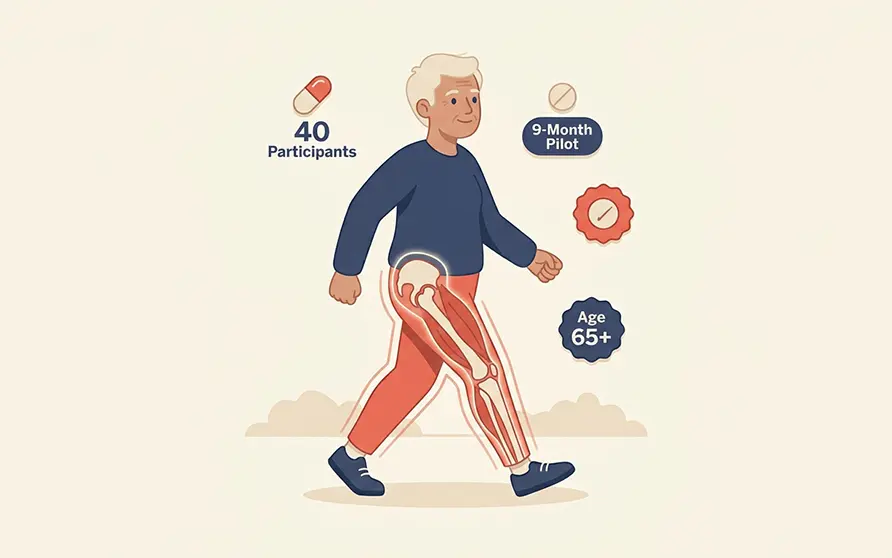
Roughly a quarter of the weight people lose on GLP-1 medications is lean muscle mass, not fat, according to a 2025 meta-analysis of 22 randomized trials.2 That concern is sharper in older adults, where muscle and bone loss already accelerate with age. A pilot trial at Wake Forest University Health Sciences, registered as GLOW, is now directly testing what happens to muscle, fat, bone, and walking ability when tirzepatide is combined with protein-focused counseling in adults over 65.
What is the GLOW trial actually testing?
The official title is "Effects of Tirzepatide on Fat-Free Mass, Bone and Physical Function in Older Adults - a Pilot Study," registered as NCT06861439 under the acronym GLOW.1 It is sponsored by Wake Forest University Health Sciences, led by principal investigator Denise Houston, PhD, and classified as a Phase 4 interventional study.1 The design is single-group assignment with no masking - every one of the 40 enrolled participants receives the same tirzepatide and counseling protocol for 9 months.1
What do participants actually receive?
Participants start on 2.5 mg of weekly subcutaneous tirzepatide (branded Zepbound), increasing to a 5 mg target dose after 4 weeks as tolerated, with a reduction back to 2.5 mg available for those who don't tolerate it.1 Alongside the drug, everyone receives individual and group counseling on diet quality and physical activity, clinic visits every 4 weeks, twice-monthly video group sessions, daily self-weighing on a smart scale, and daily step tracking.1
| Primary outcome | Measured with |
|---|---|
| Total & appendicular lean mass | DXA scan |
| Total body fat mass | DXA scan |
| Hip & lumbar spine bone density | DXA scan |
| 400-meter walk time | Timed walk test |
| Lower-extremity physical performance | Expanded Short Physical Performance Battery |
| Leg strength | Keiser AIR300 leg press |
Source: ClinicalTrials.gov record NCT06861439.1 Secondary outcomes add CT-measured thigh muscle and fat volume, D3-creatine dilution to estimate total skeletal muscle mass, high-resolution peripheral CT of the radius and tibia, and four bone-turnover blood markers (CTX, P1NP, BALP, osteocalcin), all from baseline to month 9.
Who can join, and who is excluded?
Eligible participants are community-dwelling adults aged 65 and older with independent transportation, a BMI of 30-37 kg/m², or 27-<30 kg/m² with a weight-related comorbidity, who are willing to take tirzepatide for the full 9 months.1 The exclusion list is long and specific: it screens out anyone with osteoporosis (a DXA t-score of -2.5 or lower), cognitive impairment, significant depressive symptoms, uncontrolled diabetes or hypertension, severe kidney or liver dysfunction, recent cardiac events, prior stomach or intestinal surgery, and anyone already using a GLP-1 agonist, insulin, or osteoporosis medication.1
That screening matters for reading any eventual results: a population this carefully filtered for reasonable baseline health is not representative of every older adult who might be prescribed tirzepatide in ordinary clinical practice.
"A single-arm pilot can tell you what changed over 9 months. It cannot by itself tell you why."
Why does the design matter here?
Unlike a randomized controlled trial, GLOW has no comparison group receiving counseling alone or a placebo instead of tirzepatide.1 With everyone receiving the same drug and the same counseling, any change measured in lean mass, bone density, or strength at month 9 could come from the tirzepatide, the protein-focused counseling, the added physical activity monitoring, or some combination of all three - the design cannot separate them.
That is a normal, accepted limitation for a 40-person pilot study: pilots are built to test feasibility and generate a workable estimate of effect size, not to prove causation. A positive signal here would justify a larger, controlled follow-up trial rather than stand as proof on its own.
What this does not mean - yet
NCT06861439 has produced no lean mass, bone density, or physical performance outcome data. It cannot be cited as evidence that tirzepatide preserves muscle or bone in older adults - that is the question the pilot exists to help answer, not a finding it has already delivered. The trial began July 7, 2025, is listed as active but not recruiting, and has an estimated primary completion date of September 30, 2026.1
In one sentence: a 40-person Wake Forest pilot is giving older adults with obesity weekly tirzepatide plus high-protein counseling for 9 months and measuring lean mass, bone density, and strength, but with no control group and no results yet, it can only describe what changed, not prove tirzepatide caused it.
Frequently asked
Does the GLOW tirzepatide trial have results yet?+
What is the GLOW trial actually testing in older adults?+
Is the GLOW trial a randomized, controlled trial?+
References
- Houston D, Wake Forest University Health Sciences. Effects of Tirzepatide on Fat-Free Mass, Bone and Physical Function in Older Adults - a Pilot Study (GLOW). ClinicalTrials.gov. Identifier: NCT06861439. Status: Active, not recruiting. Estimated primary completion: September 30, 2026.
Evidence current as of July 2, 2026. This article describes an ongoing, unpublished clinical trial and is educational only, not medical advice. It is not a report of trial results. Always consult your clinician before starting or changing any GLP-1 medication.
Translating new metabolic and obesity research into plain English for people living on GLP-1 therapy. Every claim is traced to its source.