How much muscle do you lose on GLP-1 drugs?
About one in four kilograms lost on GLP-1 medications is lean muscle, not fat. A 2025 network meta-analysis of 22 randomised trials and 2,258 patients puts the average lean loss at 0.86 kg per treatment course - roughly 24% of total weight lost. The amount varies significantly by drug and dose.
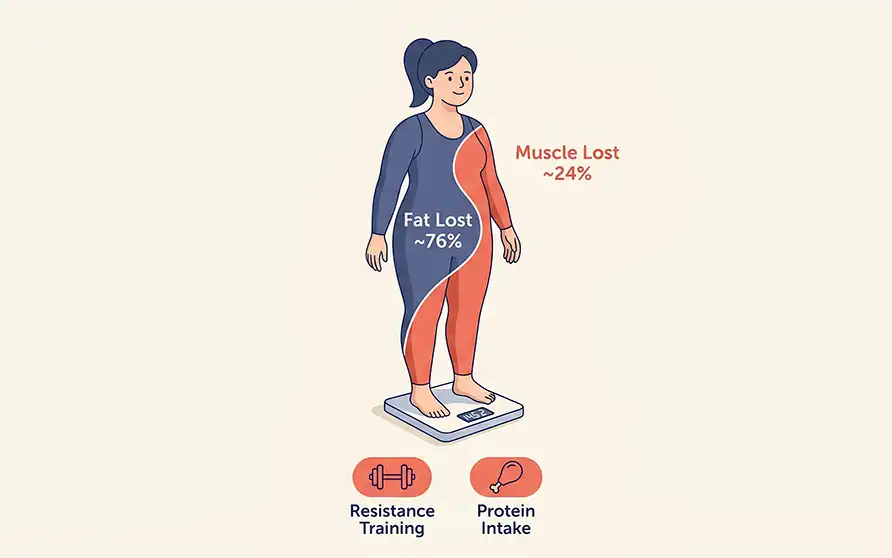
Losing weight on Ozempic, Wegovy, Mounjaro, or Zepbound is not purely fat loss. A portion of every kilogram that disappears from the scale is lean tissue - the muscle, bone, and water that your body is also shedding during rapid caloric restriction. A 2025 systematic review and network meta-analysis published in Metabolism, pooling 22 randomised controlled trials and 2,258 participants, has now put precise numbers on the lean mass cost of GLP-1 therapy.1
What does the meta-analysis actually show?
Researchers led by Karakasis et al. analysed body composition data from 22 RCTs of GLP-1 receptor agonists and dual agonists in adults with diabetes, overweight, or obesity.1 Across all drugs and doses, GLP-1 medications reduced total body weight by a mean of 3.55 kg, fat mass by 2.95 kg, and lean mass by 0.86 kg. That puts lean tissue at roughly 24% of total weight lost - approximately one kilogram of muscle for every four kilograms shed.
Relative lean mass - the percentage of your body that is muscle rather than fat - was not significantly changed. This is a partial reassurance: the body's composition ratio did not worsen even as absolute lean mass fell. But in absolute terms, the muscle loss is real and clinically relevant, particularly for older patients or those already at risk of sarcopenia.
Which drugs cause the most muscle loss?
Not all GLP-1 medications behave the same way. The network analysis found meaningful differences between agents in the class.
| Drug (dose) | Total weight loss | Lean mass impact |
|---|---|---|
| Tirzepatide 15 mg/wk | Highest in class | Substantial lean reduction |
| Semaglutide 2.4 mg/wk | High | Substantial lean reduction |
| GLP-1 class average | -3.55 kg | -0.86 kg lean mass |
| Liraglutide 3.0 mg/wk or 1.8 mg/day | Moderate | No significant lean loss |
Source: Karakasis et al., Metabolism, March 2025.1 Class averages are means across all included trials.
The pattern reflects a trade-off built into the class: the higher the weight loss, the more lean tissue is swept away alongside fat. Tirzepatide (the active ingredient in Mounjaro and Zepbound) and high-dose semaglutide (Wegovy) produce roughly 20% or more total body weight loss in dedicated obesity trials, which also means the largest absolute lean mass losses.2
Liraglutide (Saxenda) is the notable exception. At both the 3.0 mg weekly and 1.8 mg daily doses, liraglutide achieved weight reduction without a statistically significant loss of lean mass. The tradeoff is that liraglutide produces less total weight loss than the newer weekly agents.
"The more weight a GLP-1 drug removes, the more of that weight is muscle."
Why does this happen during GLP-1 weight loss?
GLP-1 medications suppress appetite powerfully, which drives a significant caloric deficit. Any time the body loses weight rapidly in a caloric deficit, lean tissue is mobilised alongside fat. The mechanism is not unique to GLP-1 drugs - it applies to any form of rapid weight loss - but the degree of appetite suppression these medications produce can make the deficit large enough that lean loss becomes clinically meaningful.
Physical activity adds another layer. ENDO 2026 data tracking 753 GLP-1 users via wearable devices found that daily steps fell from 5,047 to 4,487 after starting a GLP-1, and active minutes dropped from 28 to 22 per day.3 Less movement means less mechanical stimulus for muscle maintenance - exactly the wrong direction when lean mass is already under pressure from caloric restriction.
Who is most at risk from lean mass loss?
Lean mass loss is not equally distributed across patients. People who are older, already have lower muscle mass, or have conditions that impair muscle synthesis (such as type 2 diabetes) face the greatest functional consequences. For younger, otherwise healthy adults, a 0.86 kg lean loss is unlikely to cause noticeable strength changes. For a 65-year-old with borderline sarcopenia, it is a more serious consideration.
Clinicians are increasingly noting this concern in practice, particularly as more patients stay on GLP-1 therapy for years rather than months. A 2026 advisory from four major nutrition and obesity societies specifically recommends protein targets during GLP-1 treatment to address this risk.4
Can you prevent muscle loss on Ozempic or Wegovy?
You cannot eliminate lean loss entirely during active weight loss, but the evidence-based strategies significantly reduce it. The most important two are resistance training and protein intake.
Resistance training. Two to three sessions per week of strength or resistance exercise provide the mechanical signal that tells the body to preserve and rebuild muscle. This is the most effective single intervention for lean mass protection during caloric restriction.
Protein intake. The 2026 joint advisory from the ACLM, ASN, OMA, and The Obesity Society recommends approximately 1.2 g of protein per kg of body weight per day, distributed across meals.4 On a GLP-1 medication, when appetite is suppressed and total food volume drops, hitting this target requires deliberate planning rather than relying on appetite cues.
Micronutrient support also matters. A 2026 narrative review in Clinical Obesity found that 22.4% of GLP-1 users develop a measurable nutritional deficiency within 12 months, with vitamin D, iron, and B12 most commonly affected.5 Nutrient depletion can independently impair muscle function even when protein intake is adequate.
In one sentence: GLP-1 medications remove roughly 24% of lost weight as lean muscle, with the highest-dose drugs causing the greatest lean loss - but deliberate protein intake at 1.2 g/kg/day and regular resistance training significantly reduce that cost.
Frequently asked
How much muscle do you lose on GLP-1 drugs?+
Does tirzepatide cause more muscle loss than semaglutide?+
Can you prevent muscle loss on Ozempic or Wegovy?+
References
- Karakasis P, Patoulias D, Fragakis N, Mantzoros CS. Effect of glucagon-like peptide-1 receptor agonists and co-agonists on body composition: systematic review and network meta-analysis. Metabolism. Published online December 22, 2024; March 2025 issue. DOI: 10.1016/j.metabol.2024.156113. PMID: 39719170. Note: senior author CS Mantzoros disclosed consulting fees and research support from pharmaceutical companies and recused himself from paper handling.
- Kasagga A, Assefa AK, Amin MN, et al. Dose-dependent efficacy and safety of tirzepatide for weight loss in non-diabetic adults with obesity: a systematic review and meta-analysis. Cureus. June 7, 2025. DOI: 10.7759/cureus.85531. PMC12234836. Note: sponsored by Eli Lilly.
- Maharjan S et al. Exercise decreases among people taking GLP-1 medication. Retrospective pre-post cohort, NIH All of Us Research Program, 753 adults with obesity using Fitbit wearables. Presented at ENDO 2026 (Endocrine Society Annual Meeting), Chicago, June 14, 2026. EurekAlert / Endocrine Society press release. Note: conference abstract - not yet peer-reviewed or published.
- Mozaffarian D et al. Nutritional priorities to support GLP-1 therapy for obesity: a joint Advisory from the American College of Lifestyle Medicine, the American Society for Nutrition, the Obesity Medicine Association, and The Obesity Society. Obesity (Silver Spring). August 2025;33(8):1475-1503. DOI: 10.1002/oby.24336. PMID: 40445127.
- Urbina J, Salinas-Ruiz LE, Valenciano C, Clapp B. Micronutrient and nutritional deficiencies associated with GLP-1 receptor agonist therapy: a narrative review. Clinical Obesity. 2026;16(1):e70070. DOI: 10.1111/cob.70070. PMID: 41549912.
Evidence current as of June 23, 2026. This article is educational and not medical advice. Always consult your clinician before changing medication, diet or exercise.
Translating new metabolic and obesity research into plain English for people living on GLP-1 therapy. Every claim is traced to its source.