Is CagriSema better than Ozempic for type 2 diabetes?
Novo Nordisk's CagriSema is a once-weekly combination of the amylin drug cagrilintide and the GLP-1 drug semaglutide. In two 2026 Phase 3 diabetes trials, REIMAGINE 1 and 2, it lowered blood sugar in type 2 diabetes and, head-to-head, edged semaglutide 2.4 mg by 0.16 HbA1c points. Statistically superior, but a small margin.
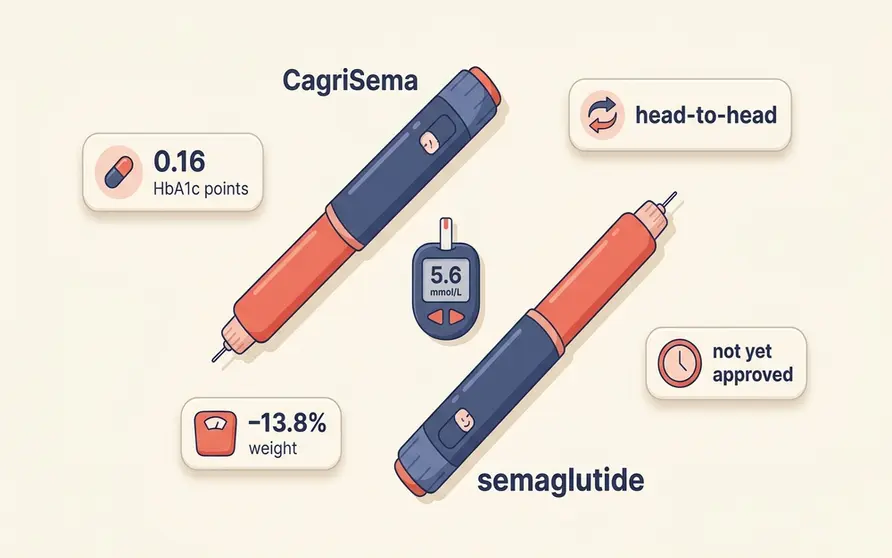
Every few months a new drug is announced as the one that finally beats Ozempic. Most of the time the claim is louder than the data. CagriSema is the latest, and in 2026 it did something the others had not: it went head-to-head against semaglutide in people with type 2 diabetes and won on blood sugar. The interesting part is how narrow that win actually was.
The short answer: in the REIMAGINE 2 trial, CagriSema lowered HbA1c slightly more than semaglutide, and the difference cleared the bar for statistical significance. But the gap was 0.16 of a percentage point, which is real on paper and hard to feel in a clinic. This article walks through what the two REIMAGINE trials measured, and what the numbers do and do not prove.
What is CagriSema?
CagriSema is a once-weekly injection that puts two medicines in one pen. The first is cagrilintide, a long-acting amylin receptor agonist. The second is semaglutide, the GLP-1 receptor agonist already sold as Ozempic for diabetes and Wegovy for weight loss. Amylin and GLP-1 are both hormones the body uses to signal fullness and steady blood sugar, but they act through different receptors, so pairing them is meant to add their effects together.1
Both drugs are made by Novo Nordisk, and so is the combination. CagriSema is still investigational, which means it is not yet approved by the FDA and is not something a person can be prescribed for type 2 diabetes today. Everything known about how well it works comes from clinical trials, and the two most important diabetes trials, REIMAGINE 1 and REIMAGINE 2, were published together in The Lancet Diabetes and Endocrinology in 2026.12
Is CagriSema better than Ozempic?
This is the question driving the headlines, and REIMAGINE 2 was built to answer a version of it. The trial enrolled 2,713 adults with type 2 diabetes that was inadequately controlled on metformin, with or without an SGLT2 inhibitor, and randomly assigned them to CagriSema, to semaglutide alone, to cagrilintide alone, or to placebo.2 The key comparison was CagriSema 2.4 mg against semaglutide 2.4 mg over 68 weeks.
CagriSema won that comparison. HbA1c, the three-month average blood-sugar marker, fell by 1.91 percentage points on CagriSema versus 1.75 points on semaglutide.2 The estimated treatment difference was 0.16 percentage points (95% confidence interval 0.27 to 0.05 points; p=0.0035), which is statistically significant. So the honest headline is that CagriSema was superior to semaglutide for blood-sugar control in this trial.
There is one detail that matters before anyone reads "CagriSema beats Ozempic" into that result. The comparator was semaglutide dosed at 2.4 mg, which is the higher dose used in Wegovy for weight management. Ozempic, the diabetes brand of semaglutide, has a maximum dose of 2 mg once weekly.3 So the trial tested CagriSema against a stronger dose of semaglutide than a person with diabetes would get from Ozempic, not a weaker one. That makes the win meaningful, but it is a win over semaglutide 2.4 mg specifically, not a direct comparison with a standard Ozempic prescription.
What did REIMAGINE 1 show?
REIMAGINE 1 asked a simpler question: how does CagriSema perform against placebo in people at an earlier stage of type 2 diabetes? It enrolled 189 adults whose diabetes was managed with diet and exercise alone, with no glucose-lowering drug on board, and ran for 40 weeks.1 This is the group where a new drug has the most room to show what it can do.
The blood-sugar result was large. HbA1c fell by 1.8 percentage points on CagriSema 2.4 mg and by 1.5 points on the lower 1.0 mg dose, against a fall of just 0.1 points on placebo.1 The estimated treatment difference for the 2.4 mg dose versus placebo was 1.7 percentage points (95% confidence interval 2.0 to 1.3; p<0.0001). Against a placebo, in other words, CagriSema produced a clear and decisive drop in blood sugar.
REIMAGINE 1 also measured body weight as a prespecified secondary endpoint, and here the number was eye-catching: a 13.8% reduction on CagriSema 2.4 mg versus 1.4% on placebo.1 That figure travels fast on social media, so it is worth being precise about what it is. It is a secondary outcome in a blood-sugar trial in people with type 2 diabetes, not the headline result of an obesity study. It shows the drug drives weight down alongside glucose, which is expected of this class, but it should not be read as CagriSema's official weight-loss efficacy.
How do the two trials compare?
The two trials tested different things against different comparators in different patients. Reading them side by side is the clearest way to see why one produced a big number and the other a small one, and why both can be true at once.
| REIMAGINE 1 | REIMAGINE 2 | |
|---|---|---|
| Compared against | Placebo | Semaglutide 2.4 mg (head-to-head) |
| Participants | 189 adults, early type 2 diabetes on diet and exercise only | 2,713 adults, type 2 diabetes on metformin with or without an SGLT2 inhibitor |
| Duration | 40 weeks | 68 weeks |
| HbA1c drop, CagriSema 2.4 mg | -1.8 points | -1.91 points |
| Comparator result | Placebo -0.1 points | Semaglutide 2.4 mg -1.75 points |
| Verdict | Superior to placebo (p<0.0001) | Superior to semaglutide by 0.16 points (p=0.0035) |
Both figures are from the REIMAGINE 1 and REIMAGINE 2 trials in The Lancet Diabetes and Endocrinology (2026). The two trials studied different populations and comparators and are not directly comparable to each other.12
How big is a 0.16-point difference?
Statistical significance and clinical significance are not the same thing, and REIMAGINE 2 is a clean example of the gap between them. With more than 1,200 people in the two key arms, the trial had enough statistical power to detect a very small true difference, and a 0.16-percentage-point edge was enough to reach p=0.0035.2 That means the difference is very unlikely to be a fluke.
Whether a person or their doctor would notice that difference is another matter. Diabetes guidelines generally treat an HbA1c change of around 0.3 to 0.5 percentage points as the threshold for a clinically meaningful shift, and 0.16 sits below that. So the fair reading of REIMAGINE 2 is that CagriSema beat semaglutide 2.4 mg on blood sugar, but by a margin that is statistically solid and clinically modest.2 "Better" is accurate. "Dramatically better" is not.
CagriSema won the head-to-head. The margin was 0.16 of a percentage point: real enough to publish, small enough to feel like a tie in the clinic. Reading REIMAGINE 2 honestly
Is the weight loss the whole story?
It is easy to conflate CagriSema's diabetes results with its weight-loss reputation, because the drug is being developed for both. Keeping the two apart is important. REIMAGINE 1 and REIMAGINE 2 are type 2 diabetes trials, and their primary endpoint in each case was HbA1c, not body weight.12 The 13.8% weight figure comes from REIMAGINE 1 as a secondary measure in people with diabetes.
CagriSema's obesity program runs under a different name, REDEFINE, in people with overweight or obesity rather than diabetes, and its results are reported separately. So when a headline pairs CagriSema with a weight-loss percentage, it is worth checking which trial and which population the number came from. A secondary weight result in a diabetes trial and a primary weight result in an obesity trial are not interchangeable, even when the drug is the same.
What were the side effects?
The safety pattern was the familiar one for this drug class: mostly gastrointestinal, mostly mild to moderate. In REIMAGINE 1, adverse events were reported by 79% of the CagriSema 2.4 mg group, 75% of the lower-dose group and 66% of the placebo group.1 In REIMAGINE 2, 86.9% of the CagriSema 2.4 mg group reported an adverse event versus 81.2% of the semaglutide 2.4 mg group, with gastrointestinal complaints the most common in the active arms.2
Adding cagrilintide to semaglutide did raise the rate of side effects modestly compared with semaglutide alone, which is the trade-off for the extra blood-sugar effect. The trial investigators concluded that CagriSema's safety profile was consistent with the GLP-1 receptor agonist class and with what was already known about cagrilintide.2 None of this is a substitute for a conversation with a clinician once the drug is available, and these figures come from controlled trials rather than everyday use.
Who funded these trials?
Both REIMAGINE trials were funded by Novo Nordisk, and this is a disclosure that deserves emphasis rather than a footnote.12 Novo Nordisk makes CagriSema, it makes semaglutide, and it makes cagrilintide. In REIMAGINE 2 that means the company designed and paid for a trial in which its combination product was tested against one of its own single ingredients.
That does not make the result invalid. These were large, randomised, double-blind trials published in a leading journal, and REIMAGINE 2 later carried a published correction, the normal process of scientific record-keeping.2 Several authors are Novo Nordisk employees or shareholders, and the independent authors report extensive industry ties. The point is not suspicion but context: an industry-funded head-to-head between two of the sponsor's own products is exactly the kind of study where an independent replication would strengthen confidence. For the trial-design questions raised by these industry-sponsored comparisons, our piece on how Mounjaro was tested against another company drug covers the same theme from the cardiovascular side.
In one sentence: in its 2026 REIMAGINE diabetes trials CagriSema clearly beat placebo and edged semaglutide 2.4 mg on blood sugar, but the head-to-head margin was 0.16 of a percentage point, statistically superior and clinically modest, in an investigational drug that is not yet approved and was tested in trials its own maker funded.
Frequently asked
Is CagriSema better than Ozempic for type 2 diabetes?+
What is CagriSema made of?+
Is CagriSema approved by the FDA?+
How much weight did people lose on CagriSema?+
References
- Aroda VR, Buzzetti R, Dalskov SM, et al. Efficacy and safety of once-weekly cagrilintide-semaglutide (CagriSema) in adults with type 2 diabetes inadequately controlled on diet and exercise (REIMAGINE 1): a randomised, double-blind, placebo-controlled, phase 3a study. Lancet Diabetes Endocrinol. 2026 Aug;14(8):649-661. PubMed. doi:10.1016/S2213-8587(26)00126-9. PMID: 42251860. NCT06323174. 189 adults with early type 2 diabetes; HbA1c fell 1.8 percentage points on CagriSema 2.4 mg versus 0.1 on placebo (estimated treatment difference -1.7 points, 95% CI -2.0 to -1.3, p<0.0001); body weight fell 13.8% versus 1.4% on placebo as a prespecified secondary endpoint. Funded by Novo Nordisk; several authors are Novo Nordisk employees or shareholders and independent authors report industry ties.
- Buse JB, Bajaj HS, Dalskov SM, et al. Cagrilintide-semaglutide (CagriSema) versus semaglutide or cagrilintide in people with type 2 diabetes (REIMAGINE 2): a double-blind, randomised, controlled, phase 3 study. Lancet Diabetes Endocrinol. 2026 Aug;14(8):662-677. PubMed. doi:10.1016/S2213-8587(26)00125-7. PMID: 42251859. NCT06065540. Erratum in Lancet Diabetes Endocrinol. 2026 Aug;14(8):e11. 2,713 adults with type 2 diabetes on metformin with or without an SGLT2 inhibitor; primary endpoint HbA1c fell 1.91 percentage points on CagriSema 2.4 mg versus 1.75 on semaglutide 2.4 mg (estimated treatment difference -0.16 points, 95% CI -0.27 to -0.05, p=0.0035). Funded by Novo Nordisk, which makes CagriSema, semaglutide and cagrilintide.
- Novo Nordisk. OZEMPIC (semaglutide) injection, for subcutaneous use: US prescribing information. DailyMed, US National Library of Medicine, accessed September 2026. The maximum Ozempic dose for glycemic control in type 2 diabetes is 2 mg once weekly; the 2.4 mg dose of semaglutide used as the comparator in REIMAGINE 2 corresponds to the higher weight-management dose (marketed as Wegovy), not the Ozempic diabetes maximum.
Evidence current as of September 3, 2026. This article is educational only and is not medical advice. CagriSema (cagrilintide-semaglutide) is an investigational combination and is not approved by the FDA. "Statistically superior" means a trial detected a difference unlikely to be due to chance; it does not mean the difference is large or clinically decisive. The REIMAGINE 1 and 2 trials studied type 2 diabetes and their primary endpoint was HbA1c; the weight-loss figures are secondary. Both trials were funded by Novo Nordisk, which manufactures all three drugs studied. Individual results vary. Do not start, stop, or change a prescribed medicine because of anything you read here.
Translating new metabolic and obesity research into plain English for people living on GLP-1 therapy. Every claim is traced to its source.