Is Ozempic safe if you get pregnant on it?
If you conceived while taking Ozempic or Mounjaro, the largest studies to date are reassuring. A 2026 meta-analysis of 2.1 million pregnancies found no clearly detectable rise in birth defects, miscarriage, or preterm birth from exposure around conception. That is reassuring about an accident, not a reason to keep taking the drug while pregnant.
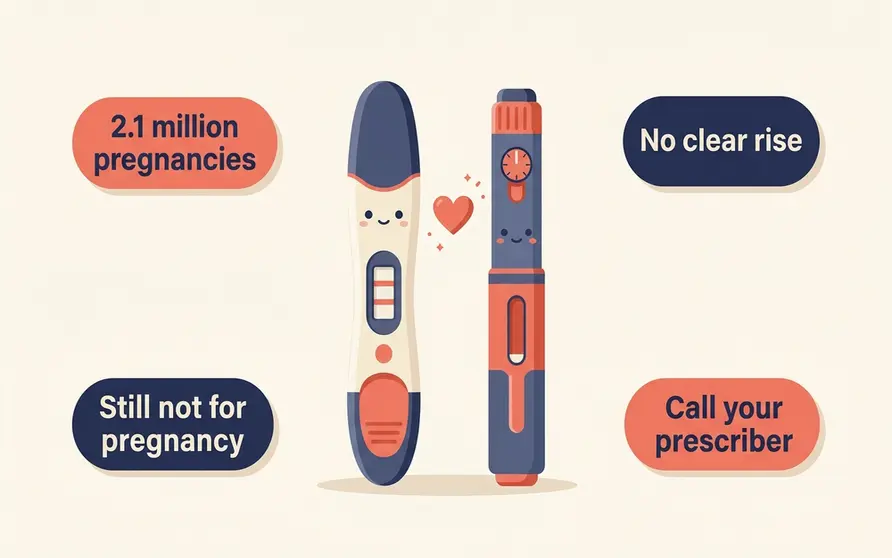
Reproductive-age women are the single largest group taking GLP-1 drugs, and many conceive before they realise they should stop. The fear that follows is specific and sharp: did the drug harm the baby during those first weeks. For most of the last two years the honest answer was that the data were too thin to say. In 2026 that changed.
This article is about accidental exposure around conception, which doctors call the periconceptional period. It is not a guide to using these drugs during pregnancy, because none of them is approved or recommended for that. The aim here is to tell the anxious reader what the biggest studies actually found, and what those studies still cannot prove.
What do the biggest studies show?
The largest analysis is a systematic review and meta-analysis published in Med in September 2026, led by D'Antonio and Khalil. It pooled 10 studies and 2,118,215 women, of whom 8,325 were exposed to a GLP-1 drug within 6 months before a positive pregnancy test.1
Across that population, exposure around conception showed no clearly detectable increase in miscarriage or intrauterine death, congenital anomalies, preterm birth, hypertensive disorders of pregnancy, gestational diabetes, abnormal fetal growth, or excess weight gain in pregnancy.1 The review even reported a lower pooled estimate for preeclampsia, an odds ratio of 0.87 (95% CI 0.78 to 0.98), though the authors stress this rested on only two datasets and should be read cautiously.1
Does a second study agree?
It does. An independent 2026 meta-analysis in Endocrine Connections pooled 6 studies and 286,599 women, of whom 43,577 were exposed around conception.2 It found no significant increase in major congenital malformations, with a relative risk of 1.02 (95% CI 0.96 to 1.08).2
The same review found no significant rise in preterm birth (RR 1.09), small-for-gestational-age babies (RR 0.71), large-for-gestational-age babies (RR 2.31), or stillbirth (RR 1.16).2 The confidence intervals on the rarer outcomes were wide, which the authors flag: an imprecise estimate cannot rule an effect in or out, and they say plainly the findings are not proof of safety.2
Why isn't this proof of safety?
Because every one of these studies is observational, not a randomised trial. Researchers compared women who happened to be exposed with women who were not; nobody was assigned to take a GLP-1 drug in pregnancy, which would be unethical. That design shows association and the absence of a clear signal, not cause and effect.1
There is also a difference between "no detectable increase" and "no risk". A null result in observational data, especially for rare outcomes with wide confidence intervals, means no clear signal was found, not that the risk is zero.2 The honest summary comes from a 2026 narrative review in BJOG: the data have not identified a clear safety signal, but they are not enough to exclude clinically important risks.4
| Study (2026) | Size | What it found |
|---|---|---|
| Med meta-analysis | 2,118,215 pregnancies | No clear rise in major risks |
| Endocrine Connections meta-analysis | 286,599 women | No rise in birth defects (RR 1.02) |
| Danish nationwide cohort | 756,636 pregnancies | More preterm birth only with diabetes use |
| BJOG narrative review | Review of the evidence | No clear signal, data still limited |
Sources: Med meta-analysis1, Endocrine Connections meta-analysis2, Danish nationwide cohort3 and BJOG narrative review4, all 2026.
"Women with inadvertent exposure should receive counselling based on the evidence, rather than assuming exposure is either proven harmful or proven safe."
What about the preterm birth signal?
This is the honest counterweight, and it matters. A Danish nationwide cohort in Human Reproduction Open studied 756,636 pregnancies, including 529 with GLP-1 exposure around conception.3 After careful matching, it found a higher risk of preterm birth, but only in one group.
The raised risk appeared in women using these drugs to treat diabetes (liraglutide adjusted odds ratio 1.70, semaglutide 1.84). In women using them for weight management, with no pre-existing diabetes, there was no such association.3 The authors conclude that the underlying diabetes, not the medication, is the more likely cause. That is a clean example of how a mother's health, rather than the drug, can drive a result.
Should you stop before conceiving?
Reassurance about an accident is not permission for planned use, and the two questions should not be blurred. If you are trying to conceive on purpose, the standard guidance is still to stop the drug first. The US labels for Ozempic and Wegovy instruct patients to stop semaglutide at least 2 months before a planned pregnancy, because the drug has a long half-life.4
The timing is a decision to make with your prescriber, because stopping a drug that controls blood sugar or weight has consequences of its own. Our companion guide on GLP-1 drugs, fertility and birth control covers the planning side in detail, including the tirzepatide contraception warning. This article is for the different, more anxious moment: the positive test you did not plan.
If that is you, the practical step is simple. A positive pregnancy test while on a GLP-1 drug is a reason to call your prescriber and your maternity team, not a reason to panic, and not a reason to make any change on your own.4
In one sentence: the largest 2026 studies, including one of 2.1 million pregnancies, found no clearly detectable rise in major risks from conceiving while on a GLP-1 drug, which is genuinely reassuring for an accidental exposure, but the evidence is observational, a diabetes-linked preterm signal remains, and none of it makes these drugs safe to use during pregnancy.
Frequently asked
Is it safe if I get pregnant while taking Ozempic or Mounjaro?+
Does Ozempic cause birth defects if I conceived on it?+
Should I stop Ozempic or Mounjaro before trying to get pregnant?+
References
- D'Antonio F, Flacco ME, Manzoli L, Samara A, Khalil A. GLP-1 receptor agonist exposure in the periconceptional period and adverse obstetric outcomes: a systematic review and meta-analysis. Med (Cell Press). 2026 (online ahead of print). DOI: 10.1016/j.medj.2026.101267. PMID: 42810337. Funding: none; the authors declare no competing interests.
- Liu X, Xiong B, Yang R, Wang H, Liu Y. Periconceptional use of GLP-1 receptor agonists and the risk of major congenital malformations: a systematic review and meta-analysis. Endocrine Connections. 2026;15(7):e260280. DOI: 10.1530/EC-26-0280. PMID: 42447044. The authors declare no conflict of interest.
- Hviid KVR, Banasik K, Mortensen LH, Madsbad S, Strandberg-Larsen K, Geiker NRW, Westergaard D, Nielsen HS. Periconceptional GLP-1 receptor agonist exposure and obstetric outcomes: a Danish nationwide cohort study. Human Reproduction Open. 2026;2026(2):hoag015. DOI: 10.1093/hropen/hoag015. PMID: 41852577. Author disclosures are not stated in the abstract record.
- Lau KGY, Chopra A, Mullins E, Agha-Jaffar R, Tan T, Sykes L, Yu CKH. Glucagon-like peptide-1 receptor agonists in pregnancy: periconception exposure and perinatal outcomes. BJOG. 2026 (online ahead of print). DOI: 10.1111/1471-0528.70339. PMID: 42830218. Narrative review. Author disclosures are not stated in the abstract record.
Evidence current as of October 9, 2026. This article is educational and not medical advice. GLP-1 drugs are not approved or recommended for use in pregnancy. If you are pregnant, think you might be, or are planning a pregnancy while taking one of these drugs, speak to your prescriber and maternity team; never start, stop, or change a prescribed medicine on your own.
Translating new metabolic and obesity research into plain English for people living on GLP-1 therapy. Every claim is traced to its source.