Is Ozempic safe if you have asthma or COPD?
For most people, GLP-1 drugs like Ozempic do not appear to harm the lungs. A 2026 review of 123 studies found no rise in respiratory side effects versus placebo, and large 2026 cohorts even link these drugs to fewer flare-ups in people who also have asthma or COPD. Those benefit signals are associations, not proof.
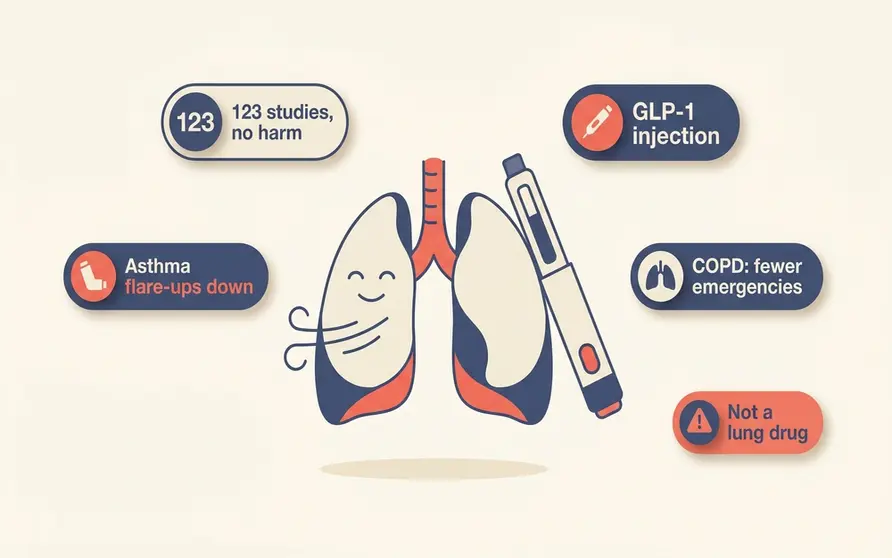
Millions of people who take Ozempic also live with asthma or chronic obstructive pulmonary disease (COPD), because excess weight and airway disease often travel together. A fair question follows: does a drug that changes appetite and digestion do anything to your breathing?
The 2026 evidence gives an unusually clear two-part answer. GLP-1 drugs do not appear to harm the lungs, and in people who already have asthma or COPD they are linked to fewer serious flare-ups. This article walks through the safety data first, then the benefit signals, and it is careful throughout about what that evidence can and cannot prove.
Is Ozempic safe for the lungs?
The strongest evidence here is a safety study. A 2026 systematic review and meta-analysis in the Annals of the American Thoracic Society screened 9,086 records and pooled 123 studies of weight-loss drugs and their respiratory side effects.1
The review found that liraglutide, semaglutide and tirzepatide were not associated with more respiratory adverse events than placebo, and the randomized trials it drew on had a low risk of bias.1 That is the reassuring headline: across a large body of trials, these drugs did not appear to make breathing worse.
Respiratory infections still occur on the drugs. Nasopharyngitis, the medical name for the common cold, was frequent, ranging from about 4.1% to over 23.7% depending on the drug and how long people were followed.1 But the review found these infections were not clearly tied to the drug, the dose or the reason it was prescribed.1 In plain terms, colds happen on these drugs about as often as they happen anyway.
One honest limit sits inside the same review. Evidence focused specifically on people who already have asthma was sparse.1 So the reassurance is strongest for the general population's breathing, and thinner for asthma patients considered as a distinct group.
Can Ozempic help COPD?
Beyond safety, some 2026 data hint at benefit. A retrospective cohort study in QJM used the TriNetX global health network to compare adults aged 40 and older who had both COPD and type 2 diabetes and newly started a GLP-1 drug against similar patients who started other diabetes medicines.2
Over one year, GLP-1 users had a lower risk of acute respiratory failure than users of DPP-4 inhibitors (hazard ratio 0.77), sulfonylureas (0.80) and metformin (0.91).2 They also had lower rates of death, hospitalization, COPD flare-ups and pneumonia across all three comparisons.2
The pattern held across sex, age, flare-up history and inhaler regimen.2 But this is an observational study, so it can show that GLP-1 users did better, not that the drug caused it. People who are prescribed these drugs may differ in ways that also affect their lungs, which is a limit no matching can fully remove.
| 2026 study | Who it studied | Main finding |
|---|---|---|
| Safety review (123 studies) | General population | No rise in respiratory side effects vs placebo |
| COPD cohort (TriNetX) | COPD + type 2 diabetes | Lower acute respiratory failure risk (HR 0.77 to 0.91) |
| Asthma cohort (100,746 people) | Asthma + type 2 diabetes | Fewer flare-ups at 6 months (HR 0.88); not significant at 1 year |
The three main 2026 sources behind this article. The safety review is a systematic review and meta-analysis; the COPD and asthma studies are retrospective cohorts that compared GLP-1 drugs with other diabetes medicines, so their findings are associations, not proof of cause and effect.123
The drugs do not appear to harm the lungs, and in people who already have asthma or COPD they are linked to fewer serious flare-ups. But linked is not the same as proven. The 2026 respiratory evidence, in one line
Can Ozempic help asthma?
The asthma picture is similar, and it comes with a useful caution built in. A multinational cohort study in Pharmacotherapy looked at 100,746 people who had both asthma and type 2 diabetes, comparing those who started a GLP-1 drug with those who started an SGLT-2 inhibitor, another common diabetes medicine.3
Over about 6 months, GLP-1 users had fewer asthma flare-ups (hazard ratio 0.88), fewer episodes of asthma symptoms (0.89) and less need for systemic steroids (0.79).3 On the surface, that is a clear win for the airways.
The caution is in the same paper. When the researchers extended follow-up to a full year, the flare-up benefit was no longer statistically significant (hazard ratio 0.95).3 A signal that shows up at 6 months but fades by 12 is a reason to be measured rather than triumphant, and the authors themselves call for randomized trials to test it properly.3
A much smaller study from Hong Kong pointed the same way, finding a significantly lower risk of hospital-treated asthma flare-ups on GLP-1 drugs, roughly half the risk seen with a comparison diabetes drug.4 But only 102 of its patients were taking a GLP-1 drug, so it supports the larger findings rather than standing on its own.4
Why might GLP-1 drugs help breathing?
Researchers offer two plausible reasons, and neither is settled. The first is weight loss. Excess weight worsens both asthma and COPD, and shedding weight is known to improve asthma control, so a drug that drives weight loss could help breathing indirectly.13
The second is inflammation. GLP-1 receptor agonists have anti-inflammatory effects, and asthma and COPD are both inflammatory diseases of the airways, so the drugs might act on the lungs more directly.2 The study authors raise this as a hypothesis, not an established mechanism.
Both ideas are reasonable, and both are still being tested. The cohort studies were not built to prove why the numbers moved, only to measure that they did, which is exactly why the results are described as associations.
What this means if you have asthma or COPD
The bottom line is reassuring but bounded. GLP-1 drugs do not appear to harm breathing, and if anything they are linked to fewer serious respiratory events in people who also have diabetes.123
What the evidence does not do is turn these drugs into asthma or COPD treatments. GLP-1 drugs are approved for type 2 diabetes, weight management and cardiovascular risk, and one drug is approved for sleep apnea, but none is approved to treat asthma or COPD.5 The benefit signals come entirely from retrospective studies in people with diabetes, where confounding is hard to rule out.
The practical rule is simple: keep taking your prescribed inhalers and controller medicines exactly as directed, and never start, stop or swap a respiratory medicine because of anything about a GLP-1 drug. If you have asthma or COPD and are considering or already taking Ozempic, tell the doctor who manages your breathing, so both conditions are handled together.
One scope note. This article is about asthma and COPD, the chronic diseases of the airways. That is a separate question from sleep apnea, where a different GLP-1 medicine already has its own approval and its own evidence, and it should not be lumped in with the airway findings here.
In one sentence: The 2026 evidence says GLP-1 drugs like Ozempic do not appear to harm breathing and are linked to fewer asthma and COPD flare-ups in people who also have diabetes, but those benefits are unproven associations, the drugs are not approved for either lung condition, and you should never change your inhaler on your own.
Frequently asked
Is it safe to take Ozempic if I have asthma?+
Can Ozempic help COPD?+
Does Ozempic cause breathing problems or shortness of breath?+
Are GLP-1 drugs approved to treat asthma or COPD?+
References
- Zeng L, Zinmon-Htet C, Hundie T, et al. Respiratory adverse events of weight-loss drugs: a systematic review and meta-analysis. Ann Am Thorac Soc. 2026. Europe PMC. doi:10.1093/annalsats/aaoag177. PMID: 42479131. A meta-analysis of 123 studies; liraglutide, semaglutide and tirzepatide were not associated with increased respiratory adverse events versus placebo, and evidence specifically in people with asthma was limited.
- Liao KM, Tsai YW, Kostikas K, Criner GJ, Wu JY, Lai CC. Associations between glucagon-like peptide-1 receptor agonists and respiratory outcomes in chronic obstructive pulmonary disease and diabetes. QJM. 2026. Europe PMC. doi:10.1093/qjmed/hcag217. PMID: 42606949. Retrospective TriNetX cohort of adults with COPD and type 2 diabetes; GLP-1 use was associated with lower acute respiratory failure risk versus DPP-4 inhibitors (HR 0.77), sulfonylureas (0.80) and metformin (0.91). Observational, not causal.
- Hung CT, An CY, Tsai YC, Suk CW, Wu CH. Antihyperglycemic drugs and risk of asthma exacerbation in patients with asthma and type 2 diabetes: a multinational retrospective cohort study. Pharmacotherapy. 2026. Europe PMC. doi:10.1002/phar.70194. PMID: 42618217. Cohort of 100,746 patients; GLP-1 versus SGLT-2 inhibitor use was associated with fewer asthma exacerbations at 6 months (HR 0.88), but the association was not significant at 1 year (HR 0.95). The authors declare no conflicts of interest.
- Kwok WC, Zhou L, Ma TF, Leung RYH, Tam TCC, Ho JCM. Glucagon-like peptide-1 receptor agonists vs dipeptidyl peptidase-4 inhibitor use on risk of asthma exacerbation among diabetic patients with co-morbid asthma in Hong Kong. J Asthma Allergy. 2026. Europe PMC. doi:10.2147/JAA.S622748. PMID: 42516533. Territory-wide cohort of 3,295 patients with asthma and diabetes, of whom only 102 took a GLP-1 drug; GLP-1 use was associated with a lower risk of hospitalized asthma exacerbation. The author reports no conflicts of interest.
- Novo Nordisk. OZEMPIC (semaglutide) injection, for subcutaneous use: US prescribing information. DailyMed, US National Library of Medicine, accessed August 2026. Lists the approved indications as type 2 diabetes glycemic control, cardiovascular risk reduction, and reducing kidney-disease progression in type 2 diabetes; asthma and COPD are not approved indications.
Evidence current as of August 28, 2026. This article is educational only and is not medical advice. Semaglutide and tirzepatide are prescription-only and should be used under medical supervision. GLP-1 drugs are not approved to treat asthma or COPD, and the benefit findings described here come from retrospective, observational studies in people who also had type 2 diabetes, so they show association rather than cause and effect, and individual results vary. Do not start, stop, or change any prescribed medicine, including an inhaler, because of anything you read here, and seek prompt care for severe breathing difficulty.
Translating new metabolic and obesity research into plain English for people living on GLP-1 therapy. Every claim is traced to its source.