Is Ozempic safe if you have epilepsy?
The current evidence is reassuring but early. In a 2026 study of 610 adults with epilepsy, starting a GLP-1 drug like Ozempic was not linked to worse seizure control, and it still drove weight loss. No GLP-1 is approved for epilepsy, though, so this is a conversation for your neurologist, not a decision to make alone.
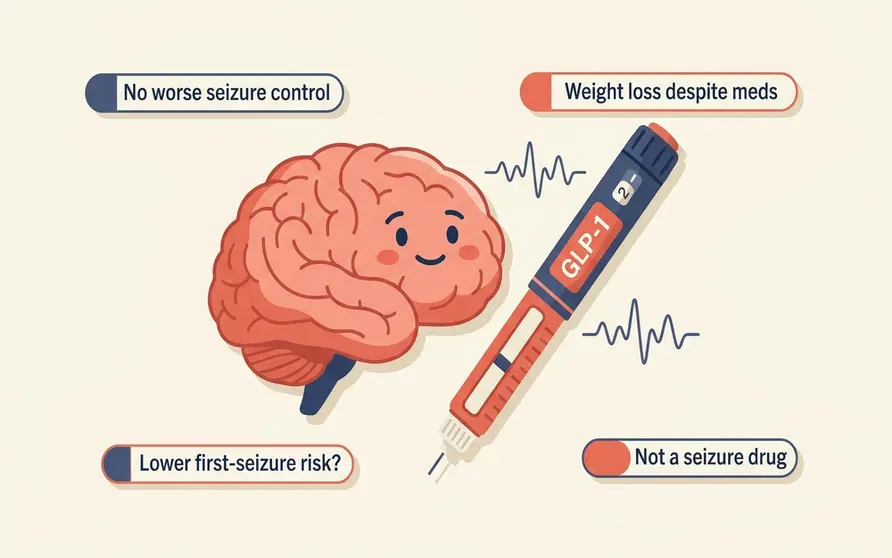
If you take a GLP-1 drug such as Ozempic, Wegovy or Mounjaro and you live with epilepsy, the natural worry is whether the medicine could trigger a seizure or make your condition harder to control. The short answer from the latest evidence is reassuring: starting a GLP-1 drug has not been linked to worse seizures, and one study even points the other way. Epilepsy is a supervised condition, though, so this is a conversation to have with your neurologist rather than a decision to make alone.
This matters because epilepsy and weight problems often travel together. People with epilepsy have higher rates of obesity and type 2 diabetes, and several common seizure medicines, including valproate and pregabalin, are known to cause weight gain.2 That leaves many people looking for a safe way to manage weight, which is exactly why researchers are now studying GLP-1 drugs in this group.
Is Ozempic safe with epilepsy?
The most direct evidence comes from a 2026 study in the journal Annals of Clinical and Translational Neurology.2 Using the NIH All of Us research database, the researchers matched 610 adults who had epilepsy, obesity and type 2 diabetes, comparing those who started a GLP-1 drug with similar people who did not.
Starting a GLP-1 drug was not associated with worse seizure control, measured as either a seizure-related hospital admission or the need to add a new seizure medicine (hazard ratio 0.92, 95% CI 0.68-1.23).2 At the same time, GLP-1 users lost an average of 5.73% of their body weight and lowered their HbA1c by 0.71%.2 The weight loss held up even among people taking weight-gaining seizure medicines, with an adjusted difference of 4.15%.2
Could a GLP-1 lower seizure risk?
A different 2026 study asked the opposite question: not whether GLP-1 drugs are safe in people who already have epilepsy, but whether they might lower the chance of a first seizure in people who do not. Published in Neurology, this target trial emulation used the same All of Us database to compare adults with type 2 diabetes who started semaglutide against those who started other glucose-lowering drugs.1
Semaglutide was associated with a lower risk of a first adult-onset seizure, both compared with other diabetes drugs (hazard ratio 0.44, 95% CI 0.25-0.79) and compared with SGLT2 inhibitors (hazard ratio 0.48, 95% CI 0.27-0.85).1 The link appeared largely independent of blood-sugar and weight changes, which hints at a direct effect rather than a knock-on from losing weight.1 A 2026 scoping review adds context, reporting that across observational studies GLP-1 use has been associated with roughly 10% to 57% relative reductions in seizure-related outcomes, alongside consistent antiseizure signals in laboratory research.3
Why keep the two findings apart?
These two studies answer different questions in different people, and blurring them would overstate what is known. One asks whether a GLP-1 drug is safe for someone who already has epilepsy. The other asks whether it might prevent a first seizure in someone who does not. A prevention signal in people without epilepsy is not the same as a treatment for people who have it.
| The question | Who was studied | What the study found | Certainty |
|---|---|---|---|
| Does it worsen seizures if you already have epilepsy? | 610 adults with epilepsy, obesity and type 2 diabetes | No link to worse control: HR 0.92 (95% CI 0.68-1.23)2 | Low |
| Could it lower the risk of a first seizure? | Adults with type 2 diabetes and no epilepsy | Lower risk with semaglutide: HR 0.44 (95% CI 0.25-0.79)1 | Class II |
"GLP-1 RAs showed no evidence of seizure worsening and remained effective for weight loss even among patients receiving weight-gaining ASMs."2
How strong is this evidence?
It points in a hopeful direction, but it is early and observational. The prevention study in Neurology carries a Class II evidence rating, and its authors state plainly that residual confounding, low event counts and short follow-up limit any causal reading.1 In other words, it shows an association, not proof that semaglutide prevents seizures.
The safety study has its own limit worth naming. With the number of events it observed, it could only reliably detect a hazard ratio of about 1.53 or greater, so its finding of no worsening is reassuring but does not rule out a smaller risk.2 It is also worth being clear on approval: Ozempic's licensed uses are type 2 diabetes, cardiovascular risk reduction and kidney disease, and the label lists no seizure or epilepsy indication.5
Could it affect my seizure medicine?
This is the practical detail most worth raising with a doctor. GLP-1 drugs slow how fast the stomach empties, which can change the timing of when a seizure medicine is absorbed, even though the total amount absorbed appears largely unchanged in most cases.3 That is a reason for medical supervision, not a reason to adjust any dose yourself.
A second, more theoretical caution also exists. A 2026 letter in the journal Seizure raises whether the fluid and sodium shifts that can come with GLP-1 drugs might matter in epilepsy, since low sodium can lower the seizure threshold.4 This is a question researchers have flagged for supervision, not an established harm, and it is one more reason the decision belongs with your care team.
What should I do?
Do not start, stop or change a GLP-1 drug or a seizure medicine based on anything you read, including this article. If you have epilepsy and are considering a GLP-1 drug for weight or diabetes, raise it with your neurologist and prescriber, tell them every medicine you take, and let them weigh it for your specific case.2
In one sentence: the current evidence suggests GLP-1 drugs like Ozempic are safe for people with epilepsy, with no sign of worse seizures and possibly a lower risk of a first seizure, but every finding is observational, none of these drugs is approved for epilepsy, and the decision should be made with your neurologist.12
Frequently asked
Can Ozempic cause seizures?+
Could a GLP-1 drug lower my seizure risk?+
Is it safe with valproate or pregabalin?+
Should I start a GLP-1 drug for my epilepsy?+
References
- Eun Y, Bong S, Koh HY, Trousdale RK, Cho YM, Jang Y, Lee ST. Semaglutide and risk of adult-onset seizure: a target trial emulation. Neurology. 2026 Jul 14;107(1):e218174. DOI: 10.1212/WNL.0000000000218174. PMID: 42308439. PMCID: PMC13278381. Classified as Class II evidence; the authors note that residual confounding, low event counts and short follow-up limit causal interpretation.
- Son H, Hwang I, Lee SW, Kim Y. Safety and efficacy of GLP-1 receptor agonists in adults with epilepsy, obesity, and type 2 diabetes. Ann Clin Transl Neurol. 2026 Aug 6. DOI: 10.1002/acn3.70505. PMID: 42563258. PMCID: PMC13447792. The authors declare no conflicts of interest, and note the study could detect a hazard ratio of 1.53 or greater given the events observed.
- Pinto LF, Guerreiro CAM. GLP-1 receptor agonists in people with epilepsy: a scoping review of clinical data, safety, and therapeutic implications. Seizure. 2026 Aug;140:1-9. DOI: 10.1016/j.seizure.2026.05.013. PMID: 42202441. Disclosure: both authors report advisory-board and continuing-education speaker relationships with multiple pharmaceutical companies, including UCB, Torrent, Abbott and Novartis.
- Cotrik E, da Silva AG. Sodium homeostatic reserve in people with epilepsy receiving glucagon-like peptide-1 receptor agonists. Seizure. 2026 Aug 25. DOI: 10.1016/j.seizure.2026.08.022. PMID: 42722577. A letter raising a theoretical sodium-balance caution, not a measured harm.
- Ozempic (semaglutide) injection, prescribing information. Novo Nordisk, via the U.S. National Library of Medicine DailyMed. Indicated for glycemic control in type 2 diabetes, cardiovascular risk reduction in type 2 diabetes with established cardiovascular disease, and chronic kidney disease in type 2 diabetes. The label lists no seizure or epilepsy indication.
Evidence current as of September 17, 2026. The findings summarised here come from observational studies, which report average effects rather than a guarantee for any individual and cannot prove cause and effect. No GLP-1 drug is approved to prevent or treat seizures or epilepsy. This content is educational only, not medical advice. Do not start, stop or change a GLP-1 drug or any seizure medicine based on this article. Epilepsy is a condition that needs specialist care, so anyone with epilepsy who is considering a GLP-1 drug should discuss it with their neurologist and prescriber first.
Translating new metabolic and obesity research into plain English for people living on GLP-1 therapy. Every claim is traced to its source.