Semaglutide vs tirzepatide: which protects the heart more?
A 2026 real-world cohort study of 21,250 patients without diabetes found semaglutide cut major cardiovascular events by 29% compared with tirzepatide, even though tirzepatide produces more weight loss. The study was sponsored by Novo Nordisk, semaglutide's manufacturer, and is observational rather than a randomized trial.
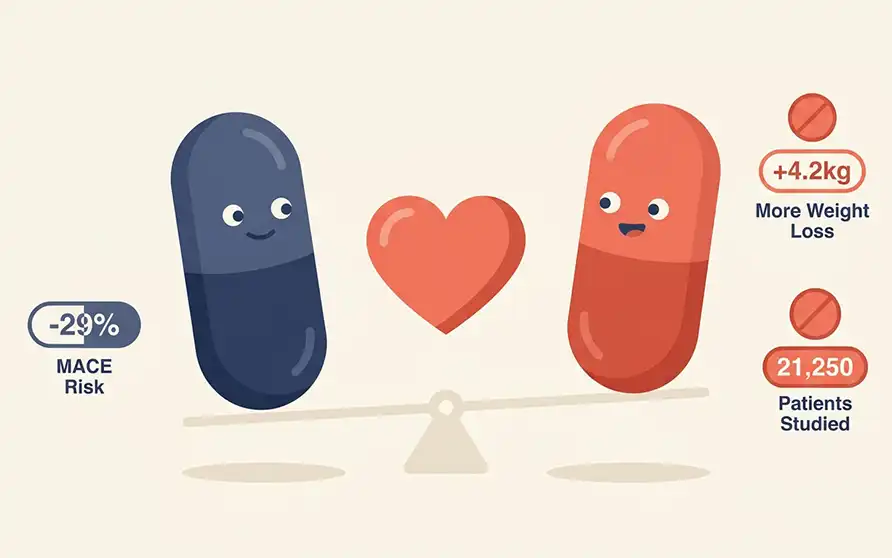
People choosing between Ozempic/Wegovy (semaglutide) and Mounjaro/Zepbound (tirzepatide) usually focus on weight loss, where tirzepatide has a consistent edge.2 A new real-world study, published in Diabetes, Obesity and Metabolism in March 2026, asks a different question: which drug better protects the heart in patients who already have cardiovascular disease.1 The answer, in this dataset, points the other way - toward semaglutide.
What did the STEER study actually measure?
The study, named STEER, used US insurance claims data from the Komodo Research Data Network, covering prescriptions written between May 13, 2022 and January 31, 2025.1 Researchers identified adults aged 45 and older with overweight or obesity and established atherosclerotic cardiovascular disease - meaning a prior heart attack, ischemic stroke, or peripheral artery disease - who did not have diabetes.
Using propensity score matching to balance the two groups on baseline characteristics, the team built two cohorts of 10,625 patients each: one prescribed semaglutide, one prescribed tirzepatide, for a combined 21,250 patients.1 They then compared rates of two composite cardiovascular outcomes between the groups.
What were the cardiovascular findings?
Patients on semaglutide had significantly fewer cardiovascular events than matched patients on tirzepatide, across both outcome definitions the study tracked.
| Outcome | Hazard ratio | p-value | Relative risk reduction |
|---|---|---|---|
| 3-point MACE | 0.71 | 0.046 | 29% |
| 5-point MACE | 0.78 | 0.040 | 22% |
Source: Wilson L et al., Diabetes, Obesity and Metabolism, March 2026.1 Semaglutide vs tirzepatide, 10,625 propensity-matched patients per cohort. Values below 1.0 favor semaglutide.
3-point MACE is the standard composite of cardiovascular death, non-fatal heart attack, and non-fatal stroke. 5-point MACE adds two broader endpoints, typically hospitalization for unstable angina and coronary revascularization.1 Both results favored semaglutide and both crossed the conventional p<0.05 threshold for statistical significance, though the 3-point MACE result (p=0.046) sits close to that line.
"Semaglutide won on heart events here. Tirzepatide still wins on the scale. The drug that's right for you depends on which number you're optimizing for."
Why funding matters for this result
Every author listed on the STEER paper is an employee or shareholder of Novo Nordisk, the manufacturer of semaglutide - the drug the study found to be superior.1 That does not automatically invalidate the result, but it is a material conflict of interest that should sit alongside the numbers, not below them. Industry-funded comparative studies, especially observational ones built on the sponsor's own analytic choices, tend to favor the sponsor's product more often than independently funded research does.
The companion finding on weight loss is the mirror image: the largest comparative meta-analyses showing tirzepatide's weight-loss advantage are not all sponsor-neutral either, and one real-world weight-loss dataset favoring tirzepatide was funded by Eli Lilly, tirzepatide's manufacturer.2 Both companies have a financial interest in how their drug compares to the other's.
Why is this an observational study, not a trial?
STEER is a retrospective cohort study: researchers looked backward at insurance claims for patients who were already being prescribed one drug or the other, rather than randomly assigning patients to a drug as a randomized controlled trial would.1 Propensity score matching narrows the gap between the two groups on measured characteristics like age and prior diagnoses, but it cannot account for unmeasured differences - for example, why a clinician chose semaglutide for one patient and tirzepatide for another.
This matters because patients prescribed one drug over another are not randomly distributed in the real world. A doctor's reason for choosing semaglutide for a specific cardiovascular patient could itself correlate with that patient's underlying risk, independent of which drug they end up taking. No head-to-head randomized trial comparing semaglutide and tirzepatide on hard cardiovascular endpoints has yet reported results.
How does this fit with the weight-loss picture?
Two independent 2025 meta-analyses covering more than 142,000 patients found tirzepatide produces roughly 4.2 kg more weight loss than semaglutide on average, with the gap widening at higher doses.2 Read together with STEER, the two drugs appear to diverge: more weight loss with tirzepatide, fewer observed cardiovascular events with semaglutide in this specific, non-diabetic, cardiovascular-disease population.
Neither comparison settles which drug is "better" in general. A patient prioritizing maximum weight loss and a patient prioritizing cardiovascular risk reduction, based on current evidence, are weighing different studies with different designs and different sponsors.
What this does not mean
This study does not show that tirzepatide is unsafe for the heart, nor that it causes more cardiovascular events than no treatment at all. It shows that, in this specific real-world comparison, patients on semaglutide had fewer recorded events than matched patients on tirzepatide. The population studied - non-diabetic patients aged 45+ with existing atherosclerotic disease - is also narrower than the general population using either drug for weight management, so the result may not generalize to younger patients or those without prior cardiovascular disease.
In one sentence: a 2026 Novo Nordisk-funded real-world study of 21,250 patients found semaglutide associated with 22-29% fewer major cardiovascular events than tirzepatide in patients with existing heart disease, but the result is observational, sponsor-funded, and sits alongside separate evidence that tirzepatide produces more weight loss.
Frequently asked
Does semaglutide protect the heart better than tirzepatide?+
If semaglutide protects the heart more, why do people still choose tirzepatide?+
Is the STEER study a randomized controlled trial?+
References
- Wilson L, Zhao Z, Divino V, Bassan M, Ó Hartaigh B, Stensen S, Ozer K. Semaglutide and tirzepatide effects on cardiovascular outcomes in people with overweight or obesity in the real world (STEER). Diabetes, Obesity and Metabolism. March 2026;28(3):2403-2415. PMID: 41491349. Funded by Novo Nordisk, Inc.; all authors are employees/shareholders of Novo Nordisk.
Evidence current as of June 25, 2026. This article is educational and not medical advice. Always consult your clinician before changing medication, diet or exercise.
Translating new metabolic and obesity research into plain English for people living on GLP-1 therapy. Every claim is traced to its source.