Should I tell my dentist I'm on Ozempic?
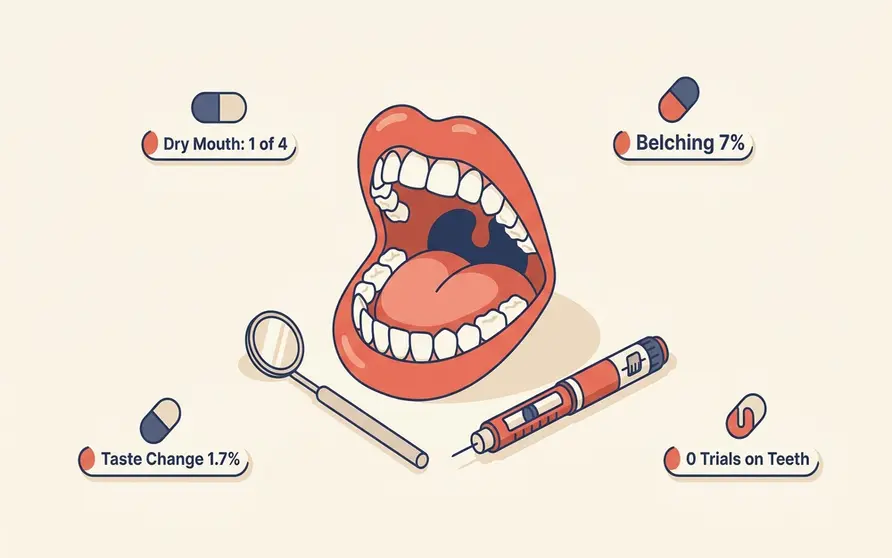
Yes, and for two separate reasons. All four US labels tell patients to inform providers about any planned procedure, because of a sedation risk. Separately, taste change and belching are listed on all four labels, dry mouth on one, and vomiting damages enamel. No trial has ever measured teeth.
Search "Ozempic mouth" and you will find thousands of people describing the same handful of things: a mouth that feels like paper, a tongue that feels coated, breath that has turned, teeth that suddenly feel sensitive at the gum line.
Search the prescribing information for the same phrase and you will find nothing. None of the four US labels uses it. That gap between what patients say and what the label lists is the whole subject of this article.
What is "Ozempic mouth"?
"Ozempic mouth" is a patient term, not a medical diagnosis. A narrative review published in the Journal of Clinical Medicine in July 2026 defines it as an umbrella label for a cluster of complaints: dry mouth, a sticky or coated tongue, tooth sensitivity, enamel erosion and gum irritation.1
The same review treats "Ozempic teeth" as part of that cluster and "Ozempic breath" as a separate complaint with its own mechanisms. Its author, Jakub Bijoch, searched six databases covering January 2010 to June 2026.1
The review attributes the cluster to a convergence rather than a single cause: less saliva, from reduced fluid intake and possible direct effects on the glands, acid exposure from vomiting and reflux, and changed eating patterns.1
What do the drug labels actually say?
Three oral effects appear in the US prescribing information, and it is worth knowing exactly which three, because the answer is more specific than most coverage suggests.
Taste distortion is on all four labels, under the medical name dysgeusia. Wegovy reports it in 1.7% of treated adults against 0.5% on placebo; Zepbound in 0.4% against none on placebo; Mounjaro in 0.1% against none; Ozempic lists it among reactions occurring in more than 0.4% of patients.2345
Belching is on all four, under the name eructation. In the Wegovy adult weight-management trials it occurred in 7% of treated patients against under 1% on placebo.3
Dry mouth is on one. Zepbound lists dry mouth or dry throat in 1% of treated patients against 0.1% on placebo. Ozempic, Wegovy and Mounjaro do not list dry mouth or xerostomia anywhere in their current US prescribing information.2345
That is a genuine and checkable oddity. The Bijoch review cites pharmacovigilance analyses in which dry mouth is reported disproportionately more often for semaglutide, with a reporting odds ratio of 3.21, than for liraglutide at 1.80 or exenatide at 1.26.1 Semaglutide is the drug whose two labels do not mention it.
| Label | Belching | Taste change | Dry mouth | Vomiting |
|---|---|---|---|---|
| Ozempic | 2.7% vs 0% | Listed, no rate | Not listed | 9.2% vs 2.3% |
| Wegovy | 7% vs under 1% | 1.7% vs 0.5% | Not listed | 24% vs 6% |
| Mounjaro | 3.3% vs 0.4% | 0.1% vs 0% | Not listed | 9% vs 2% |
| Zepbound | 5% vs 1% | 0.4% vs 0% | 1% vs 0.1% | 13% vs 2% |
Rates are drug versus placebo, taken from each label's main adverse-reaction table; where a label reports several doses, the highest reported rate is shown.2345 These columns are not a head-to-head comparison. The Ozempic and Mounjaro figures come from type 2 diabetes trials; the Wegovy and Zepbound figures come from weight-management trials in different populations, which is why the placebo rates differ so widely.
Why does less saliva matter?
Saliva is not just wetness. It lubricates, buffers acid, defends against bacteria and carries the calcium and phosphate that repair enamel between meals.1 Losing volume removes several defences at once.
The mechanism for why a GLP-1 drug might reduce it is only half established. GLP-1 receptors have been demonstrated in the parotid, submandibular and sublingual glands of rodents. Whether they are present and meaningful in the equivalent human tissue at real drug doses has not been established.1
The indirect routes are less speculative. People on these drugs drink less, and nausea and vomiting cause dehydration. The review reports a small case series describing severe hyposalivation starting around four weeks after initiation, and notes that direct measurements of human salivary flow remain limited.1
Reduced flow also explains the coated tongue people describe: saliva is what normally cleans the tongue's surface.1
Is "Ozempic breath" real?
Halitosis is not listed in any prescribing information, and the review states that few peer-reviewed data specifically link these drugs to oral malodour.1 The mechanisms proposed for it, though, are all documented effects.
The review sets out three. Belching is a confirmed drug effect at roughly 7% of treated patients. Delayed gastric emptying may allow stomach contents to ferment and release sulphur-containing gases. Reduced saliva lets anaerobic bacteria multiply on the back of the tongue, the main source of ordinary bad breath.1
A fourth contributor is the weight loss itself: the metabolic shift towards burning fat produces a distinct breath odour.1 That one is a sign the drug is working, which is an awkward thing to be told.
Belching is also one of the loudest signals in real-world reporting. A July 2026 analysis of 123,145 tirzepatide reports in the FDA's adverse event database flagged eructation among its notable signals.6 Worth noting: the current Mounjaro and Zepbound labels do list it, so on this point the label and the patient reports agree.
The mouth is one of the most complained-about places on these drugs and one of the least measured. Paraphrasing the limitations section of Bijoch, Journal of Clinical Medicine, 2026
Can these drugs help your gums?
Possibly, and this is the half of the story that gets no attention at all. The evidence is early and almost entirely non-human.
In laboratory work, GLP-1 drugs including liraglutide and exenatide promote the bone-forming differentiation of periodontal ligament stem cells. In a stimulated human periodontal ligament cell model and in animal models of gum disease, liraglutide reduced inflammatory bone destruction.1
A 2025 review synthesising ten laboratory studies, nine animal studies and a single clinical study concluded that these drugs may improve periodontal health.1 Bijoch's verdict on that is blunt: no adequately powered randomised trial has tested a GLP-1 drug against an active comparator with gum disease as the primary outcome, so claims that these drugs treat periodontitis are premature.1
The jawbone question points the other way. In a phase 2 randomised trial in adults at increased fracture risk, 52 weeks of weekly semaglutide was associated with more bone breakdown and lower bone mass at the spine and hip than placebo, changes the review attributes largely to carrying less weight rather than to the drug.1 Whether the jawbone gains or loses on balance, the review says, remains genuinely uncertain.1
What is reversible and what is not?
This is the single most useful distinction in the review, and it is the reason not to simply wait these symptoms out.
Dry mouth, taste changes and breath effects are plausibly reversible as the gastrointestinal effects settle or on stopping treatment, and the review notes that many oral symptoms improve as the body adjusts.1
Enamel erosion and established cavities are not reversible.1 Enamel dissolves below about pH 5.5, and stomach acid sits well under that, so repeated vomiting removes tooth surface permanently.1
There is a second route that catches people out. Grazing on small carbohydrate snacks to keep nausea down feeds the bacteria that cause decay, over and over through the day.1 If nausea is what is driving your snacking, our guide to managing GLP-1 nausea is the more useful place to start.
The review also notes a countervailing force: better blood sugar control lowers the sugar in saliva and improves the mouth's immune defences.1 The net effect on any individual is not known.
What should you do at the dentist?
Tell them. The review's own recommendation is that drug name, dose, duration and tolerability, especially how often you are being sick or belching, should be recorded at every examination, because patients seldom volunteer it.1
There is a second, sharper reason that comes from the labels rather than the review. All four US prescribing documents carry the same instruction in identical wording: pulmonary aspiration has been reported in patients on GLP-1 drugs undergoing elective procedures, and patients should inform healthcare providers of any planned surgeries or procedures.2345
That warning concerns general anaesthesia and deep sedation, not a routine scale and polish. It still means a dental practice planning any sedated procedure needs to know, and current multi-society guidance favours risk-stratified management over routinely stopping the drug.1
For the symptoms themselves, the review's practical measures are unglamorous and cheap. After vomiting, rinse with water or a sodium bicarbonate solution and wait 30 to 60 minutes before brushing, so you are not scrubbing acid-softened enamel. Ask about high-fluoride toothpaste at 5,000 ppm and fluoride varnish two to four times a year if your risk is raised.1
For dry mouth, the review suggests measuring unstimulated salivary flow at baseline and yearly, and managing it with hydration, xylitol-containing lozenges or gum, and saliva substitutes.1 For breath, it points at tongue cleaning, hydration and hygiene, and notes it often improves with adjustment.1
Go back to your prescriber, not just your dentist, if the dental findings suggest frequent severe vomiting, new significant dry mouth, or decay that is moving fast.1
What research is coming?
Very little has been done, and the first attempt to fix that is weeks away.
A prospective study at Bilecik Seyh Edebali University in Turkey will follow 40 adults with a BMI of 27 or above from before they start semaglutide or tirzepatide through three months of treatment. It starts on 17 August 2026, with primary completion estimated for 21 October 2026.7
Its primary measure is the change in salivary calcium, the mineral that repairs enamel. It will also measure salivary pH, unstimulated flow rate, and tooth surface wear using a standard erosion index.7 With 40 people at one centre and no control group, it will describe what happens rather than prove the drug caused it.
This is the same pattern we found writing about the eye-damage signal: a complaint that spread through patient forums long before anyone measured it properly.
In one sentence: tell your dentist you are taking a GLP-1 drug, because the label itself instructs you to disclose it before any procedure and because taste change, belching and, on one label, dry mouth are documented effects, but be aware that no trial has yet measured what these drugs do to teeth, so the honest state of the evidence is a plausible mechanism with almost no human outcome data behind it.
Frequently asked
Should I tell my dentist I am on Ozempic?+
Is Ozempic mouth on the drug label?+
Can GLP-1 drugs damage your teeth?+
Do these mouth problems go away?+
References
- Bijoch J. Oral health implications of GLP-1 receptor agonists and other incretin-based therapies. J Clin Med. 2026;15(14):5358. Europe PMC. doi:10.3390/jcm15145358. PMID: 42513271. PMCID: PMC13410358. Narrative review, not systematic. The author declares no conflicts of interest and states the research received no external funding.
- Novo Nordisk. OZEMPIC (semaglutide) injection, for subcutaneous use: US prescribing information, revised May 2026. DailyMed, US National Library of Medicine. Sections 5 and 6.1 were checked, including the placebo-controlled adverse reaction tables in adults with type 2 diabetes.
- Novo Nordisk. WEGOVY (semaglutide) injection and tablets: US prescribing information, revised June 2026. DailyMed, US National Library of Medicine. Table 3 covers 2,116 adults on 2.4 mg weekly injection against 1,261 on placebo.
- Eli Lilly and Company. MOUNJARO (tirzepatide) injection, for subcutaneous use: US prescribing information, revised April 2026. DailyMed, US National Library of Medicine. Adverse reaction rates are from placebo-controlled trials in adults with type 2 diabetes.
- Eli Lilly and Company. ZEPBOUND (tirzepatide) injection, for subcutaneous use: US prescribing information, revised April 2026. DailyMed, US National Library of Medicine. Dry mouth, dysgeusia and eructation rates are from the pooled Study 1 and Study 2 weight-management population.
- Guo X, Zhang J, Li Q, Ye Z, Yuan S. Safety profile of tirzepatide in real-world clinical practice: a pharmacovigilance study using the FAERS database. Diabetes Obes Metab. Published online 13 July 2026. Europe PMC. doi:10.1111/dom.71025. PMID: 42443144. Disproportionality analysis of 123,145 reports; a reporting signal is not an incidence rate. No funding record was returned in the bibliographic record.
- Bilecik Seyh Edebali Universitesi. Prospective evaluation of salivary calcium levels, salivary function, and dental hard tissue changes in patients receiving GLP-1 receptor agonist therapy. ClinicalTrials.gov identifier NCT07720466. Registry record last updated 22 July 2026; status not yet recruiting; estimated enrolment 40.
Evidence current as of August 1, 2026. This article is educational only and is not medical advice, and it is not dental advice. Semaglutide and tirzepatide are prescription-only and should be used under medical supervision. The main source is a narrative review, which selects the literature it cites and does not pool results, and it states plainly that dedicated human trials with oral health endpoints are essentially absent. Adverse reaction rates quoted from the labels come from different trial populations and are not comparable between drugs. Do not start, stop or change a prescribed medicine because of anything here. Take dental symptoms to your dentist and drug decisions to your prescriber.
Translating new metabolic and obesity research into plain English for people living on GLP-1 therapy. Every claim is traced to its source.