Does tirzepatide protect the kidneys?
Yes, compared to an older GLP-1 drug. A pre-specified analysis of the SURPASS-CVOT trial, covering more than 13,000 patients with type 2 diabetes and cardiovascular disease, found tirzepatide reduced major kidney events by 23% versus dulaglutide. The benefit held across both lower-risk and higher-risk kidney disease patients, though the trial was funded by Eli Lilly, which makes both drugs.
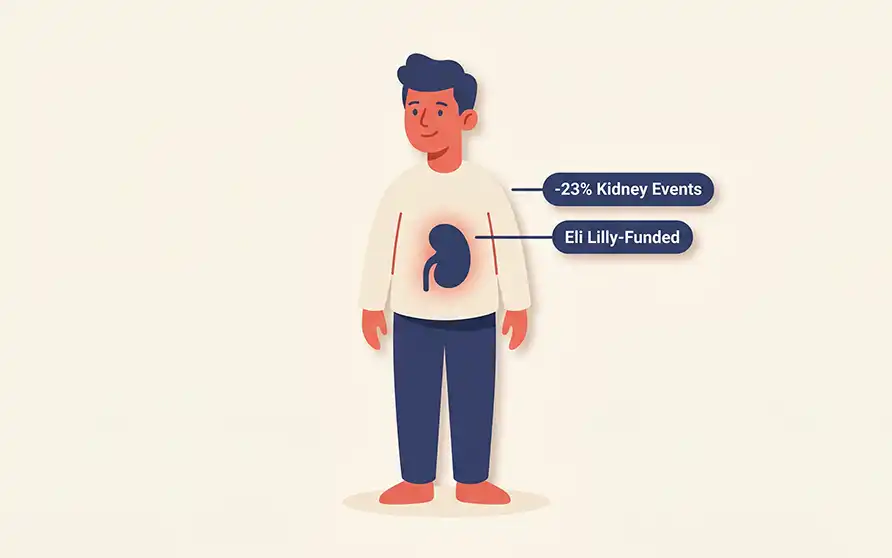
People with type 2 diabetes face a substantially elevated risk of chronic kidney disease, and clinicians increasingly look to GLP-1 and dual-agonist medications for kidney protection alongside glucose control. A pre-specified exploratory analysis of the SURPASS-CVOT trial, published in The Lancet Diabetes & Endocrinology in May 2026, directly compared kidney outcomes between tirzepatide and dulaglutide - two GLP-1-pathway drugs made by the same manufacturer.1 The result: a clear kidney advantage for tirzepatide, the newer dual GIP/GLP-1 agonist.
What was the SURPASS-CVOT trial designed to test?
SURPASS-CVOT was a randomised, double-blind, active-comparator cardiovascular outcomes trial enrolling 13,299 adults with type 2 diabetes and established atherosclerotic cardiovascular disease, conducted at 640 sites in 30 countries.2 Patients were randomised to tirzepatide (Mounjaro) or dulaglutide (Trulicity), both manufactured by Eli Lilly, rather than to a placebo. The primary results, published separately in the New England Journal of Medicine, found the composite cardiovascular endpoint - death from cardiovascular causes, heart attack, or stroke - occurred in 12.2% of tirzepatide patients versus 13.1% of dulaglutide patients over a median follow-up of 4 years.2 That difference met the statistical bar for noninferiority but not for superiority.
The kidney analysis discussed here was a separate, pre-specified secondary objective using the same trial population, examining a composite of persistent macroalbuminuria, a sustained 50% or greater drop in eGFR, end-stage kidney disease, or death from kidney disease.1
How much did tirzepatide reduce major kidney events?
The composite kidney outcome occurred in 396 patients (6.0%) on tirzepatide versus 498 patients (7.6%) on dulaglutide - a 23% relative risk reduction (hazard ratio 0.77, 95% CI 0.68-0.88, p=0.0002).1 This is a statistically robust result: the entire confidence interval sits below 1.0, and the p-value is well below the conventional 0.05 threshold.
| Outcome / subgroup | Hazard ratio | 95% CI | p-value |
|---|---|---|---|
| Composite kidney outcome (overall) | 0.77 | 0.68-0.88 | 0.0002 |
| Low-to-moderate-risk CKD subgroup | 0.70 | 0.58-0.84 | 0.0001 |
| High-risk CKD subgroup | 0.79 | 0.64-0.96 | 0.018 |
| Persistent macroalbuminuria | 0.72 | - | 0.0002 |
Source: SURPASS-CVOT pre-specified kidney analysis, The Lancet Diabetes & Endocrinology, May 2026.1 HR below 1.0 favors tirzepatide. Funded by Eli Lilly, manufacturer of both tirzepatide and dulaglutide.
The benefit was not confined to patients who already had advanced kidney disease. In the low-to-moderate-risk CKD subgroup, the risk reduction was driven mainly by fewer new cases of persistent macroalbuminuria - protein leaking into the urine, an early sign of kidney damage. In the high-risk CKD subgroup, the benefit was driven more by a slower rate of eGFR decline, meaning kidney function was lost more slowly over time.1
"The kidney benefit showed up whether patients started with low-risk or high-risk kidney disease."
Why didn't tirzepatide beat dulaglutide on heart outcomes too?
The primary cardiovascular endpoint of SURPASS-CVOT - death from cardiovascular causes, heart attack, or stroke - showed tirzepatide was noninferior to dulaglutide, not statistically superior.2 Dulaglutide already has a well-established cardiovascular benefit from its own trials, so showing tirzepatide matches that benefit is itself a meaningful finding - it confirms the newer drug does not sacrifice cardiovascular protection. The kidney analysis is where tirzepatide showed a clear additional advantage over an already cardioprotective comparator.
Why does the funding source matter here?
Eli Lilly funded SURPASS-CVOT and manufactures both tirzepatide and dulaglutide.1 This is a different conflict-of-interest profile than a trial pitting one company's drug against a competitor's: Lilly had a commercial incentive to show its newer, more expensive drug (tirzepatide) outperforms its older one (dulaglutide), which is now facing patent and pricing pressure. Using an active, approved comparator instead of a placebo is methodologically stronger than a placebo-controlled trial, but the sponsor's incentive to favor its own newer product should still be weighed when interpreting the magnitude of the result.
Independent replication of this kidney finding, ideally in a trial not funded by either drug's manufacturer, would strengthen confidence in the 23% figure.
What does this mean for patients with type 2 diabetes and kidney concerns?
For patients with type 2 diabetes and atherosclerotic cardiovascular disease who are deciding between tirzepatide and dulaglutide, this analysis adds kidney protection as a factor favoring tirzepatide - on top of its already-established advantage in weight loss and glycemic control. The benefit applied across the kidney disease risk spectrum studied, from patients with only mild kidney impairment to those with more advanced disease.
This trial enrolled patients with type 2 diabetes and existing cardiovascular disease specifically - the findings do not necessarily generalize to people taking tirzepatide for obesity alone without diabetes, a population SURPASS-CVOT did not study.
In one sentence: a pre-specified analysis of the 13,299-patient SURPASS-CVOT trial found tirzepatide reduced major kidney events by 23% compared to dulaglutide in patients with type 2 diabetes and cardiovascular disease, a finding from an Eli Lilly-funded head-to-head of its own two drugs that still awaits independent confirmation.
Frequently asked
Does tirzepatide protect the kidneys better than dulaglutide?+
Did tirzepatide reduce heart attacks and strokes more than dulaglutide?+
Who funded the SURPASS-CVOT kidney analysis and why does that matter?+
References
- A comparison of the effects of tirzepatide and dulaglutide on major kidney events in people with type 2 diabetes: pre-specified exploratory analyses of the SURPASS-CVOT trial. The Lancet Diabetes & Endocrinology. May 2026. DOI: 10.1016/S2213-8587(26)00032-X. PMID: 42114520. Funded by Eli Lilly and Company, manufacturer of both tirzepatide and dulaglutide.
- Nicholls SJ, et al. Cardiovascular Outcomes with Tirzepatide versus Dulaglutide in Type 2 Diabetes (SURPASS-CVOT). New England Journal of Medicine. 2025;393:2409-2420. DOI: 10.1056/NEJMoa2505928. PMID: 41406444. Funded by Eli Lilly and Company.
Evidence current as of June 16, 2026. This article is educational and not medical advice. Always consult your clinician before changing medication, diet or exercise.
Translating new metabolic and obesity research into plain English for people living on GLP-1 therapy. Every claim is traced to its source.