Tirzepatide vs semaglutide for HFpEF: what's being studied
Brigham and Women's Hospital is comparing tirzepatide and semaglutide in an estimated 26,000 people who have type 2 diabetes and heart failure with preserved ejection fraction, using insurance claims data instead of a randomized trial. No results are posted yet.
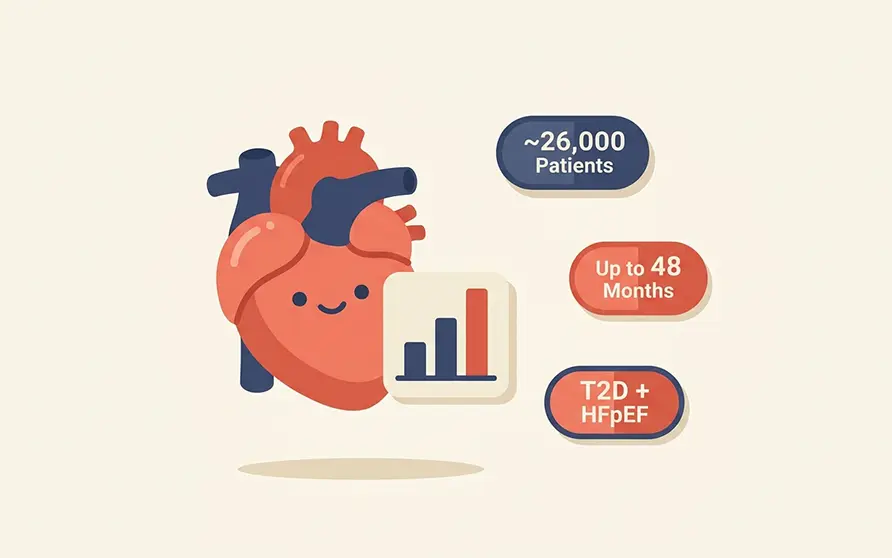
A separate real-world cohort study published earlier in 2026 found that semaglutide cut major cardiovascular events by 29% compared with tirzepatide in 21,250 patients without diabetes, though that study was funded by semaglutide's own manufacturer.2 A new study from Brigham and Women's Hospital asks a narrower, related question: among people who have both type 2 diabetes and a specific type of heart failure, does either drug lower the risk of hospitalization or death more than the other?
What is NCT06980623 actually testing?
The official title is "Comparative Effectiveness of Tirzepatide vs Semaglutide in Participants With Type 2 Diabetes and Heart Failure With Preserved Ejection Fraction," registered as NCT06980623.1 It is sponsored by Brigham and Women's Hospital and led by principal investigator Elisabetta Patorno, MD, DrPH, an academic study with no pharmaceutical company listed as sponsor or collaborator.1 Rather than enrolling and randomizing patients, the study is a retrospective, observational cohort analysis built from insurance claims records of people who newly started either tirzepatide or semaglutide between June 1, 2022 and December 31, 2024.1
What does "HFpEF" mean, and who is included?
Heart failure with preserved ejection fraction (HFpEF) is heart failure where the heart's main pumping chamber still squeezes with a normal or near-normal ejection fraction, defined in this study as 45% or higher, even though the heart cannot fill or relax properly. Eligible patients are adults 18 or older with type 2 diabetes, a documented HFpEF diagnosis, and continuous health plan enrollment who newly started tirzepatide or semaglutide in the study window.1 The study excludes anyone with missing demographic data, type 1 diabetes, significant diabetes complications, certain gastrointestinal conditions, prior use of a GLP-1 receptor agonist before the study window, or a prescription for both drugs at once.1
| Study feature | Detail |
|---|---|
| Design | Retrospective observational cohort, insurance claims data |
| Estimated enrollment | 26,000 participants |
| Comparison groups | New tirzepatide users vs. new semaglutide users |
| Primary outcome | Heart failure hospitalization or all-cause mortality |
| Follow-up window | Up to 48 months |
| Statistical approach | Propensity-score adjustment, Cox proportional hazards models |
Source: ClinicalTrials.gov record NCT06980623.1
"Claims data can follow tens of thousands of real-world patients, but it cannot randomize who gets which drug."
Why does the claims-data design matter here?
Because doctors, not a randomization protocol, decided which patients received tirzepatide and which received semaglutide, the two groups may differ in ways the study cannot fully see, such as disease severity, insurance formulary access, or a physician's personal prescribing habits.1 Propensity-score adjustment and Cox proportional hazards modeling are standard statistical tools for narrowing that gap, matching patients on measured characteristics before comparing outcomes, but they can only adjust for differences the claims data actually captures.1 A finding from this design would be a strong real-world signal, not proof of causation the way a randomized trial like SURPASS-CVOT or SELECT could provide.
What this does not mean - yet
NCT06980623 has produced no published hospitalization or mortality outcome data. Its estimated primary completion date, November 30, 2025, has already passed according to the registry, but the record's most recent update, May 15, 2026, still lists the study as active and not recruiting with no results section populated.1 Full study completion is estimated for October 1, 2026.1 Until a results submission or peer-reviewed publication appears, this study cannot be cited as evidence that either drug is safer or more effective for HFpEF patients.
In one sentence: a Brigham and Women's Hospital team is using insurance claims on roughly 26,000 people with type 2 diabetes and HFpEF to compare tirzepatide and semaglutide on heart failure hospitalization and death, but with no results posted yet, the study can only be described, not cited as an answer.
Frequently asked
Does the tirzepatide vs semaglutide HFpEF study have results yet?+
What makes this study different from other tirzepatide vs semaglutide comparisons?+
What are the limits of a claims-data cohort study like this one?+
References
- Patorno E, Brigham and Women's Hospital. Comparative Effectiveness of Tirzepatide vs Semaglutide in Participants With Type 2 Diabetes and Heart Failure With Preserved Ejection Fraction. ClinicalTrials.gov. Identifier: NCT06980623. Status: Active, not recruiting. Estimated study completion: October 1, 2026.
Evidence current as of July 4, 2026. This article describes an ongoing, unpublished cohort study and is educational only, not medical advice. It is not a report of study results. People with type 2 diabetes and heart failure should discuss the choice between tirzepatide and semaglutide with their prescribing clinician, not this article.
Translating new metabolic and obesity research into plain English for people living on GLP-1 therapy. Every claim is traced to its source.