Tirzepatide vs semaglutide: which loses more weight?
Both drugs produce significant weight loss. But two independent 2025 meta-analyses - pooling data from more than 142,000 patients - consistently show tirzepatide (Mounjaro, Zepbound) outperforms semaglutide (Wegovy, Ozempic) by roughly 4 kg on average, with the gap growing at higher doses. Here is what the evidence actually shows, and where it still has limits.
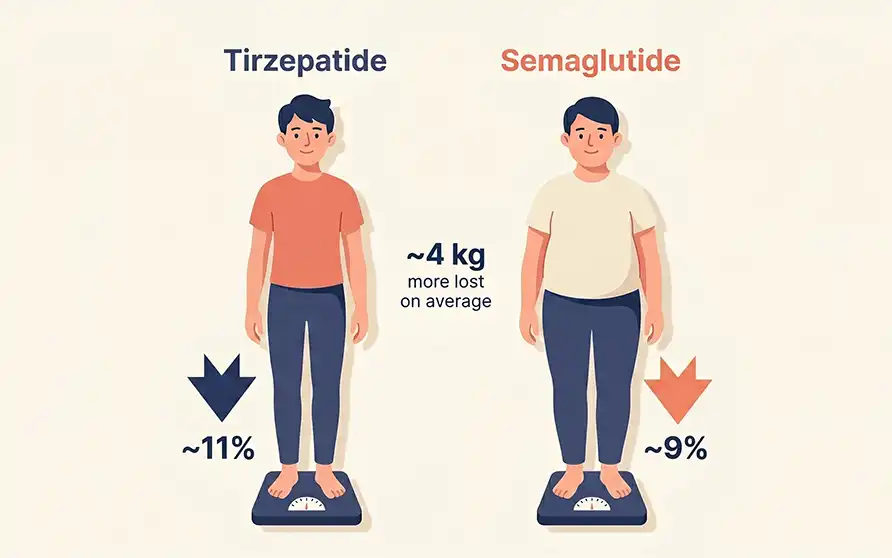
Tirzepatide and semaglutide are now the two dominant injectable weight-loss medications in the United States. Tirzepatide (sold as Mounjaro for type 2 diabetes and Zepbound for obesity) activates both the GLP-1 and GIP receptors. Semaglutide (sold as Ozempic for T2D and Wegovy for obesity) activates the GLP-1 receptor only. That dual mechanism is the theoretical reason tirzepatide might work better - but theory needs data. Two independent 2025 systematic reviews now provide that data at scale.
What do the independent meta-analyses show?
The first analysis, by Munawar et al., published in Cureus in June 2025, pooled 7 studies and 28,980 participants with follow-up of 6 to 12 months.1 The authors declared no financial support and no competing interests. Tirzepatide produced significantly greater weight reduction, with a standardised mean difference of 0.75 (95% CI 0.52-0.92) overall. At the six-month mark specifically, the mean difference was 1.33 (95% CI 0.58-2.08) in favour of tirzepatide. Tirzepatide patients were also significantly more likely to achieve at least 10% weight loss (OR 0.21, 95% CI 0.06-0.78).
The second analysis, by Aamir et al., published in the Journal of Clinical Medicine Research in May 2025, cast a wider net: 7 studies and 142,811 participants combining RCTs and real-world retrospective cohorts.2 The headline result was an absolute mean difference of 4.23 kg (95% CI 3.22-5.25) in favour of tirzepatide. The authors declared no conflict of interest.
Both analyses converge on the same directional conclusion: tirzepatide produces meaningfully more weight loss on average. Importantly, neither analysis was funded by a manufacturer of either drug - which distinguishes them from some of the individual trials they pool.
Does the dose change the gap?
Yes, substantially. In the Aamir meta-analysis, the advantage of tirzepatide over semaglutide grew with dose and duration.2 At doses above 10 mg, tirzepatide outperformed semaglutide by a mean of 6.50 kg (95% CI 5.93-7.08). At doses of 10 mg or below, the gap narrowed to 3.89 kg (95% CI 2.12-5.65). When treatment exceeded 6 months, the advantage was 5.00 kg (95% CI 3.48-6.52); at 6 months or less it was 3.50 kg.
This dose-response relationship matters for real-world comparisons. A patient on tirzepatide 5 mg is not in the same comparison as one on 15 mg - and the same applies to semaglutide doses. Direct head-to-head comparisons that do not control for dose are hard to interpret.
What do real-world patients actually achieve?
A February 2026 retrospective cohort study by le Roux et al. used de-identified electronic health records from 30 US health systems (Truveta) to compare 2,396 patients starting either tirzepatide (n=1,003) or semaglutide (n=1,393) for obesity without diabetes between December 2023 and June 2024.3 After 6 months on treatment, tirzepatide patients lost 11.15% of body weight versus 8.83% for semaglutide - a difference of 2.32 percentage points.
The table below shows the proportion of patients achieving each weight-loss threshold at 6 months. All numbers come from the le Roux 2026 study, which carries a significant conflict of interest: it was funded by Eli Lilly, the manufacturer of tirzepatide, and several authors are Eli Lilly employees (see reference 3 for full disclosure). These figures should be read in that context.
| Weight loss threshold | Tirzepatide | Semaglutide | Adjusted odds ratio |
|---|---|---|---|
| At least 5% lost | 85.7% | 75.2% | aOR 2.03 |
| At least 10% lost | 59.0% | 38.0% | aOR 2.46 |
| At least 15% lost | 31.2% | 14.0% | aOR 2.88 |
| At least 20% lost | 11.3% | 3.8% | aOR 3.23 |
Source: le Roux CW et al., Journal of Endocrinological Investigation, February 2026.3 COI: funded by Eli Lilly; several authors are Eli Lilly employees. aOR = adjusted odds ratio versus semaglutide.
Tirzepatide patients were also less likely to have reached the highest doses in this cohort: only 42.4% reached 10 mg or above, versus 67.7% of semaglutide patients at 1.7 mg or above.3 That means tirzepatide's advantage in this dataset was achieved despite more patients remaining on lower maintenance doses - a finding the COI caveat does not erase.
"Tirzepatide's advantage held even though fewer patients reached the highest doses."
Why does tirzepatide produce more weight loss?
Tirzepatide is a dual agonist: it activates both the GLP-1 (glucagon-like peptide-1) and GIP (glucose-dependent insulinotropic polypeptide) receptors simultaneously.2 Semaglutide activates only GLP-1. Both receptors are involved in appetite regulation, energy homeostasis, and insulin secretion - and the dual activation appears to produce a stronger appetite-suppressing and metabolic effect than GLP-1 activation alone.
Whether this is because GIP adds an independent anorectic signal, or because the two receptors interact synergistically, is still being studied. What the clinical data confirms is that the combination produces a larger weight-loss effect at equivalent therapeutic stages - and that the gap grows when tirzepatide is titrated to higher doses.
What are the key limits of this evidence?
The Munawar meta-analysis reported high heterogeneity across its included studies (I squared above 90%).1 High heterogeneity means the individual studies differed substantially in their results - the pooled average conceals wide variation. Some populations and dose combinations saw much larger differences between the drugs; others saw smaller ones. An average of 4 kg is not a guarantee of 4 kg for any individual patient.
The real-world le Roux study has a prominent conflict of interest: Eli Lilly funded it, and multiple authors are Eli Lilly employees.3 Manufacturer-funded studies of a manufacturer's own product consistently show larger effects than independently-funded research. The direction of the finding - tirzepatide superior - is consistent with independent meta-analyses. The exact magnitude reported in the le Roux study should be read with that COI clearly in mind.
Neither drug has a head-to-head randomised controlled trial comparing their maximum approved doses in the same study under controlled conditions. That gap in the evidence is significant. Most of the pooled data comes from observational studies or RCTs that were not designed as direct comparisons.
What does this mean if you are already on one of these drugs?
If you are taking semaglutide and have not reached your weight-loss goal, the data does not automatically mean you should switch to tirzepatide. The most important variables are whether you are at your maximum tolerated dose, how long you have been on treatment, and whether plateaus are due to the drug itself or to other factors. Both drugs continue to produce benefits well beyond 6 months in dedicated trials.
The data also does not address tolerability, cost, or insurance coverage - all of which matter more than a 4 kg average difference for many patients. Both medications carry the same class-level cautions around gastrointestinal side effects, thyroid C-cell tumour risk in animal models, and the need for ongoing clinical supervision.
In one sentence: two independent 2025 meta-analyses consistently show tirzepatide produces roughly 4 kg more weight loss than semaglutide on average - a difference that grows at higher doses - but high heterogeneity, no head-to-head RCT at maximum doses, and a heavily Eli Lilly-funded real-world dataset mean individual patient decisions should be made with a clinician, not a data table.
Frequently asked
Does tirzepatide cause more weight loss than semaglutide?+
What is the difference between Mounjaro and Ozempic for weight loss?+
Should I switch from semaglutide to tirzepatide for more weight loss?+
References
- Munawar N, Ahmed W, Khan O, et al. Tirzepatide Versus Semaglutide for Weight Loss in Overweight and Obese Adults: A Systematic Review and Meta-Analysis of Direct Comparative Studies. Cureus. June 15, 2025. DOI: 10.7759/cureus.86080. PMID: 40666599. PMC12263181. No funding received; no competing interests declared.
- Aamir AB, Latif R, Alqoofi JF, et al. Comparative Efficacy of Tirzepatide vs. Semaglutide in Reducing Body Weight in Humans: A Systematic Review and Meta-Analysis of Clinical Trials and Real-World Data. Journal of Clinical Medicine Research. May 13, 2025. DOI: 10.14740/jocmr6231. PMID: 40503067. PMC12151102. Authors declared no conflict of interest.
- le Roux CW, Done N, Brnabic AJM, et al. Comparative effectiveness of tirzepatide and semaglutide for obesity management in US clinical practice: a 6-month retrospective cohort study. Journal of Endocrinological Investigation. February 9, 2026. DOI: 10.1007/s40618-025-02792-1. PMID: 41661445. COI: funded by Eli Lilly and Company; Brnabic, Lipkovich, Kan, Dimitriadis, and Dunn are Eli Lilly employees and shareholders.
Evidence current as of June 18, 2026. This article is educational and not medical advice. Always consult your clinician before changing medication, diet or exercise.
Translating new metabolic and obesity research into plain English for people living on GLP-1 therapy. Every claim is traced to its source.