What causes Ozempic face?
Ozempic face is the nickname for facial hollowing, sagging and an older look during GLP-1 weight loss. The established cause is rapid, whole-body fat loss reaching the face, not a skin-specific drug effect. Some reviews propose the drugs may also age skin directly, but that part is still unproven.
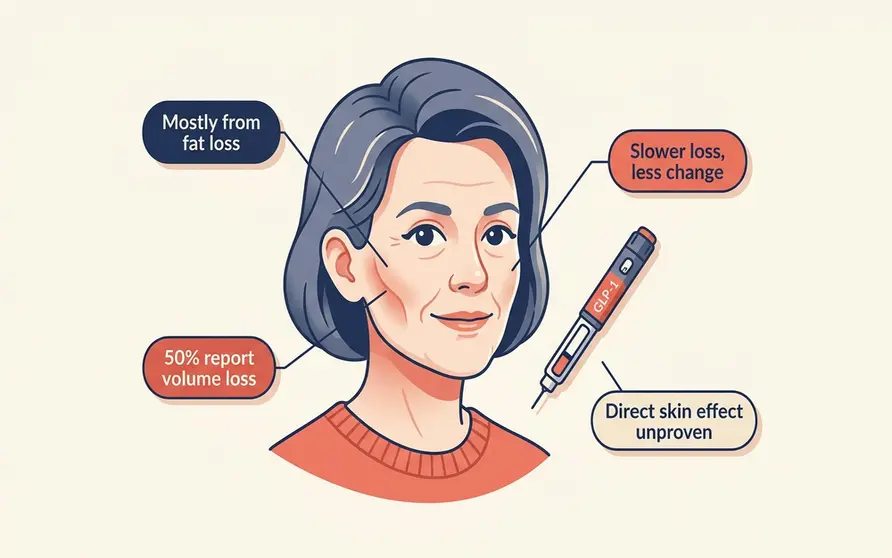
"Ozempic face" is the nickname people give to the gaunt, hollowed, slightly older look that can appear during fast weight loss on a GLP-1 drug like Ozempic, Wegovy or Mounjaro. It is not a medical diagnosis and it is not listed as a side effect of the medicine. It is a description of what a shrinking face can look like.
The useful question is not whether it is real, because the changes are real, but what actually causes them. The honest answer separates into two parts: a well-established driver that explains most of it, and a newer, unproven idea that researchers are still arguing about. This article keeps those two apart, because they lead to very different conclusions.
What is Ozempic face?
Ozempic face describes facial volume loss: sinking cheeks, more visible bone structure, deeper folds, and skin that looks looser or crepey. Cleveland Clinic frames it plainly, saying it "isn't a side effect of the medication itself" but rather "a side effect of the rapid weight loss the medication can bring."6
The term took off because these drugs produce fast, large weight loss, and the face is where a loss of fat is hardest to hide. The same look appears after rapid weight loss from any cause, including bariatric surgery, so it is better understood as a weight-loss effect than an Ozempic-specific one.2
How common is facial volume loss?
Facial change is common once weight loss is large. In a 2026 survey published in Dermatology and Therapy, researchers asked 1,226 people in a virtual cardio-kidney-metabolic program about the skin effects of GLP-1 therapy.1 Among the 325 respondents who had lost more than 20% of their body weight, half noticed the change in their face.
In that high-loss group, 50% reported decreased facial volume (95% CI 45 to 55), 72% reported skin sagging, 52% reported hair loss and 33% reported reduced strength.1 These are self-reported figures from a single program, so they carry selection and recall bias and are not measured clinical rates. They still show that among people losing the most weight, a facial change is something most people see.
Is it the drug or the weight loss?
The established cause is the weight loss. Fat sits in pads across the face, and as total body fat falls, those pads shrink too, because the body cannot be told to spare the face. A 2024 systematic review of 14 studies concluded that "massive weight loss causes accelerated facial aging, manifested through fat devolumization, and increased skin laxity," with the most significant loss along the mid-cheek and loose skin in the central neck.2
A 2025 systematic review of 23 articles reached the same place, finding that GLP-1 receptor agonists cause morphological changes resembling advanced aging, and that interest in rejuvenation procedures has risen alongside them.3 On this part, the reviews agree: a fast, large loss of fat ages the face.
The newer and unsettled question is whether the drugs also age skin directly, on top of the fat loss. A 2025 review in Endocrine argues the complication "is not exclusively related to decreased facial fat, but there are more aging mechanisms that have to be elucidated," pointing to reduced protective signals from skin stem cells, oxidative damage to collagen-making fibroblasts, and disrupted hormone signaling in facial fat.4 These are proposed mechanisms, not measured effects in people.
A 2025 review in the Journal of Cosmetic Dermatology is more cautious still, noting the skin-receptor evidence is contradictory: one study it cites found human skin keratinocytes showed no GLP-1 receptors at all.5 So the "direct skin aging" idea is a live hypothesis that reviews and letters are debating, not a finding backed by a clinical trial.
| Proposed driver | What it means | How strong is the evidence |
|---|---|---|
| Whole-body fat loss | Fat leaves the facial pads as total body fat falls | Established across reviews |
| Rapid pace of loss | Fast loss shows sooner, before skin adapts | Supported, clinician consensus |
| Direct skin or collagen effect | Drug may act on skin cells to cut collagen | Proposed only, receptor evidence mixed, no trial |
Why does the face show it first?
The face loses volume early because its fat pads are thin and sit right under the skin, so a change in them is visible in a way that fat loss from the belly or hips is not. The body also cannot spot-reduce, so there is no way to lose weight everywhere else while keeping the face full. As overall fat falls, facial fat falls with it.
Speed matters as much as amount. When weight comes off quickly, the skin does not have time to tighten to the smaller frame underneath, so looseness shows up sooner. Dr. Vinni Makin, an endocrinologist at Cleveland Clinic, puts it simply: the faster weight loss occurs, the more likely the face will show it.6 Age and skin elasticity feed into this too, which is why the same weight loss can look different on two people.
Most of Ozempic face is the weight loss catching up with the face. Whether the drug also ages skin on its own is a question researchers are still trying to answer.
Can you prevent or reduce it?
There is no proven way to prevent facial change, because it tracks the weight loss people are taking the drug to achieve. What clinicians suggest is aimed at slowing the loss and protecting what holds the face up. Cleveland Clinic advises a gradual approach of about one to two pounds a week, eating enough protein, and keeping up exercise.6
Protecting muscle is part of the same picture, since rapid weight loss strips lean tissue along with fat. Our guides on whether high-protein diets can slow GLP-1 muscle loss and how much muscle you lose on a GLP-1 go deeper on the protein and resistance-training side. None of this stops facial fat loss, but it supports the structure underneath.
If the change still bothers you, this is where dermatology comes in. The 2025 review noted that interest in rejuvenation procedures has climbed alongside GLP-1 use, and options like dermal fillers to replace lost volume, microneedling, energy-based devices and, for marked laxity, surgery are discussed by clinicians.36 These are cosmetic treatments to raise with a dermatologist, not reasons to start, stop or change the drug yourself.
In one sentence: Ozempic face is caused mainly by rapid, whole-body fat loss reaching the face, a well-established weight-loss effect rather than a skin-specific drug action, while the idea that GLP-1 drugs age skin directly remains an unproven hypothesis.24
Frequently asked
What is Ozempic face?+
Is Ozempic face caused by the drug or the weight loss?+
How common is Ozempic face?+
Can you prevent Ozempic face?+
References
- Rao S, Midura I, Mangual KPS, Igel LI, Saunders KH, Carter J, Murase JE, Kourosh AS. Skin Impacts and Tradeoffs of GLP-1 Therapy: Improved Patient-Reported Outcomes of Inflammatory Skin Disease in the Era of "Ozempic Face". Dermatology and Therapy. 2026 Sep. DOI: 10.1007/s13555-026-01882-z. PMID: 42579223. An anonymous patient-reported survey of 1,226 people in one virtual cardio-kidney-metabolic program; among the 325 who lost more than 20% of their body weight, 50% (95% CI 45 to 55) reported decreased facial volume and 72% reported skin sagging. These are self-reported figures carrying selection and recall bias, not measured clinical outcomes. One author is an editorial board member of the journal but was uninvolved in peer review; the others reported no disclosures.
- Jafar AB, Jacob J, Kao WK, Ho T. Soft Tissue Facial Changes Following Massive Weight Loss Secondary to Medical and Surgical Bariatric Interventions: A Systematic Review. Aesthetic Surgery Journal Open Forum. 2024;6:ojae069. DOI: 10.1093/asjof/ojae069. PMID: 39346804. A systematic review of 14 studies concluding that massive weight loss causes accelerated facial aging through fat devolumization and increased skin laxity, with the most significant loss along the mid-cheek region and skin laxity in the central neck, across both medical and surgical weight loss.
- Daneshgaran G, Shauly O, Gould DJ. "Ozempic Face" in Plastic Surgery: A Systematic Review of the Literature on GLP-1 Receptor Agonist Mediated Weight Loss and Analysis of Public Perceptions. Aesthetic Surgery Journal Open Forum. 2025;7:ojaf056. DOI: 10.1093/asjof/ojaf056. PMID: 40626110. A systematic review of 23 articles finding that GLP-1 receptor agonists cause morphological changes resembling advanced facial aging, and that public interest in seeking rejuvenation procedures has risen alongside their use.
- Paschou IA, Sali E, Paschou SA, Tsamis KI, Peppa M, Psaltopoulou T, Nicolaidou E, Stratigos AJ. GLP-1RA and the possible skin aging. Endocrine. 2025;89(3):680-685. DOI: 10.1007/s12020-025-04293-w. PMID: 40498168. A review proposing that facial aging with GLP-1 therapy is "not exclusively related to decreased facial fat, but there are more aging mechanisms that have to be elucidated", including reduced protective signals from stem cells, oxidative damage to fibroblasts, decreased collagen synthesis and disrupted hormone signaling in dermal fat. These are proposed mechanisms, not measured effects in people.
- Kruglikov IL. Mechanisms of Glucagon-Like Peptide 1 Receptor Agonist-Induced Facial Lipodystrophy and a Path Toward Prevention. Journal of Cosmetic Dermatology. 2025 Nov 28;24(12):e70584. DOI: 10.1111/jocd.70584. PMID: 41316800. A review and commentary noting that the skin-receptor evidence is contradictory, citing a study in which human keratinocytes showed no GLP-1 receptor expression, describing a shift in collagen fiber balance after rapid weight loss, and proposing exploratory, not yet proven, prevention approaches.
- Cleveland Clinic. "Ozempic Face": What It Is and How To Avoid It, with endocrinologist Dr. Vinni Makin. Cleveland Clinic Health Essentials. Clinician guidance, not a research study, describing Ozempic face as a result of rapid weight loss rather than the drug itself, and suggesting slower weight loss of about one to two pounds a week, enough protein, exercise, and dermatologic treatments such as fillers and microneedling.
Evidence current as of October 2, 2026. The facial-volume figures come from a single self-reported survey and show what people noticed, not measured clinical rates; they carry selection and recall bias. The link between rapid weight loss and facial aging is supported by two systematic reviews, while the idea that GLP-1 drugs age skin directly, beyond fat loss, is a proposed mechanism from reviews and letters, with contradictory skin-receptor evidence and no randomized trial. No GLP-1 drug is approved or tested for facial appearance. This content is educational only, not medical advice. Do not start, stop or change any medicine based on this article; cosmetic treatments and concerns about facial changes should be discussed with a clinician or dermatologist.
Translating new metabolic and obesity research into plain English for people living on GLP-1 therapy. Every claim is traced to its source.