What is petrelintide, and is it gentler than Ozempic?
Petrelintide is an investigational once-weekly injection for obesity from Zealand Pharma. It is not a GLP-1 and not approved or available. In its first published trial it produced about 9% to 10% weight loss with mostly mild nausea, but it has never been tested head-to-head against Ozempic, so "gentler" is a hypothesis, not a proven fact.
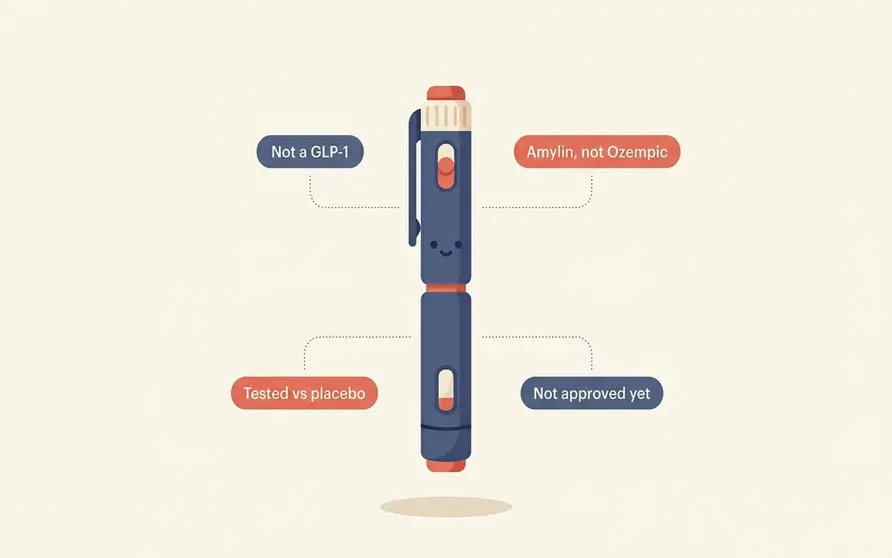
You may have seen headlines about a "new class of weight-loss drugs with fewer side effects than Ozempic." The drug behind most of them is petrelintide. The excitement is real, and the first proper trial has now been published in a respected journal, which is a genuine step up from the company press releases that drive a lot of pipeline news.
This article explains what petrelintide is, why it is not simply "another Ozempic," what its first peer-reviewed trial actually showed, and why the "gentler" label is still a hypothesis rather than a settled fact. Nothing here is a reason to seek out, wait for, or quit a working medicine for an unapproved drug.
What is petrelintide?
Petrelintide is an investigational once-weekly injection being developed for long-term weight management in adults with obesity.1 It is made by the Danish company Zealand Pharma and is being co-developed and co-commercialised with Roche under a collaboration announced in March 2025.4 Petrelintide is a long-acting amylin analogue, which means it is a lab-made copy of the natural hormone amylin.1
Amylin is a satiety hormone released by the pancreas alongside insulin when you eat, and it helps signal fullness. Petrelintide is designed to switch on that fullness signal for a whole week from a single injection. The trial authors describe its mechanism as distinct from the incretin drugs, the group that includes GLP-1 medicines.1
Is petrelintide another Ozempic?
No. Petrelintide is not a GLP-1, and it is not a pill. Ozempic and Wegovy contain semaglutide, a GLP-1 drug, and Mounjaro and Zepbound contain tirzepatide, which targets GLP-1 and a second hormone called GIP. Petrelintide works on the amylin pathway instead, so it is a different kind of drug aimed at the same goal of reducing appetite.1
Petrelintide is also not the same as the amylin combinations in the news. CagriSema pairs an amylin analogue, cagrilintide, with the GLP-1 drug semaglutide, so it uses both pathways at once. Petrelintide is amylin alone. If you want the combination story, our guide to whether CagriSema is better than Ozempic covers it, and for another investigational injection sold as a possible step up, see what survodutide is and how it compares.
What did the first trial show?
The first published trial is called ZUPREME 1, reported in The Lancet Diabetes & Endocrinology in 2026.1 It was a Phase 2 dose-finding study at 32 sites in Poland, Romania and the United States, enrolling 493 adults with obesity, or overweight with a related health problem, but without type 2 diabetes.12 Participants were randomly assigned to one of several petrelintide doses or to placebo for 42 weeks, and the main measure was weight change at 28 weeks.1
Average weight loss at 28 weeks was about 7.9% on the two lowest doses and 9.3% to 9.8% on the higher doses, compared with 1.7% on placebo.1 Weight had not levelled off by the end: it kept falling to week 42, reaching up to about 10.7%.1 That is a solid Phase 2 result, though it sits below the roughly 15% to 20% weight loss reported at the highest doses of the strongest approved drugs.
| Weekly dose | Weight loss at 28 weeks | Difference vs placebo |
|---|---|---|
| 1.0 mg | 7.9% | 6.2% |
| 2.5 mg | 7.9% | 6.2% |
| 5.0 mg | 9.8% | 8.1% |
| 7.0 mg | 9.3% | 7.7% |
| 9.0 mg | 9.4% | 7.7% |
| Placebo | 1.7% | reference |
Average weight loss at 28 weeks (efficacy estimand) from ZUPREME 1, The Lancet Diabetes & Endocrinology, 2026.1 Weight kept falling to week 42, reaching up to about 10.7%. Figures are averages; individual results vary.
Does it really have fewer side effects?
This is the claim to handle carefully. In ZUPREME 1, the most common side effect was nausea, which affected 20% of people on petrelintide versus 6% on placebo, and the authors describe it as mostly mild and occurring while the dose was raised.1 Vomiting was uncommon, at 3% versus 6% on placebo, and diarrhoea and constipation were close to placebo levels.1 No deaths were reported, and the authors concluded that gut tolerability was similar to placebo apart from that early nausea.1
That is why coverage calls petrelintide a gentler alternative. The honest catch is that ZUPREME 1 compared petrelintide only against placebo, never against a GLP-1 drug.1 The "about half the nausea of Ozempic" line that circulates in the press comes from lining up petrelintide's numbers against nausea rates reported in separate semaglutide and tirzepatide trials. Comparing results across different trials, with different patients and designs, is not a fair head-to-head test, so it suggests a possibility rather than proving one.
So "gentler than Ozempic" is a reasonable hypothesis that fits the early data, not an established fact. The only way to settle it is a trial that gives some people petrelintide and others a GLP-1 and measures both, and no such trial has reported.1
"Fewer side effects than placebo is not the same claim as fewer side effects than Ozempic."
Is petrelintide approved or available?
No. Petrelintide is not approved by the FDA or any other regulator, it is not sold in any pharmacy, and no doctor can prescribe it outside a clinical trial.1 ZUPREME 1 was a Phase 2 study, the dose-finding stage that comes before the large trials used to seek approval.2 A second Phase 2 trial in people who also have type 2 diabetes, ZUPREME 2, has finished but its results have not yet been published.3
Phase 3 is the stage that will actually decide whether petrelintide works and is safe enough to approve, and strong Phase 2 numbers can still shrink or stall at that point. For anyone managing their weight today, the practical choices are the drugs already approved and in use, chosen with a doctor. Petrelintide is one of several candidates worth watching, not a treatment you can get.
In one sentence: Petrelintide is a promising investigational amylin injection that produced about 9% to 10% weight loss with mostly mild nausea in its first published trial, but it is not approved, not available, and has never been tested head-to-head against Ozempic, so calling it "gentler" is still a hypothesis.
Frequently asked
Is petrelintide approved or available to buy?+
Is petrelintide a GLP-1 like Ozempic?+
Does petrelintide really have fewer side effects than Ozempic?+
References
- Garvey WT, Ard J, Connery L, Frias JP, le Roux CW, Pietilainen KH, Dinesen M, Hagen BF, Larsen L, Hesse D, Kendall DM. Petrelintide, a human amylin analogue for the treatment of obesity (ZUPREME 1): a randomised, double-blind, placebo-controlled, phase 2 trial. The Lancet Diabetes & Endocrinology, 2026 Nov;14(11):914-926. doi:10.1016/S2213-8587(26)00213-5; PMID 42810355. Phase 2 dose-finding RCT, 493 adults, 42 weeks; funded by Zealand Pharma, with five Zealand employees among the authors and academic authors reporting broad obesity-drug industry ties.
- Zealand Pharma. A Randomized, Double-blind, Phase 2, Dose-finding Trial of Once Weekly Petrelintide Compared With Placebo in Participants With Obesity or Overweight With Weight Related Comorbidities (ZUPREME 1). ClinicalTrials.gov, NCT06662539. Phase 2; completed; actual enrolment 493; study start December 9, 2024; actual primary completion September 30, 2025.
- Zealand Pharma. A Randomized, Double-Blind, Phase 2 Trial of Once-Weekly Petrelintide Compared With Placebo in Participants With Overweight or Obesity and Type 2 Diabetes (ZUPREME 2). ClinicalTrials.gov, NCT06926842. Phase 2; completed; actual enrolment 221; actual primary completion August 13, 2026. As of October 2026 the record shows no results section posted.
- F. Hoffmann-La Roche Ltd. Roche enters into an exclusive collaboration and licensing agreement with Zealand Pharma to co-develop and co-commercialise petrelintide. Roche Investor Update, March 12, 2025. Announces the Roche and Zealand Pharma collaboration to co-develop petrelintide, an amylin analogue, for obesity.
Evidence current as of October 27, 2026. This article is educational and not medical advice. Petrelintide is an investigational drug that is not approved or available; always consult a qualified clinician before starting, stopping or changing a medication.
Translating new metabolic and obesity research into plain English for people living on GLP-1 therapy. Every claim is traced to its source.