Why does Ozempic give you diarrhea and sulfur burps?
Ozempic and other GLP-1 drugs change how fast the gut moves and how it handles bile and food, so some people get diarrhea rather than constipation. Reported rates run from about 9% on Ozempic in diabetes trials to 30% on Wegovy at the higher weight-loss dose. Sulfur burps come from food fermenting in a slowed stomach.
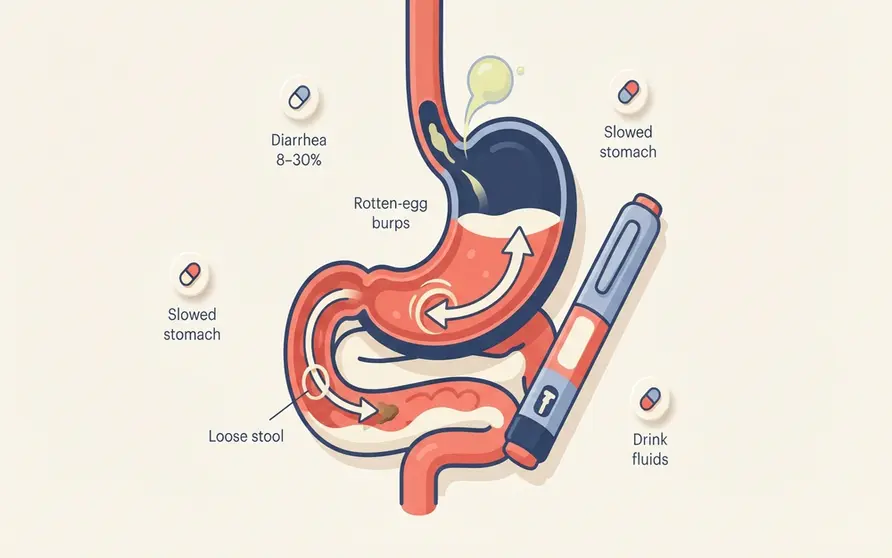
Most coverage of GLP-1 side effects talks about constipation. But plenty of people on Ozempic and its relatives get the opposite problem, and some also notice belches that smell of rotten eggs. Both come from the same place: the way these drugs reshape how the gut handles food.
This article explains why one drug can cause constipation in one person and diarrhea in another, gives the actual diarrhea rates from the four US drug labels, explains where the sulfur burps come from, and separates the ordinary version that eases with simple steps from the warning signs that need a doctor.
Why does Ozempic cause diarrhea?
GLP-1 drugs slow how fast the stomach empties, which is central to how they curb appetite. That slowing is the mechanism most people have heard about, and it is the one that tends to produce constipation.1
But these drugs do more than slow the stomach. A 2026 narrative review in the Indian Journal of Pharmacology describes several overlapping mechanisms behind their gut effects: altered stomach and intestinal motility, activation of the vagus and the gut's own nervous system, changes in bile-acid handling, and shifts in the gut microbiome.1 Depending on which effect dominates in a given person, the result can be constipation or diarrhea.1
Loose stools and urgency tend to follow when bile acids reach the lower bowel in larger amounts and when the gut's secretion and microbial balance shift.1 That is why the same medicine that binds one person up can leave another running to the bathroom. The review groups diarrhea with nausea, vomiting and constipation as the most consistently reported gastrointestinal effects of GLP-1 drugs.1
How common is diarrhea on Ozempic?
Common, but the exact figure depends heavily on the specific drug and the dose. The clearest numbers come from the manufacturers' own clinical trials, printed in each US label.
In the diabetes trials, diarrhea was reported by about 9% of people taking Ozempic and 12 to 17% of people taking Mounjaro.24 In the weight-management trials, which use higher doses, the rates were higher: about 30% on Wegovy and 19 to 23% on Zepbound.35
The placebo numbers matter too, and they are not the same across trials. In the Ozempic diabetes trials, diarrhea on placebo was 1.9%, so the drug clearly raised it.2 In the Mounjaro diabetes trials, placebo diarrhea was 9%, because those patients were also on background metformin, which loosens stools on its own.4 The gap between drug and placebo is a fairer guide than the raw drug number.
| US label | Trial population | Diarrhea vs placebo |
|---|---|---|
| Ozempic (semaglutide) | Type 2 diabetes | 8.5 to 8.8% vs 1.9% |
| Mounjaro (tirzepatide) | Type 2 diabetes | 12 to 17% vs 9% |
| Zepbound (tirzepatide) | Weight management | 19 to 23% vs 8% |
| Wegovy (semaglutide) | Weight management | 30% vs 16% |
Reported diarrhea rate versus placebo, taken from each drug's current US prescribing information. The diabetes labels (Ozempic, Mounjaro) and the weight-management labels (Wegovy, Zepbound) come from different trial programs, populations and doses, so these figures are not a head-to-head comparison. The Zepbound figure also counts frequent bowel movements.2345
One pattern is worth holding onto: the higher weight-loss doses come with more diarrhea than the diabetes doses. Diarrhea is also often worst while the dose is climbing and tends to settle as the body adjusts, which is why prescribers raise the dose gradually.1
The same drug slows one person's gut into constipation and tips another's into diarrhea. Which way it goes depends on motility, bile and the gut's own bacteria. Summarising the 2026 Indian Journal of Pharmacology review
What are the sulfur burps?
Sulfur burps are belches that smell of rotten eggs. The smell is hydrogen sulfide, a gas that gut bacteria make when they break down food, especially sulfur-rich and protein-heavy foods.
The link to GLP-1 drugs is the slowed stomach. When food empties more slowly, it sits longer before moving on, giving bacteria more time to ferment it and produce that gas.1 That is the widely accepted explanation for why people describe sulfur burps after starting these medicines, and it is the same delayed-emptying mechanism behind the nausea.
Belching itself is a listed side effect on the higher-dose weight labels. Eructation, the medical term for belching, was reported by about 7% of people on Wegovy versus under 1% on placebo, and by about 4 to 5% on Zepbound versus 1% on placebo.35 The labels do not break out the sulfur smell as its own number, and a specific rate for sulfur burps is not established, so treat any single figure you see online with caution.
Diarrhea and burping are also among the symptoms people talk about most in their own words. A 2026 analysis of 410,198 Reddit posts mentioning semaglutide or tirzepatide found gastrointestinal symptoms dominated what users self-reported, with diarrhea among the most mentioned.6 That analysis is a preprint and has not yet been peer-reviewed, and social-media mentions are not the same as a measured clinical rate, so it is useful for showing what patients notice, not for putting a number on how common a symptom is.6
What helps GLP-1 diarrhea?
The 2026 review lists the practical levers, and they are worth trying before anything stronger: raise the dose slowly under your prescriber's guidance, drink more fluid, eat smaller low-fat meals, and adjust your diet toward foods that are easier to digest.1
Rehydration matters more with diarrhea than with constipation, because loose stools drain fluid and salts. Every US GLP-1 label warns that diarrhea, along with nausea and vomiting, can cause dehydration that in turn strains the kidneys, so keeping fluids up is not just for comfort.2 Smaller, lower-fat meals reduce the load the slowed gut has to process, and a gradual dose increase gives the gut time to adapt.1
For the sulfur burps specifically, the same slow-and-steady eating helps, and cutting back on very sulfur-rich or high-fat meals may reduce the gas that causes the smell. If you want to add an over-the-counter anti-diarrhea remedy, confirm it with your prescriber or pharmacist first rather than stacking treatments on your own.
When is diarrhea an emergency?
Most GLP-1 diarrhea is mild and short-lived. The version that needs attention is different, and it is worth knowing the line between them.
Seek medical care promptly if your diarrhea is severe, bloody, or lasts several days, or if you have signs of dehydration such as dizziness, a dry mouth, dark urine, a fast heartbeat or passing very little urine.2 Those are the signs that diarrhea has moved from an ordinary side effect to something that needs treatment, especially because dehydration can affect the kidneys.
One rule holds across all of this: do not stop a prescribed GLP-1 medicine on your own because of diarrhea or burping. Talk to the prescriber, who can adjust the dose or timing, because stopping abruptly has its own consequences for blood sugar and weight.
In one sentence: Ozempic and other GLP-1 drugs cause diarrhea because they change gut motility, bile handling and the microbiome, and they cause sulfur burps because food ferments longer in a slowed stomach; diarrhea runs from about 9% in diabetes trials to 30% at the highest weight-loss doses, usually eases with fluids, smaller low-fat meals and a slow dose increase, and only needs urgent care when it is severe, bloody or causing dehydration.
Frequently asked
Why does Ozempic give you diarrhea?+
Why do GLP-1 drugs cause sulfur burps?+
How common is diarrhea on Ozempic?+
When should I worry about diarrhea on Ozempic?+
References
- Singh A, Yadav D, Singh MP. Systemic pathways linking subcutaneous therapies to gastrointestinal adverse effects: a narrative review of mechanisms and mitigation strategies. Indian J Pharmacol. 2026. Europe PMC. doi:10.4103/ijp.ijp_1343_25. PMID: 42583966. Narrative review of the mechanisms and management of gastrointestinal effects across subcutaneous drug classes, including GLP-1 receptor agonists; the authors declare no conflicts of interest. Qualitative, so it describes mechanisms and management rather than a single pooled rate.
- Novo Nordisk. OZEMPIC (semaglutide) injection, for subcutaneous use: US prescribing information. DailyMed, US National Library of Medicine, accessed August 2026. Reports diarrhea in 8.5% of patients at 0.5 mg and 8.8% at 1 mg versus 1.9% on placebo in the pooled diabetes trials, and warns that nausea, vomiting and diarrhea can cause dehydration and acute kidney injury.
- Novo Nordisk. WEGOVY (semaglutide) injection and tablets: US prescribing information. DailyMed, US National Library of Medicine, accessed August 2026. Reports diarrhea in 30% of patients on the 2.4 mg dose versus 16% on placebo, and eructation (belching) in about 7% versus under 1% on placebo, in the adult weight-management trials.
- Eli Lilly and Company. MOUNJARO (tirzepatide) injection, for subcutaneous use: US prescribing information. DailyMed, US National Library of Medicine, accessed August 2026. Reports diarrhea in 12% of patients at 5 mg, 13% at 10 mg and 17% at 15 mg versus 9% on placebo in the pooled diabetes trials, where patients also received background metformin.
- Eli Lilly and Company. ZEPBOUND (tirzepatide) injection, for subcutaneous use: US prescribing information. DailyMed, US National Library of Medicine, accessed August 2026. Reports diarrhea, including frequent bowel movements, in 19 to 23% of patients across doses versus 8% on placebo, and eructation in about 4 to 5% versus 1% on placebo, in the weight-management trials.
- Sehgal NKR, Tronieri JS, Ungar L, Guntuku SC. Self-reported side effects of semaglutide and tirzepatide in online communities. medRxiv (preprint, not yet peer-reviewed). 2026. medRxiv. doi:10.64898/2026.03.12.26348253. Analysis of 410,198 Reddit posts from 67,008 self-reported users; gastrointestinal symptoms dominated self-reports. Social-media mentions are not a measured clinical incidence rate.
Evidence current as of August 26, 2026. This article is educational only and is not medical advice. Semaglutide and tirzepatide are prescription-only and should be used under medical supervision. The diarrhea rates are from clinical trials in different populations and at different doses, so they are not directly comparable between drugs, and individual results vary. Do not start, stop, or change a prescribed medicine because of anything you read here. Talk to your doctor or pharmacist before adding an anti-diarrhea remedy, and seek prompt care for severe or bloody diarrhea, or for signs of dehydration such as dizziness, dark urine or a fast heartbeat.
Translating new metabolic and obesity research into plain English for people living on GLP-1 therapy. Every claim is traced to its source.