Why does Ozempic make you constipated?
Ozempic and other GLP-1 drugs slow how fast the stomach and intestines move food along. That same slowing, which curbs appetite, also gives the gut more time to pull water from stool, leaving it harder and less frequent. Constipation is one of the most common effects, and it usually eases with fluids, fibre and movement.
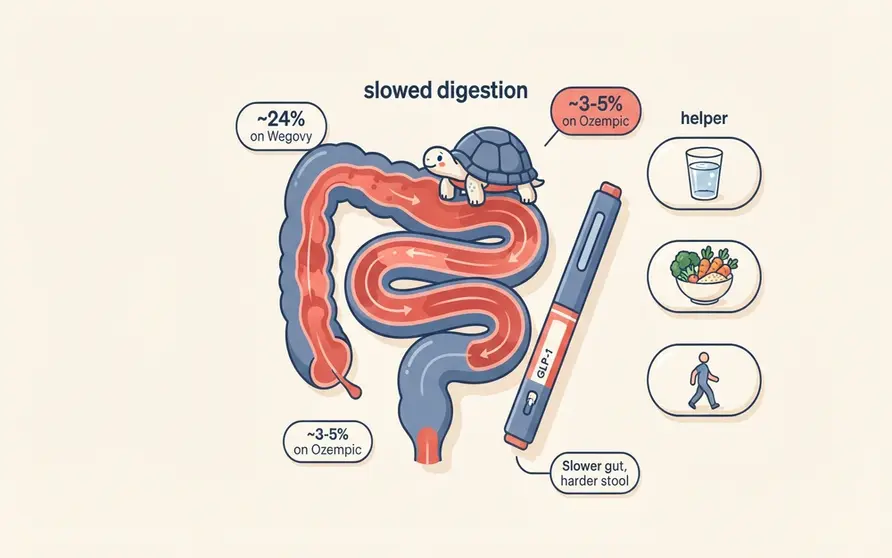
If you started a GLP-1 drug for weight or blood sugar and your bathroom routine ground to a halt, you are not imagining it. Constipation is one of the most common complaints on Ozempic and its relatives, and it comes from the same feature that makes the drugs work.
The good news is that constipation is usually manageable and rarely serious. This article explains the mechanism in plain terms, gives the actual rates from the four US drug labels, and separates the ordinary sluggishness that responds to simple steps from the rare warning signs that need a doctor.
Why does Ozempic cause constipation?
GLP-1 drugs slow the movement of food through the gut. This is not a side quirk of the medicine; it is central to how the drug reduces appetite. By delaying how quickly the stomach empties, semaglutide and tirzepatide keep you feeling full for longer.1
The same slowdown continues further along. When the intestines move their contents more slowly, the body has more time to reabsorb water from the stool. Less water in the stool means it becomes harder, drier and more difficult to pass, which is the everyday experience people describe as constipation.1
A 2026 narrative review in Drug Design, Development and Therapy examined the safety profile of these drugs and grouped nausea, vomiting, diarrhoea and constipation together as the most consistently reported side effects, and as the leading reason people discontinue treatment.1 The review frames these effects as predictable results of how the drug works, rather than signs of damage to the gut.1
How common is constipation on Ozempic?
Common, but the exact figure depends heavily on the specific drug and the dose. The clearest numbers come from the manufacturers' own clinical trials, printed in each US label.
In the diabetes trials, constipation was reported by about 3 to 5% of people taking Ozempic and 6 to 7% of people taking Mounjaro, against roughly 1 to 2% on placebo.24 In the weight-management trials, which use higher doses, the rates were markedly higher: about 24% on Wegovy and 11 to 17% on Zepbound.35
| US label | Trial population | Constipation vs placebo |
|---|---|---|
| Ozempic (semaglutide) | Type 2 diabetes | 3 to 5% vs 1.5% |
| Mounjaro (tirzepatide) | Type 2 diabetes | 6 to 7% vs 1% |
| Zepbound (tirzepatide) | Weight management | 11 to 17% vs 5% |
| Wegovy (semaglutide) | Weight management | 24% vs 11% |
Reported constipation rate versus placebo, taken from each drug's current US prescribing information. The diabetes labels (Ozempic, Mounjaro) and the weight-management labels (Wegovy, Zepbound) come from different trial programs, populations and doses, so these figures are not a head-to-head comparison. The Zepbound figure also counts hard stools.2345
Two patterns stand out. First, tirzepatide and semaglutide sit in a similar range within each use. Second, and more useful for a reader, the higher weight-loss doses come with more constipation than the diabetes doses. If you moved from a starting dose to a higher one and things got worse, the numbers say that is expected.1
The effect that makes you eat less is the same effect that slows your gut. Constipation is not a sign the drug is harming you, but a predictable result of how it works. Summarising the 2026 Drug Design, Development and Therapy review
What actually helps constipation?
The 2026 review lists the practical levers as the standard ones, and they are worth trying before anything stronger: increase the dose slowly under your prescriber's guidance, drink more fluid, eat more dietary fibre, and stay physically active.1
Each of these works against the mechanism. Fluid keeps stool softer when the gut is pulling water out of it. Fibre adds bulk that helps the intestine keep things moving. Physical activity stimulates the natural muscular waves that push stool along. And a slow dose increase gives the gut time to adapt, which is why prescribers titrate these drugs upward gradually rather than starting high.1
Many people also reach for an over-the-counter fibre supplement or a gentle laxative. These are reasonable options, but confirm any addition with your prescriber or pharmacist first. Constipation that keeps worsening despite these steps is a reason to check in, not a reason to keep stacking remedies on your own.
When is constipation an emergency?
Ordinary constipation is uncomfortable but not dangerous. The rare version is different, and it is worth knowing the line between them.
All four US GLP-1 labels carry the same warning: these drugs can, uncommonly, cause severe constipation with fecal impaction, along with intestinal blockage known as ileus and bowel obstruction.2345 These are serious events, not the everyday sluggishness most people get.
Seek medical care promptly if you have gone several days with no bowel movement and you also have severe or worsening stomach pain, a hard swollen belly, persistent nausea or vomiting, or an inability to pass gas. Those are the signs that constipation has tipped into something that needs treatment rather than home measures.2
In one sentence: Ozempic and other GLP-1 drugs cause constipation because they slow the gut, which is also how they curb appetite; the rate runs from about 3% in diabetes trials to 24% at the highest weight-loss doses, it usually responds to more fluid, fibre and movement plus a slow dose increase, and only rarely turns into a blockage that needs urgent care.
Frequently asked
Why does Ozempic make you constipated?+
How common is constipation on Ozempic?+
What helps constipation from Ozempic?+
When should I worry about constipation on Ozempic?+
References
- Tobaiqy M, Alqutub ST. Adverse events associated with incretin-based therapies: a narrative review on mechanisms, clinical management, and risk mitigation. Drug Des Devel Ther. 2026. Europe PMC. doi:10.2147/DDDT.S622972. PMID: 42544311. Narrative review synthesising 60 studies and safety reports; qualitative, so it describes patterns and management rather than a single pooled effect size.
- Novo Nordisk. OZEMPIC (semaglutide) injection, for subcutaneous use: US prescribing information. DailyMed, US National Library of Medicine, accessed August 2026. Reports constipation in 5.0% of patients at 0.5 mg and 3.1% at 1 mg versus 1.5% on placebo, and lists severe constipation with fecal impaction, ileus and intestinal obstruction among postmarketing gastrointestinal events.
- Novo Nordisk. WEGOVY (semaglutide) injection and tablets: US prescribing information. DailyMed, US National Library of Medicine, accessed August 2026. Reports constipation in 24% of patients on the 2.4 mg dose versus 11% on placebo, and lists severe constipation with fecal impaction, ileus and intestinal obstruction among postmarketing events.
- Eli Lilly and Company. MOUNJARO (tirzepatide) injection, for subcutaneous use: US prescribing information. DailyMed, US National Library of Medicine, accessed August 2026. Reports constipation in 6 to 7% of patients across the 5 mg, 10 mg and 15 mg doses versus 1% on placebo, and lists severe constipation with fecal impaction, ileus and intestinal obstruction among postmarketing events.
- Eli Lilly and Company. ZEPBOUND (tirzepatide) injection, for subcutaneous use: US prescribing information. DailyMed, US National Library of Medicine, accessed August 2026. Reports constipation, including hard stools, in 11 to 17% of patients across doses versus 5% on placebo, and lists severe constipation with fecal impaction, ileus and intestinal obstruction among postmarketing events.
Evidence current as of August 23, 2026. This article is educational only and is not medical advice. Semaglutide and tirzepatide are prescription-only and should be used under medical supervision. The constipation rates are from clinical trials in different populations and at different doses, so they are not directly comparable between drugs, and individual results vary. Do not start, stop, or change a prescribed medicine because of anything you read here. Talk to your doctor or pharmacist before adding a laxative or fibre supplement, and seek prompt care for severe or worsening abdominal pain, a hard swollen belly, vomiting, or an inability to pass stool or gas.
Translating new metabolic and obesity research into plain English for people living on GLP-1 therapy. Every claim is traced to its source.