Are GLP-1 drugs safe to take long term?
The biggest safety review so far, a 2026 JAMA Network Open umbrella review of 60 meta-analyses and about 3.58 million people, found the familiar gut side effects as the only high-certainty harms and no high-certainty new organ-system risk out to roughly five years. But most other outcomes were low certainty, and true 10-year data still does not exist.
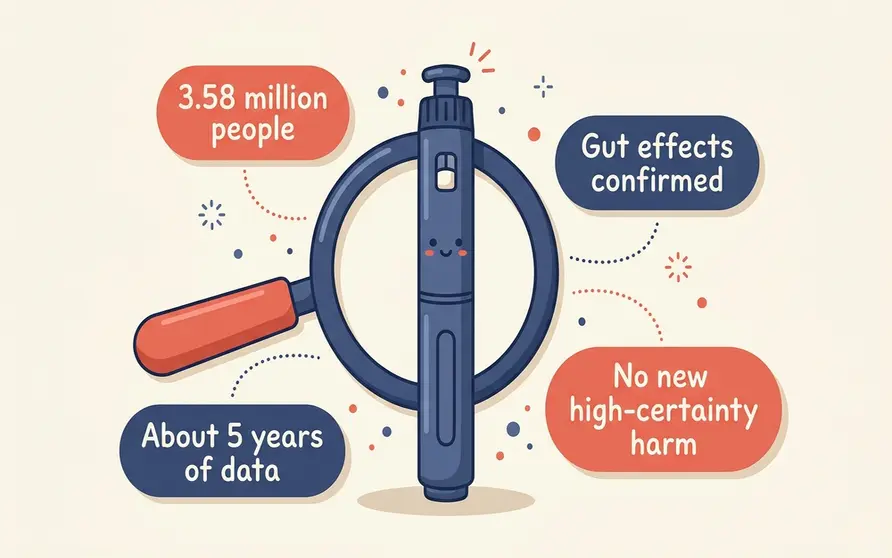
"Are GLP-1 drugs safe to take long term" is one of the most-searched questions about these medicines, and until recently the honest answer was "we do not have one big study that settles it." That changed in 2026, when the largest safety review so far was published. The short version: it is broadly reassuring about new organ-system harms, it confirms the gut side effects everyone already knows, and it still only reaches about five years.
This article explains what that review is, what it actually found, and, just as important, what it still cannot tell you. Nothing here is a reason to start, stop, switch or change the dose of a medicine on your own. That is a decision for you and your doctor.
What did the biggest safety review find?
The review is an umbrella review, which means a study of studies, published in JAMA Network Open in March 2026.1 It pooled 60 separate meta-analyses of randomized trials, covering 1,751 trials and 3,580,616 people, and looked specifically at non-cardiometabolic outcomes, meaning everything beyond the known effects on blood sugar, weight, heart and kidney.1 In plain terms, it is the "what about the rest of my body" safety picture.
The headline is calm. The most consistent, best-supported signals were gastrointestinal, the nausea and diarrhea already on every label. For most of the organ-system fears people search for, the review could not find a high-certainty harm, but it also graded the evidence for most of those outcomes as low certainty.1 Those two facts have to be held together, and the rest of this article does exactly that.
Which side effects are proven?
The gastrointestinal effects are the part of the picture the evidence is confident about. The review reports higher odds of nausea, diarrhea and vomiting, and it graded the first two as high certainty.1 An odds ratio above 1 means higher odds of that effect than placebo, and below 1 means lower odds. The table below shows the main signals.
| Outcome | Odds ratio (95% CI) | Certainty |
|---|---|---|
| Nausea | 2.47 (1.84-3.34) | High |
| Diarrhea | 1.94 (1.52-2.49) | High |
| Vomiting | 2.78 (1.91-4.06) | Moderate |
| Serious infections | 0.89 (0.87-0.92) | High (lower risk) |
| New respiratory disease | 0.85 (0.80-0.92) | Suggestive |
| Gallbladder or biliary disease | 1.34 (1.16-1.55) | Exploratory |
Pooled odds ratios from the GLP-1 noncardiometabolic umbrella review, JAMA Network Open, 2026.1 Certainty is the authors' GRADE rating. The gallbladder signal did not meet the review's stringent credibility thresholds and is labelled exploratory. Figures are averages across trials; individual risk varies.
What does "low certainty" mean?
Low certainty is the phrase that does the heavy lifting here, so it is worth being blunt about it. When the review grades an outcome as low certainty, it means the evidence is too thin, too mixed, or too short to draw a firm conclusion in either direction.1 It is not the same as a clean bill of health.
So when people read that the biggest review found no high-certainty cancer, thyroid, bone or mental-health alarm, the accurate reading is "not shown to be a problem on current evidence," not "proven safe." That distinction is the single most important thing to carry away from this piece.
"Not shown to be harmful is not the same thing as shown to be safe."
Does "long term" mean forever?
No, and this caveat is central. The trials inside the review had follow-up ranging from 3 months to about 5.4 years or longer.1 So "long term" in this evidence means up to roughly five years, not a decade and not a lifetime.
For most of these outcomes, genuine 10-year-plus safety data simply does not exist yet, because the drugs have not been in widespread use that long. The most comprehensive read available today stops at about five years, and anyone who tells you the decade-out picture is settled is going beyond the evidence.
What about cancer, thyroid and mental health?
These are the fears that drive most of the searching, and the review is reassuring but not conclusive on them. Across its cancer, fracture, neurologic, psychiatric and endocrine domains, no high-certainty harm emerged, yet the authors graded most of these outcomes as low certainty, so the evidence could neither confirm nor rule them out.1
That is why specific risks are still screened for individually rather than waved away. The Academy covers several of them in their own right, including whether Ozempic causes thyroid cancer, the pancreatitis question, how much muscle you lose, and the eye-health signal. This review sits above those articles as the big-picture summary, not a replacement for them.
Are there any upsides in the data?
Yes, and they are worth naming because the safety conversation is usually one-sided. The review found lower odds of serious infections, graded high certainty, and a suggestive signal of less new respiratory disease.1 Both are flagged as needing further confirmation rather than established, so they are early good news, not a reason to take the drug.
On the other side, a modest signal for gallbladder or biliary disease appeared but did not meet the review's stringent credibility thresholds, so the authors labelled it exploratory.1 It is a known association with rapid weight loss, and it is one more reason the safety picture is "mostly reassuring, with specifics to watch" rather than a flat all-clear.
What should this change for someone on a GLP-1?
Practically, very little changes on your own initiative. The proven burden of these drugs is gastrointestinal, it is usually mild, and it is most common while the dose is being raised rather than years in. The biggest review to date did not surface a new high-certainty organ-system harm out to about five years, which is genuinely reassuring for medium-term use.
What it cannot do is promise a decade. So the sensible posture is to keep routine monitoring and follow-up with the clinician who prescribes the drug, raise any specific worry with them rather than acting on a headline, and treat this evidence as the best current map, not the final word.
In one sentence: The largest GLP-1 safety review so far confirmed the familiar gut side effects, found no high-certainty new organ-system harm out to about five years, and graded most other outcomes as low certainty, so the honest answer is "broadly reassuring to roughly five years, with true long-horizon data still missing."
Frequently asked
Are GLP-1 drugs safe to take for years?+
What are the proven long-term side effects of GLP-1 drugs?+
Do GLP-1 drugs cause cancer or thyroid problems?+
References
- Yang K, Liu C, Guo Q, Li Y. GLP-1 Receptor Agonists and Noncardiometabolic Outcomes: An Umbrella Review of Meta-Analyses. JAMA Network Open, 2026 Mar 2;9(3):e264722. doi:10.1001/jamanetworkopen.2026.4722; PMID 41915388; PMCID PMC13040404. Umbrella review of 60 meta-analyses (1,751 randomized trials, 3,580,616 participants), follow-up 3 months to 5.4 years or longer; appraised with AMSTAR 2 and GRADE. Academic authors at the First Hospital of China Medical University, Shenyang; no conflicts of interest reported.
Evidence current as of October 28, 2026. This article is general information, not medical advice. GLP-1 drugs are prescription-only and should be used under medical supervision; always consult a qualified clinician before starting, stopping or changing a medication.
Translating new metabolic and obesity research into plain English for people living on GLP-1 therapy. Every claim is traced to its source.