Does Ozempic cause pancreatitis?
Large studies have not found that Ozempic and similar GLP-1 drugs raise the risk of pancreatitis. A 2026 meta-analysis of 52 studies found no significant increase. But acute pancreatitis remains a rare, labelled warning with emergency symptoms, so the caution stays even though the average risk looks reassuring.
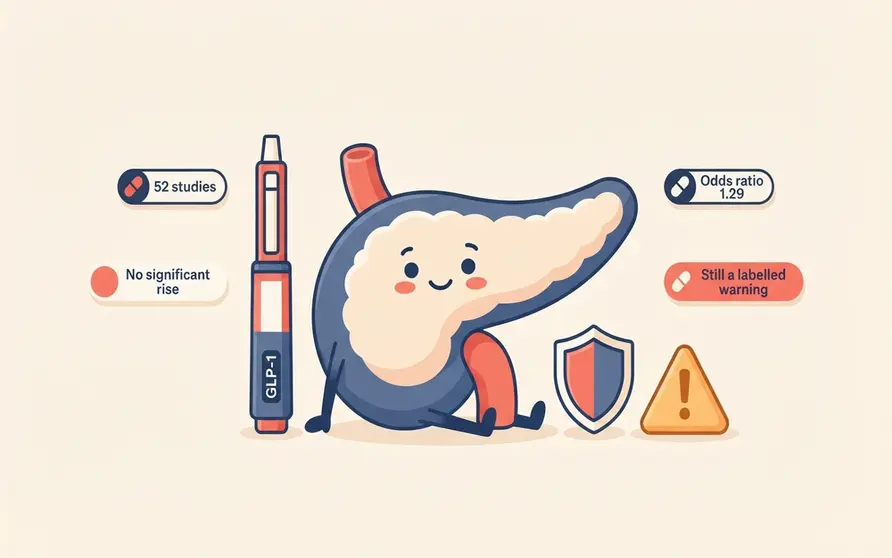
Pancreatitis is one of the most feared names attached to GLP-1 drugs. Search "Ozempic pancreatitis" and the first page is mostly law firms, not doctors. So it is worth separating what the largest studies actually show from what the lawsuit ads imply.
The short answer: the best pooled evidence to date does not find that these drugs meaningfully raise pancreatitis risk. But acute pancreatitis is still listed as a warning on every label, it is a genuine emergency when it happens, and "no clear signal" is not the same as "no risk at all." This article holds both of those facts together.
Does Ozempic cause pancreatitis?
On current evidence, Ozempic and other GLP-1 drugs are not clearly linked to a higher rate of pancreatitis. The strongest single source is a 2026 meta-analysis in Hormone and Metabolic Research that pooled 52 studies of these drugs used for weight management.1
Pooling all 52 studies, the analysis found a pancreatitis odds ratio of 1.29, with a 95% confidence interval of 0.91 to 1.84.1 Because that interval crosses 1.0, the result was not statistically significant, meaning the data cannot distinguish the drug's risk from the comparator's. The authors, who declared no conflict of interest, concluded that GLP-1 drugs used for weight management were not associated with an increased risk of pancreatitis.1
What did the 52-study analysis find?
The researchers searched five major databases through June 15, 2026, and pooled results using Peto odds ratios, applying random-effects models where the studies disagreed with each other.1 They then re-ran the analysis by study design, follow-up length, control type, drug and dose.
The reassuring finding held up across those subgroups and across leave-one-out sensitivity analyses, in which the pooled result is recalculated with each study removed in turn to check that no single trial is driving it.1 That consistency is what makes the "no significant increase" conclusion more than a one-off.
The same paper also looked at pancreatic cancer and found an odds ratio of 1.34 (95% confidence interval 0.76 to 2.34), which again did not reach significance.1 The evidence on cancer is more mixed: a separate large meta-analysis has reported a slightly protective association, so the honest read is that no study shows a significant increase, not that the question is fully settled. We cover that literature in our companion piece on whether Ozempic causes pancreatic cancer.
What do the drug labels say?
Every US GLP-1 label carries acute pancreatitis as a warning, and each one reports how often it actually happened in the trials. Those trial numbers are the most concrete answer to "how common is this," and they line up with the meta-analysis: rare, and close to the comparator rate.
| US label | Trial population | Pancreatitis vs comparator |
|---|---|---|
| Ozempic (semaglutide) | Type 2 diabetes | 0.3 vs 0.2 per 100 patient-years |
| Wegovy (semaglutide) | Weight management | 0.2 vs under 0.1 per 100 patient-years |
| Mounjaro (tirzepatide) | Type 2 diabetes | 0.23 vs 0.11 per 100 patient-years |
| Zepbound (tirzepatide) | Weight management | 0.2% vs 0.2% (about 0.14 vs 0.15 per 100 patient-years) |
Adjudication-confirmed acute pancreatitis, taken from each drug's current US prescribing information. The diabetes labels (Ozempic, Mounjaro) and the weight-management labels (Wegovy, Zepbound) come from different trial programs, populations and doses, so these figures are not a head-to-head comparison. Counts are small, so exact rates should be read as low, not precise.2345
Two things stand out. First, the absolute numbers are tiny: a fraction of one case per 100 patient-years, meaning most people will go years without seeing it.2 Second, the drug-arm and placebo-arm rates are close, and in the Zepbound weight-loss trials they were essentially identical.5 That pattern is exactly what the pooled meta-analysis captured.
The average risk looks reassuring, but the label still says to stop the drug and seek care if pancreatitis is suspected. Both things are true at once. Reading the 2026 meta-analysis alongside the US labels
Does no signal mean no risk?
No. A pooled result that is not significant means the studies could not detect a clear difference, not that the risk is proven to be zero. Pancreatitis is uncommon, so even large trials contain only a handful of cases, and small numbers make firm conclusions hard.1
Most of the pooled evidence also comes from trials that lasted months to a few years, and much of it relies on cases reported during routine safety monitoring rather than actively hunted for. There is also a real counter-example inside the labels: one pooled analysis of Zepbound in obstructive sleep apnea reported a higher pancreatitis rate on the drug than on placebo, on very small numbers.5 Naming that keeps the reassuring headline honest.
So the fair summary is that GLP-1 drugs do not appear to raise pancreatitis risk on average, while acute pancreatitis remains a listed, if uncommon, adverse event that both patients and prescribers should still watch for.2
Who should be cautious, and when to worry?
A history of pancreatitis is not a formal reason to avoid these drugs. The US labels contraindicate them only for people with a personal or family history of medullary thyroid cancer, the MEN 2 syndrome, or a serious allergy to the medicine.2 Even so, anyone who has had pancreatitis before should raise it with their prescriber, who can weigh the history and monitor more closely.
The part everyone should know is what an attack looks like. All four labels describe acute pancreatitis as severe, persistent abdominal pain, often in the upper belly and sometimes radiating to the back, which may or may not come with nausea or vomiting.25 Fever, a yellow tint to the skin or eyes, and clay-coloured stools can also appear.5
Every label gives the same instruction: if pancreatitis is suspected, stop the drug and get medical care.2345 This is not a "wait and see" side effect like mild nausea. Acute pancreatitis is a medical emergency, and prompt treatment matters.
In one sentence: a 2026 meta-analysis of 52 studies and the four US drug labels agree that pancreatitis on Ozempic and its relatives is rare and not clearly more common than on placebo, but acute pancreatitis is still a labelled warning and a medical emergency, so people with a history of it should talk to their doctor and everyone should know the warning signs.
Frequently asked
Does Ozempic cause pancreatitis?+
How common is pancreatitis on Ozempic?+
Can you take Ozempic if you have had pancreatitis?+
What are the warning signs of pancreatitis on Ozempic?+
References
- Zhong X, Zhao Y, Han M, Zheng Q, Cheng Q, Shi B, Zhang Y. Effects of glucagon-like peptide-1 receptor agonists as weight loss drugs on pancreatitis and pancreatic cancer: a meta-analysis. Horm Metab Res. 2026. PubMed. doi:10.1055/a-2923-3830. PMID: 42600634. Pooled 52 studies; pancreatitis odds ratio 1.29 (95% CI 0.91 to 1.84, not significant) and pancreatic cancer odds ratio 1.34 (95% CI 0.76 to 2.34, not significant); authors declare no conflict of interest.
- Novo Nordisk. OZEMPIC (semaglutide) injection, for subcutaneous use: US prescribing information. DailyMed, US National Library of Medicine, accessed August 2026. Lists acute pancreatitis as a Warnings and Precautions item and reports it adjudication-confirmed in 7 Ozempic-treated patients (0.3 cases per 100 patient-years) versus 3 comparator-treated patients (0.2 per 100 patient-years) in glycemic control trials.
- Novo Nordisk. WEGOVY (semaglutide) injection and tablets: US prescribing information. DailyMed, US National Library of Medicine, accessed August 2026. Reports acute pancreatitis adjudication-confirmed in 4 Wegovy-treated patients (0.2 cases per 100 patient-years) versus 1 placebo-treated patient (less than 0.1 per 100 patient-years) in weight-reduction trials, with one additional case in another trial.
- Eli Lilly and Company. MOUNJARO (tirzepatide) injection, for subcutaneous use: US prescribing information. DailyMed, US National Library of Medicine, accessed August 2026. Reports 14 events of acute pancreatitis adjudication-confirmed in 13 Mounjaro-treated patients (0.23 patients per 100 years of exposure) versus 3 events in 3 comparator-treated patients (0.11 per 100 years).
- Eli Lilly and Company. ZEPBOUND (tirzepatide) injection, for subcutaneous use: US prescribing information. DailyMed, US National Library of Medicine, accessed August 2026. In the pooled weight-reduction trials (Studies 1 and 2), 0.2% of Zepbound-treated patients had adjudication-confirmed acute pancreatitis (0.14 per 100 years of exposure) versus 0.2% on placebo (0.15 per 100 years); a separate obstructive sleep apnea pool reported 0.84 per 100 years on Zepbound versus 0 on placebo.
Evidence current as of August 24, 2026. This article is educational only and is not medical advice. Semaglutide and tirzepatide are prescription-only and should be used under medical supervision. "No significant increase" means studies did not detect a clear difference, not that risk is zero, and the trial rates come from different populations and doses, so they are not directly comparable between drugs. Individual results vary. Do not start, stop, or change a prescribed medicine because of anything you read here. Seek urgent medical care for severe or persistent abdominal pain, especially if it spreads to the back or comes with vomiting, fever, or yellowing of the skin or eyes.
Translating new metabolic and obesity research into plain English for people living on GLP-1 therapy. Every claim is traced to its source.