Can a genetic test predict if Ozempic will work?
Not yet. A 2026 Nature study of 27,885 people on GLP-1 drugs found gene variants that nudge how much weight you lose and how likely you are to feel sick. But the effects are tiny, the outcomes were self-reported, and every author works for a genetics company. No genetic test should change your prescription today.
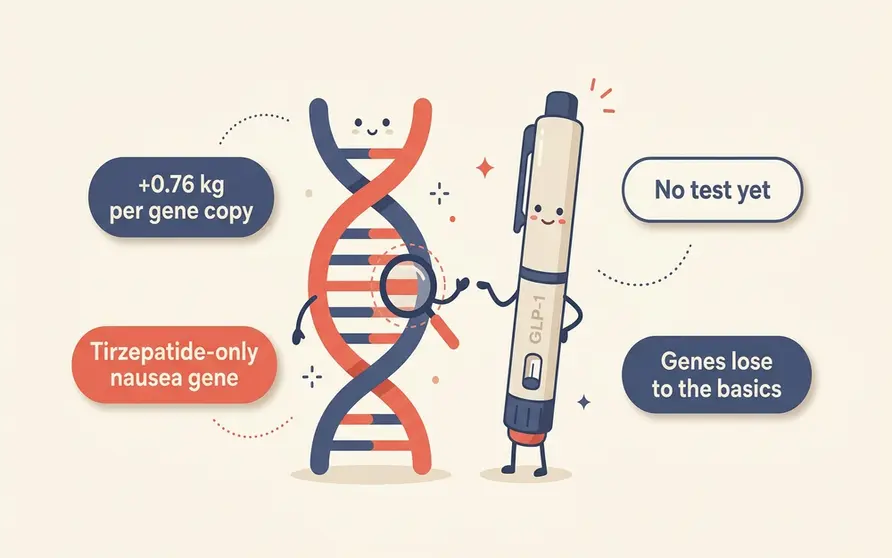
Personalized medicine has reached GLP-1 drugs, at least in the headlines. The question people are now asking is simple: can a cheek-swab genetic test, like the one from a consumer company, tell you whether Ozempic or Mounjaro will work for you, or whether it will make you sick? In 2026 a large study gave the first real answer, and the honest version is more cautious than the marketing.
What did the Nature study find?
Researchers ran a genome-wide association study of self-reported weight loss and treatment side effects in 27,885 people taking GLP-1 receptor agonists, published in Nature in 2026.1 A genome-wide association study scans the whole genome to see which common gene variants track with an outcome. The team found that variation in the drugs' own target genes does influence how people respond, and they built the signals into a model that could sort patients by expected benefit and side-effect risk.
That is a genuine scientific first. For years, doctors have had no biological marker to explain why one person loses 20 percent of their body weight on these drugs and another loses almost nothing. This study shows at least part of that variation is written in the genes for the GLP-1 and GIP receptors. The catch is what the finding means for any single person standing in a pharmacy.
Can a gene predict your weight loss?
The strongest efficacy signal was a missense variant in the GLP1R gene, which codes for the receptor these drugs act on. It was associated with greater weight loss at a highly significant level (P = 2.9 x 10⁻¹⁰), worth about an extra 0.76 kg of weight loss per copy of the effect allele.1 A P-value that small means the association is real and not a fluke.
Real is not the same as useful. An extra 0.76 kg per gene copy is a tiny fraction of the 15 to 25 percent of total body weight that semaglutide and tirzepatide remove in obesity trials, which you can see in our breakdown of how much weight each drug actually delivers. A gene can reach statistical significance across tens of thousands of people and still tell you almost nothing about your own result, because it explains only a sliver of the person-to-person difference.
Do your genes predict nausea?
The study also looked at side effects, and here the genetics were more interesting. Variants in both GLP1R and GIPR were associated with higher odds of nausea or vomiting.1 One detail stood out: the GIPR nausea signal appeared only in people taking tirzepatide, the drug in Mounjaro and Zepbound, and not in those taking semaglutide.
That pattern is biologically logical. Tirzepatide is the only one of these drugs that also acts on the GIP receptor, so a GIPR variant plausibly matters for tirzepatide and not for semaglutide. It is an elegant, drug-specific result. Even so, it predicts nothing certain for an individual: the association is a shift in odds across a large group, not a verdict on whether you will feel queasy. If nausea is your worry, our guide to managing GLP-1 nausea without quitting is more useful than any swab.
| Genetic signal | What it was linked to | What it means for you |
|---|---|---|
| GLP1R variant (efficacy) | About 0.76 kg more weight loss per copy | Real but tiny next to a 15 to 25 percent total loss |
| GLP1R variants (side effects) | Higher odds of nausea and vomiting | Cannot tell you if you personally will feel sick |
| GIPR variant | More vomiting, tirzepatide users only | Biologically logical, still not a prescribing tool |
Source: Su et al., Nature, 2026, a genome-wide association study of 27,885 GLP-1 users with self-reported outcomes.1
"A gene can reach statistical significance across tens of thousands of people and still tell you almost nothing about your own result."
Who ran the study, and why it matters
This is the part a sales page will skip. Every author of the Nature paper is a current or former employee of 23andMe, the direct-to-consumer genetics company, with the study run through its research arm.1 That does not make the science wrong. It is peer-reviewed, in one of the world's top journals, with a very large sample. But a company whose business is selling genetic tests publishing a paper about genetic prediction is a textbook reason to read the headline slowly rather than reach for your wallet.
There is a second limitation built into the data. Both the weight loss and the side effects were self-reported by participants, not measured in a controlled trial. Self-report is how a consumer-genetics dataset gets this big, but it is softer evidence than a clinic weighing people and recording adverse events. The study itself frames its results as a foundation for future precision medicine, which is to say a research starting point, not a test to act on.
Do genes beat the basics?
No, and this is the most practical point in the whole story. Two 2026 reviews of what predicts GLP-1 response put the weight on ordinary clinical factors, not genetics. One review of semaglutide response found that women lose more weight than men, by around 6 percent on average, that type 2 diabetes predicts smaller weight loss, and that there is no clear link between weight loss and either age or starting BMI.2 It described the GLP1R gene effect as modest and poorly understood.
A second review was blunter about the genetics. It concluded that no single baseline characteristic reliably predicts response, and that the genetic findings so far come from a single, unreplicated study and are hypothesis-generating only.3 The most useful predictor it identified was not a gene at all: it was how a person responds in the first weeks of treatment. A cheek swab does not beat watching the scale.
Should you buy a genetic test for this?
There is no validated genetic test that should change which GLP-1 drug or dose anyone is prescribed today. Buying a consumer test to pick between Ozempic and Mounjaro would be spending money on a result no clinician can yet act on. If you already have genetic data and you are curious, the sensible move is to bring it to your prescriber, who will still choose a drug on clinical grounds: your health history, which conditions you have, how you tolerate the first doses.
This is a different question from whether these drugs affect your biological age, which the Academy covers separately in what the epigenetic-clock data shows. That work measures how old your cells look; this study is about which gene variants you inherited. The two get blurred together under "GLP-1 and your DNA," but they answer completely different questions.
In one sentence: a 2026 Nature study found real genetic signals that nudge GLP-1 weight loss and nausea, including an elegant tirzepatide-only nausea gene, but the effects are small, the data are self-reported and come from a genetics company, and no genetic test can yet predict how the drug will work for you.
Frequently asked
Can a genetic test predict if Ozempic will work for me?+
Does a gene affect whether Ozempic makes you nauseous?+
Should I buy a 23andMe test to choose a GLP-1 drug?+
References
- Su QJ, Ashenhurst JR, Xu W, et al.; 23andMe Research Team. Genetic predictors of GLP1 receptor agonist weight loss and side effects. Nature. 2026 May;653(8115):770-775. Epub 2026 Apr 8. DOI: 10.1038/s41586-026-10330-z. PMID: 41951734. Note: all authors are current or former employees of 23andMe, the direct-to-consumer genetics company; outcomes were self-reported.
- Tzoulis P. Predictors of treatment response to semaglutide for weight management. Frontiers in Endocrinology (Lausanne). 2026;17:1893511. Epub 2026 Sep 17. DOI: 10.3389/fendo.2026.1893511. PMID: 42824923.
- Kurylowicz A, Czupryniak L. Responders vs. non-responders, or how to predict the response to GLP-1 or GLP-1/GIP receptor agonist therapy. Diabetes, Obesity and Metabolism. 2026 Aug 23. DOI: 10.1111/dom.71226. PMID: 42634284.
Evidence current as of October 13, 2026. This article is educational and not medical advice. Always consult your clinician before changing medication or dose.
Translating new metabolic and obesity research into plain English for people living on GLP-1 therapy. Every claim is traced to its source.