Can Ozempic damage your eyes?
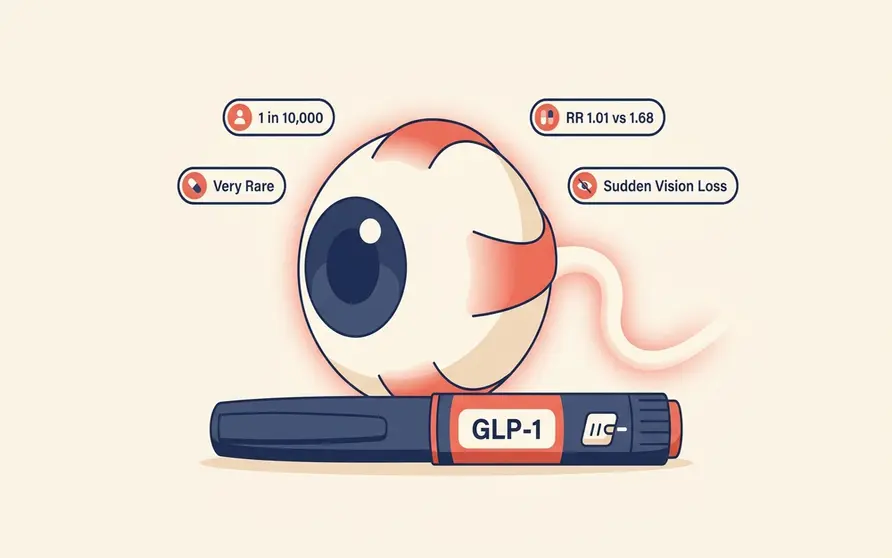
Europe's medicines regulator classifies NAION, a rare form of sudden vision loss, as a very rare side effect of semaglutide: roughly one extra case per 10,000 person-years. The largest pooled review found no increased risk overall. Its own sensitivity analysis, dropping a single study, found the opposite.
Search "Ozempic eyes" and the first page belongs largely to law firms. Search the medical literature for the same question and the top result is a June 2026 meta-analysis reporting no increased risk. Both of those things are true at the same time, and neither is the whole answer.
This article does not argue that semaglutide is safe for your eyes, and it does not argue that it blinds people. It explains what each type of evidence can and cannot measure, because that is where the apparent contradiction actually lives.
What is NAION?
NAION, or non-arteritic anterior ischemic optic neuropathy, is a sudden loss of blood supply to the front of the optic nerve that causes painless vision loss, usually in one eye. It is one of the most common causes of blindness in adults, and its underlying mechanism is still not established.3
NAION comes on without pain, which is part of why it can be dismissed for a day or two. Barnett and colleagues describe it as one of the most common causes of blindness among adults, with numerous recognised risk factors including systemic diseases and medications.3 That combination of rarity and severity is why regulators act on even a small signal.
How common is NAION on semaglutide?
The European Medicines Agency answered this question directly. In June 2025 its safety committee concluded that NAION is a very rare side effect of semaglutide, which in regulatory language means it may affect up to 1 in 10,000 people taking the medicine.2
The EMA also quantified the size of the effect. Large epidemiological studies suggested that semaglutide exposure in adults with type 2 diabetes is associated with an approximately two-fold increase in NAION risk, corresponding to approximately one additional case per 10,000 person-years of treatment.2
That recommendation applied to Ozempic and Rybelsus, which are prescribed for type 2 diabetes, and to Wegovy, which is prescribed for weight management. All three contain semaglutide.2
What did the biggest review find?
The largest synthesis to date is a systematic review and meta-analysis published in Frontiers in Pharmacology on 2 June 2026 by Anatriello and colleagues, pooling 28 observational studies of ocular adverse events in people with type 2 diabetes.1
Its headline result is a null. Compared with other antidiabetic treatments, GLP-1 receptor agonists were not associated with an increased risk of NAION (RR 1.01, 95% CI 0.62 to 1.64), glaucoma (HR 0.84, 95% CI 0.71 to 1.00), new-onset retinopathy (HR 0.96, 95% CI 0.85 to 1.08) or retinopathy progression (HR 0.97, 95% CI 0.83 to 1.14).1
Two scope details matter before anyone quotes that as an all-clear. The comparison group was other diabetes drugs, not people taking nothing, and the included populations were patients with type 2 diabetes, not the wider weight-management population.1
Why does one study change the answer?
Because the pooled NAION estimate turns out not to be stable. The same paper ran a leave-one-out sensitivity analysis, a standard check that repeats the calculation with each study removed in turn to see whether any single dataset is driving the result.1
Removing one study, by Cai and colleagues, flipped the finding: the risk ratio rose to 1.68 (95% CI 1.10 to 2.57), a statistically significant increase. The authors state in their own discussion that this result is in line with the European regulator's evidence.1
The heterogeneity figure explains why that is possible. For NAION the I-squared statistic was 89%, and the authors report that heterogeneity exceeded 85% for most of their analyses, which they attribute partly to limited sample size and power.1 High heterogeneity means the pooled studies were not measuring the same thing consistently, so the average across them is fragile.
In other words: the review most likely to be quoted as proof of no risk contains, inside its own robustness check, a result that agrees with the regulators. Anyone citing only the 1.01 is citing half the paper.
What does the largest cohort show?
The single largest study of this question is a retrospective cohort by Barnett and colleagues, published in Cureus in January 2026, using the TriNetX network. After one-to-one propensity-score matching on 20 covariates it compared 388,333 adults with type 2 diabetes taking a GLP-1 receptor agonist against 388,333 who were not, a total of 776,666 people followed for five years.3
It found a statistically significant increase: risk ratio 1.339 (95% CI 1.137 to 1.577, p = 0.005). The absolute figure is the one worth carrying: the risk difference was 0.022% (95% CI 0.01% to 0.034%), which is roughly 2 extra cases per 10,000 people over five years.3
The statistical signal is real. What it means for any one person is far less certain, because the benefit-to-risk balance of this drug class is well established. A paraphrase of how Barnett and colleagues read their own result, Cureus, 2026
Why do reporting databases look worse?
This is where the numbers get frightening and least informative. A comparative analysis by Kakkar and colleagues, published in Diabetes, Obesity and Metabolism in June 2026, searched the FDA Adverse Event Reporting System for optic ischaemic neuropathy across six incretin drugs through the third quarter of 2025.4
Semaglutide produced 355 reports and a reporting odds ratio of 94.45 (95% CI 83.02 to 107.45). Tirzepatide produced 49 reports (ROR 2.94) and liraglutide 13 reports (ROR 4.58). Dulaglutide, exenatide and lixisenatide produced no signal at all, which the authors say argues against a uniform class effect.4
A reporting odds ratio measures how disproportionately often a side effect appears in a voluntary reporting database, relative to all other reports. It does not measure how often the event happens, because it has no denominator: nobody knows how many people took the drug and did not report anything.
Reporting volume also responds to attention. When a side effect is covered in the news and named in litigation, clinicians and patients file more reports about it, which inflates the signal for the drug in the headlines without any change in underlying biology. That is the most likely reason semaglutide's number dwarfs every other drug in the class. The authors themselves conclude that prospective studies with confirmed diagnoses are needed to establish causality and quantify absolute risk.4
How the four sources compare
The table below sets them side by side, because the disagreement between them is mostly a disagreement about method.
| Source | Design | Headline result | Main limitation |
|---|---|---|---|
| Anatriello 2026 | Meta-analysis, 28 studies | RR 1.01 (0.62 to 1.64) | Heterogeneity 89%; flips to 1.68 without one study |
| Barnett 2026 | Matched cohort, 776,666 people | RR 1.339; risk difference 0.022% | Observational; coded records, not eye exams |
| Kakkar 2026 | FDA reporting database | ROR 94.45 for semaglutide | No denominator; inflated by attention |
| EMA PRAC 2025 | Regulatory review of all data | Very rare; ~1 per 10,000 person-years | Semaglutide only; based on studies in diabetes |
Sources: Anatriello et al. 20261, European Medicines Agency 20252, Barnett et al. 20263, Kakkar et al. 20264. The four rows use different populations, comparators and outcome definitions, so their numbers are not interchangeable.
Does the US label mention NAION?
Not as of this writing. The US prescribing information for Ozempic and for Wegovy, both revised in June 2026, contains no mention of NAION or ischemic optic neuropathy anywhere in the document.6 The European product information for semaglutide medicines carries NAION as a very rare side effect.2
The US label does carry a different eye warning, and the two are easy to confuse. In SUSTAIN-6, the cardiovascular outcomes trial in patients with type 2 diabetes and high cardiovascular risk, more diabetic retinopathy complications occurred on Ozempic (3.0%) than on placebo (1.8%).6 Diabetic retinopathy is a disease of the retina's small blood vessels. NAION affects the optic nerve. They are different conditions with different warnings and different evidence.
The Ozempic label already instructs patients to contact their physician if changes in vision occur during treatment.6 So the practical advice does not actually differ much between jurisdictions, even though the labelled side effects do.
What should you do about vision changes?
The UK regulator gives the clearest instruction. In a Drug Safety Update issued on 5 February 2026, the Medicines and Healthcare products Regulatory Agency classified NAION as very rare, affecting fewer than 1 in 10,000 patients, and advised that if patients experience a sudden loss of vision, treatment with semaglutide should be stopped.5 Patients are told to seek immediate medical attention if their vision changes.5
Two boundaries on that. Stopping is a clinical decision made when sudden vision loss has actually occurred, not a precaution to take because of a news story. And stopping a diabetes medicine on your own carries its own risk, which is why every regulator routes this through a prescriber.
If your vision changes suddenly, including partial loss in one eye, that warrants urgent assessment whether or not you take a GLP-1 drug, because NAION is a time-sensitive diagnosis and several other causes of sudden vision loss are treatable.
What is worth knowing is that the eye signal is not evenly spread across the class. In the FDA reporting analysis, semaglutide's signal was many times larger than tirzepatide's, and three other GLP-1 drugs produced no signal at all.4 That is a reporting pattern rather than a measured risk, but it is one of the few places where the differences between semaglutide and tirzepatide may matter beyond weight loss. If eye symptoms are your concern, it is a reasonable thing to raise with your prescriber.
For the far more common side effects that actually drive people off these drugs, the published guidance on managing GLP-1 nausea covers what to change first.
In one sentence: NAION on semaglutide is real but very rare, at roughly one to two extra cases per 10,000 people, the studies disagree mainly because they measure different things, and the only action that matters for you is to treat sudden vision loss as an emergency and let a clinician decide about the drug.
Frequently asked
Can Ozempic make you go blind?+
What eye symptoms should I report urgently?+
Should I stop taking Ozempic because of the eye risk?+
Why do studies disagree about Ozempic and NAION?+
References
- Anatriello A, Liguori V, Cagnotta C, Pentella C, Scavone C, Capuano A, Rinaldi B. Ocular disorders during treatment with GLP-1 receptor agonists: a systematic review and meta-analysis of observational studies. Front Pharmacol. 2026;17:1808359. Frontiers in Pharmacology. doi:10.3389/fphar.2026.1808359. PMID: 42311413. PROSPERO CRD420251080120. The authors state that financial support was not received for this work and declare no competing interests.
- European Medicines Agency. PRAC concludes eye condition NAION is a very rare side effect of semaglutide medicines Ozempic, Rybelsus and Wegovy. 6 June 2025. European Medicines Agency.
- Barnett MJ, Ibe F, Lam J. Sight unseen: glucagon-like peptide-1 (GLP-1) agonism therapy and nonarteritic anterior ischemic optic neuropathy. Cureus. 2026;18(1):e100953. PubMed. doi:10.7759/cureus.100953. PMID: 41523719. Open access (CC BY). No funding or competing-interest statement was retrieved from the bibliographic record.
- Kakkar AK, Payra S, Charaya A. Optic ischaemic neuropathy in incretin-based therapy: a comparative analysis of real-world safety data. Diabetes Obes Metab. 2026;28(8):7527-7535. PubMed. doi:10.1111/dom.70952. PMID: 42259643. No funding or competing-interest statement was retrieved from the bibliographic record.
- Medicines and Healthcare products Regulatory Agency (UK). Drug Safety Update: semaglutide and non-arteritic anterior ischaemic optic neuropathy (NAION). 5 February 2026. GOV.UK (PDF).
- Novo Nordisk. OZEMPIC (semaglutide) injection, for subcutaneous use: US prescribing information, revised June 2026. DailyMed, US National Library of Medicine. The WEGOVY prescribing information, revised June 2026, was checked in the same way.
Evidence current as of July 29, 2026. This article is educational only and is not medical advice. Semaglutide and tirzepatide are prescription-only and should be used under medical supervision. Individual results vary, and the figures above are group estimates from studies with differing populations and methods. Sudden loss of vision, including partial loss in one eye, is a medical emergency: seek urgent care. Never stop, pause or change a prescribed medicine without speaking to your clinician.
Translating new metabolic and obesity research into plain English for people living on GLP-1 therapy. Every claim is traced to its source.