Can Ozempic help bipolar disorder?
A 2026 nationwide Swedish study links semaglutide, the drug in Ozempic and Wegovy, to a 21% lower risk of psychiatric hospitalisation in people who have both bipolar disorder and diabetes or obesity. Liraglutide and dulaglutide showed no such link, so this is a semaglutide-specific signal, not a class effect, and it is promising but unproven.
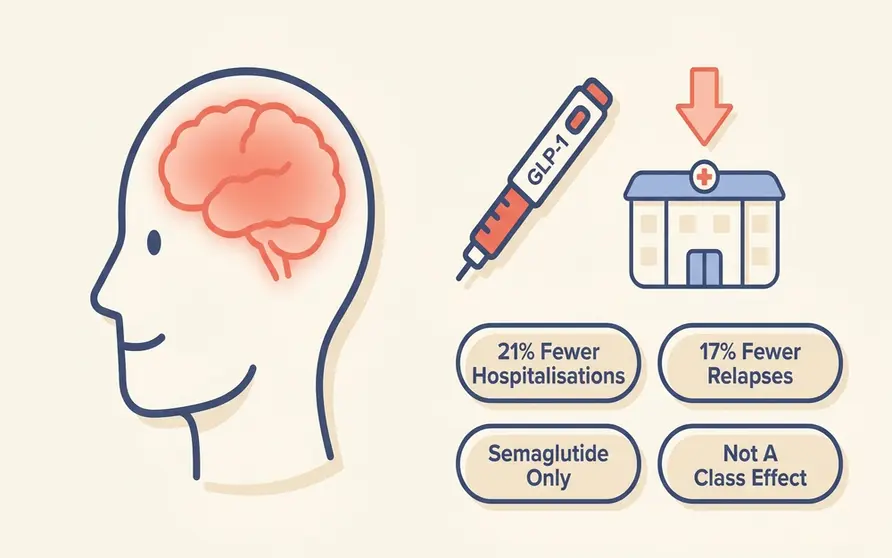
Bipolar disorder, diabetes and obesity often travel together, and the drugs used for one can affect the others. A 2026 study in Acta Psychiatrica Scandinavica asked a direct question: in people who have both bipolar disorder and diabetes or obesity, is using a GLP-1 drug such as semaglutide linked to fewer psychiatric crises?1 The answer it found was yes for semaglutide, and, unexpectedly, no for two other GLP-1 drugs.
What did the bipolar study find?
The study drew on the National Swedish Registers and included every person diagnosed with bipolar disorder who used any antidiabetic medication between 2009 and 2024, a total of 14,694 people, of whom 5,200 used a GLP-1 receptor agonist.1 Semaglutide was associated with a 21% lower risk of psychiatric hospitalisation for any reason, with an adjusted hazard ratio of 0.79 (95% CI 0.69-0.91), compared with periods when the same person was not using a GLP-1 drug.1
Semaglutide was also linked to a 17% lower risk of a hospitalisation following a bipolar relapse, with an adjusted hazard ratio of 0.83 (95% CI 0.69-0.99).1 Absences from work due to psychiatric sick leave were not significantly associated with any of the specific antidiabetic medicines studied, so the clearest signal was in hospitalisation, not day-to-day functioning.1
Why does only semaglutide stand out?
The most striking part of the study is what did not happen. Liraglutide and dulaglutide, two other GLP-1 drugs in the same cohort, were not associated with a lower risk of psychiatric hospitalisation.1 Because these drugs share the same broad mechanism yet did not share the benefit, the authors concluded the finding is not a class effect and appears specific to semaglutide in this data.1
This fits a wider pattern researchers have noticed in 2026, where semaglutide alone shows up in signals that other GLP-1 drugs do not, including a separate mouse study on ageing. That pattern is intriguing but unexplained, and a single registry study cannot prove a drug-specific brain effect. Our companion piece on the Ozempic mouse lifespan study walks through why a semaglutide-only result needs cautious reading rather than hype.
| GLP-1 drug | Link to psychiatric hospitalisation | Adjusted hazard ratio |
|---|---|---|
| Semaglutide | 21% lower risk | 0.79 (95% CI 0.69-0.91)1 |
| Liraglutide | No significant link | Not associated1 |
| Dulaglutide | No significant link | Not associated1 |
"Liraglutide and dulaglutide were not associated with reduced psychiatric hospitalisation, implying this is not a class effect."1
How strong is this evidence?
This is an observational study, not a randomised trial, so it can show an association but cannot prove that semaglutide caused fewer hospitalisations.1 Its main strength is the within-individual design, which compared each person to themselves across periods on and off the drug. That approach removes stable differences between people, such as genetics and baseline illness severity, that muddy ordinary comparisons.1
Several limits still matter. The semaglutide-versus-other-GLP-1 difference comes from one registry study and could partly reflect which patients get prescribed which drug, rather than a true brain effect.1 Everyone studied also had diabetes or obesity, so the results do not speak to people who have bipolar disorder with normal weight and glucose. The authors say plainly that the semaglutide finding should be further tested in a randomised controlled trial.1
Funding and disclosures are worth naming. The analysis used national registry data with no industry funder recorded, but several authors report personal fees or research funding from drug companies including Janssen, Lundbeck and Otsuka.1 That does not invalidate the result, and it is a reason to read a single study as a starting point rather than a verdict.
Is Ozempic a treatment for bipolar disorder?
No. Semaglutide is approved to improve blood sugar in type 2 diabetes, to lower cardiovascular risk in type 2 diabetes with heart disease, and to slow kidney disease in type 2 diabetes; the Ozempic label lists no psychiatric indication.2 Bipolar disorder is a serious condition that needs specialist care, and this study is not a reason to start, stop, or switch any psychiatric or diabetes medicine.
Broader safety questions about GLP-1 drugs and mental health have been examined directly. In January 2026, the FDA completed a review of 91 placebo-controlled trials covering 107,910 patients and found no increased risk of suicidal thoughts, depression, or psychosis, and it requested removal of the suicidality warning from GLP-1 labels.3 That review is about safety across the class, not about treating bipolar disorder, and the two questions should not be blurred.
The honest reading of the bipolar study is narrow and specific. In people who already have bipolar disorder plus diabetes or obesity, semaglutide, and not liraglutide or dulaglutide, was linked to fewer psychiatric hospitalisations, the signal is promising, and it now needs a randomised trial to confirm whether the drug is doing the work.
In one sentence: a large Swedish study links semaglutide, but not other GLP-1 drugs, to fewer psychiatric hospitalisations in people who have both bipolar disorder and diabetes or obesity, an early and observational finding that is not proof and not a treatment for bipolar disorder.1
Frequently asked
Can Ozempic or semaglutide help bipolar disorder?+
Did other GLP-1 drugs show the same benefit?+
Does this mean semaglutide treats bipolar disorder?+
Should someone with bipolar disorder start or switch medication because of this?+
References
- Taipale H, Taylor M, Lahteenvuo M, Mittendorfer-Rutz E, Tanskanen A, Tiihonen J. Use of Glucagon-Like Peptide 1 Receptor Agonists and the Associated Risk of Hospitalisation in Bipolar Disorder, From a Nationwide Cohort, 2009-2024. Acta Psychiatr Scand. 2026 Oct;154(4):305-312. DOI: 10.1111/acps.70120. PMID: 42324672. PMCID: PMC13532777. Note: several authors report personal fees or research funding from Janssen, Lundbeck, Otsuka and others.
- U.S. Food and Drug Administration / Novo Nordisk. Ozempic (semaglutide) injection, prescribing information: indications and usage. DailyMed. Indicated for type 2 diabetes glycemic control, cardiovascular risk reduction in type 2 diabetes with established cardiovascular disease, and kidney disease risk reduction in type 2 diabetes with chronic kidney disease; no psychiatric indication is listed.
- U.S. Food and Drug Administration. FDA Requests Removal of Suicidal Behavior and Ideation Warning from Glucagon-Like Peptide-1 Receptor Agonist (GLP-1 RA) Medications. Drug Safety Communication. Issued January 13, 2026. Review of 91 placebo-controlled trials covering 107,910 patients.
Evidence current as of September 11, 2026. This article describes a single observational cohort study, not a randomised trial, and reports an association rather than a proven cause. This content is educational only, not medical advice. Bipolar disorder requires specialist care, and no one should start, stop, or change a psychiatric or diabetes medication based on this article. Anyone considering a change should speak with their prescribing clinician.
Translating new metabolic and obesity research into plain English for people living on GLP-1 therapy. Every claim is traced to its source.