Can Ozempic or tirzepatide cause ketoacidosis?
Ketoacidosis on GLP-1 drugs like Ozempic and Mounjaro is rare. A 2026 review of 25 studies in type 1 diabetes, where the fear is greatest, found no clear rise, though the evidence is limited. The real danger clusters around three situations: insulin-deficient diabetes, combining an SGLT2 inhibitor, and unsupervised weight-loss use.
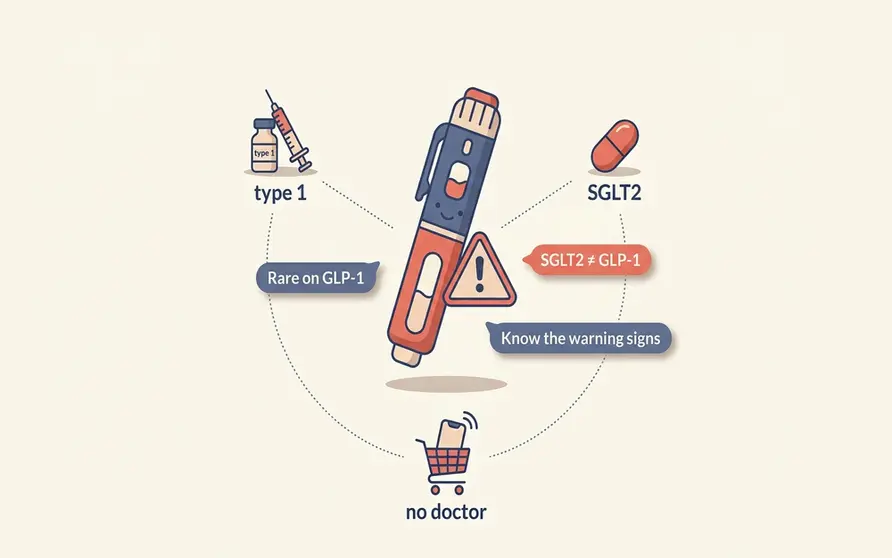
Ketoacidosis is a frightening word, and a real emergency: acid and ketones build up in the blood faster than the body can clear them. So when headlines describe young women using tirzepatide for weight loss and ending up in intensive care, the fear that "Ozempic gives you ketoacidosis" spreads quickly. It is worth separating what the evidence shows from what the scare implies.
The short answer: ketoacidosis on GLP-1 drugs is rare, and the strongest evidence, drawn from people with type 1 diabetes, does not show a clear increase. But "rare" is not "never," and the real risk is not spread evenly. It clusters around a few specific situations. This article names them plainly.
Can Ozempic or tirzepatide cause ketoacidosis?
On current evidence, GLP-1 drugs like Ozempic and Wegovy, and the GLP-1/GIP drug tirzepatide (Mounjaro and Zepbound), are not clearly linked to a higher rate of ketoacidosis. The strongest single source is a 2026 systematic review and meta-analysis in Diabetes Research and Clinical Practice that pooled 25 studies of these drugs used as an add-on in type 1 diabetes.1
Type 1 diabetes is the right place to look, because that is where the fear of ketoacidosis is greatest: people with type 1 make little or no insulin, and insulin is what holds ketoacidosis at bay. In that highest-risk group, the pooled analysis found a diabetic ketoacidosis relative risk of 0.60, meaning no signal of an increase.1 The authors, who declared no competing interests, also found neutral overall hypoglycaemia (relative risk 1.01) and no rise in severe hypoglycaemia (relative risk 0.74) or serious adverse events (relative risk 0.89).1
What did the type 1 diabetes review find?
The reviewers pooled 25 studies, 23 of them randomised controlled trials, and searched the literature through June 2025.1 Their headline safety conclusion is reassuring: adding a GLP-1 drug to insulin in type 1 diabetes did not raise ketoacidosis or severe low blood sugar in the pooled data.
But the honest reading needs one important caveat, which the authors themselves flag. The ketoacidosis estimate was graded very-low certainty, because ketoacidosis was uncommon in the trials and the numbers carried wide statistical imprecision.1 That means the fair conclusion is "no signal of increased ketoacidosis, on limited evidence," never "GLP-1 drugs cut ketoacidosis risk by 40 percent." A relative risk below 1 here reflects sparse data, not a proven benefit.
The same review did find a real, expected downside: GLP-1 drugs sharply increased nausea (relative risk 2.89) and vomiting (relative risk 3.10), which drove a roughly twofold rise in early treatment withdrawal.1 That matters here, because persistent vomiting and not eating are exactly the conditions that can tip a susceptible person toward ketoacidosis. Tolerability improved after the first six months.1
Where does the real risk cluster?
Ketoacidosis on these drugs is best understood as a situation, not a simple drug side effect. Three settings account for most of the concern, and they are different from each other. Reading them side by side is the clearest way to see who should be careful.
| Situation | Why the risk rises | What the evidence shows |
|---|---|---|
| Insulin-deficient diabetes (mainly type 1) that under-doses insulin or skips meals | Too little insulin plus reduced eating and vomiting lets ketones build up | Pooled review: no rise in ketoacidosis, but evidence limited and safe-use guidance advised |
| Co-use of an SGLT2 inhibitor | SGLT2 inhibitors, a different drug class, independently promote ketone production | Swedish cohort: 24.9 ketoacidosis events per 1,000 person-years among SGLT2 users, not GLP-1 users |
| Unsupervised off-label or cosmetic weight-loss use | No screening, no monitoring, and severe vomiting with poor intake go unmanaged | 2026 ICU case: ketoacidosis six days after a first tirzepatide dose in a non-diabetic woman |
Drawn from the 2026 type 1 diabetes meta-analysis, a 2026 Swedish nationwide cohort, a 2026 multi-society consensus guideline, and a 2026 intensive-care case report. These sources study different populations and are not a head-to-head comparison.1234
Is the SGLT2 number the same thing?
This is the single most-confused point, so it is worth stating carefully. A 2026 Swedish nationwide study followed all 72,698 adults with type 1 diabetes in the country and reported a diabetic ketoacidosis incidence of 24.9 events per 1,000 person-years.2 That number gets copied around as if it describes GLP-1 drugs. It does not.
The 24.9-per-1,000 figure was measured specifically among 1,291 first-time SGLT2 inhibitor users, a separate class of drugs (such as dapagliflozin and empagliflozin) that has a long-recognised link to ketoacidosis.2 GLP-1 drugs and SGLT2 inhibitors are frequently discussed together and sometimes prescribed together, which is exactly how the two get blurred. In the same population, off-label GLP-1 use had climbed to 5.5 percent by 2024, while SGLT2 use stayed under 1 percent.2 Attributing the SGLT2 ketoacidosis rate to a GLP-1 drug is a factual error, not a rounding difference.
The through-line is not the GLP-1 drug itself. It is insulin deficiency, an SGLT2 inhibitor in the mix, or using a powerful medicine with no one watching. Reading the 2026 evidence together
What about weight loss without a doctor?
The situation driving today's headlines is the third one: buying these drugs online for cosmetic weight loss and using them with no medical oversight. A 2026 case report in Cureus makes the risk concrete. A woman in her early 30s with class II obesity, and no diabetes, developed persistent vomiting, upper-abdominal pain and fatigue six days after her first tirzepatide injection.4
Tests showed a high-anion-gap metabolic acidosis with markedly raised ketones. She was admitted to intensive care, treated with intravenous fluids, electrolytes, dextrose and insulin, and recovered within 48 hours.4 One case cannot tell you how often this happens, and it does not. What it illustrates is that severe vomiting and sharply reduced eating, common when starting these drugs, can push even a non-diabetic person into ketoacidosis, and that having no one screening or monitoring removes the safety net.
This is also why supervised use matters for people with type 1 diabetes specifically. A 2026 multi-society consensus report, endorsed by bodies including the AACE, ISPAD and Breakthrough T1D, sets out practical guidelines for using GLP-1 and GLP-1/GIP drugs safely alongside insulin in type 1 diabetes.3 The report is candid that these drugs are not approved for type 1 diabetes and that hypoglycaemia and ketosis are potential risks, which is precisely the education a person cannot get if they obtain the drug without a clinician.3
What do the drug labels say?
The regulatory picture reinforces the drug-class distinction. Ozempic is approved in adults with type 2 diabetes for blood-sugar control, for reducing cardiovascular risk in those with heart disease, and for slowing kidney-disease progression.5 It is not approved for type 1 diabetes or for weight loss, and its US label does not list diabetic ketoacidosis as a warning or a reported adverse reaction.5
That is a meaningful contrast. SGLT2 inhibitors carry an explicit ketoacidosis warning on their labels; the semaglutide label does not.5 The absence of a labelled ketoacidosis warning is not a promise that it can never occur, but it does tell you where regulators saw a signal strong enough to warn about, and where they did not. For GLP-1 drugs, the concern is driven by context, not by a class-wide alarm.
What are the warning signs?
Whatever the setting, the symptoms of ketoacidosis are the same, and they are worth memorising. Watch for persistent nausea and vomiting, abdominal pain, unusual tiredness or drowsiness, a fruity or acetone-like smell to the breath, and rapid, deep breathing.4 These can come on over hours.
Ketoacidosis is a medical emergency, not a side effect to ride out at home. The risk is highest for people with type 1 or other insulin-deficient diabetes, for anyone combining a GLP-1 drug with an SGLT2 inhibitor, and for anyone unable to keep fluids or food down.2 If those symptoms appear, seek urgent care rather than waiting. For people with type 1 diabetes weighing a GLP-1 drug as an add-on, our companion piece on tirzepatide in type 1 diabetes and obesity covers the efficacy side of that conversation.
In one sentence: ketoacidosis on Ozempic and tirzepatide is rare and, in the type 1 diabetes trials where it is most feared, showed no clear increase on limited evidence, but the real risk clusters around insulin deficiency, co-use of an SGLT2 inhibitor, and unsupervised weight-loss use, so the answer is medical supervision and knowing the warning signs, not avoiding the drug.
Frequently asked
Can Ozempic or tirzepatide cause ketoacidosis?+
What is the difference between GLP-1 and SGLT2 ketoacidosis risk?+
Is it dangerous to use Ozempic for weight loss without a doctor?+
What are the warning signs of ketoacidosis?+
References
- Kateel R, Parida A, Chogtu B, Holla SN. Safety of GLP-1 receptor agonists in type 1 diabetes: a systematic review and meta-analysis. Diabetes Res Clin Pract. 2026 Jul;237:113270. PubMed. doi:10.1016/j.diabres.2026.113270. PMID: 42105869. Pooled 25 studies (23 randomised controlled trials); no significant increase in diabetic ketoacidosis (relative risk 0.60, graded very-low certainty) or severe hypoglycaemia (relative risk 0.74), neutral overall hypoglycaemia (relative risk 1.01) and serious adverse events (relative risk 0.89), with increased nausea and vomiting; authors declare no competing interests.
- Lim CE, Pasternak B, Eliasson B, Pazzagli L, Ueda P. Use of GLP-1 receptor agonists and SGLT2 inhibitors among patients with type 1 diabetes: a nationwide register-based cohort study. Lancet Reg Health Eur. 2026 Jun 4;67:101729. PubMed. doi:10.1016/j.lanepe.2026.101729. PMID: 42306189. Swedish nationwide registers, 72,698 adults with type 1 diabetes; GLP-1 receptor agonist use reached 5.5% in 2024; among 1,291 first-time SGLT2 inhibitor users the on-treatment diabetic ketoacidosis incidence was 24.9 events per 1,000 person-years (95% CI 18.4 to 31.5) - this rate is for SGLT2 inhibitor users, not GLP-1 users. One author reports industry fees outside the work; the others declare none.
- Garg SK, Akturk HK, Beck RW, et al. Adjunctive treatment with GLP-1 and dual GLP-1/GIP receptor agonists for people with type 1 diabetes: consensus report and practical guidelines for safe use. Diabetes Technol Ther. 2026 Jun 5. PubMed. doi:10.1177/15209156261449879. PMID: 42246488. Multi-society consensus report (endorsed by ATTD, IDF-Europe, AACE, Breakthrough T1D, ISPAD and ADCES); notes these drugs are not approved for type 1 diabetes and that hypoglycaemia and hyperglycaemia-related ketosis are potential risks; large author panel, many members carry industry disclosures.
- Sadiq H, Amini Z, Husain MM, Alao DO, Jaiganesh T. When weight loss turns dangerous: a case report of tirzepatide-induced ketoacidosis in a non-diabetic woman. Cureus. 2026 Jul 25;18(7):e113368. PubMed. doi:10.7759/cureus.113368. PMID: 42639616. A woman in her early 30s with class II obesity and no diabetes developed high-anion-gap ketoacidosis with markedly elevated ketones six days after her first tirzepatide injection, was treated in intensive care and recovered within 48 hours; authors declare no financial relationships. A single case does not establish an incidence rate.
- Novo Nordisk. OZEMPIC (semaglutide) injection, for subcutaneous use: US prescribing information. DailyMed, US National Library of Medicine, accessed September 2026. Indicated in adults with type 2 diabetes for glycemic control, cardiovascular risk reduction with established cardiovascular disease, and reducing the risk of kidney-disease progression; not approved for type 1 diabetes or weight loss, and the label does not list diabetic ketoacidosis as a Warnings and Precautions item or a reported adverse reaction.
Evidence current as of September 2, 2026. This article is educational only and is not medical advice. Semaglutide and tirzepatide are prescription-only and should be used under medical supervision. "No significant increase" means studies did not detect a clear difference, not that risk is zero, and the very-low-certainty type 1 diabetes estimate should not be read as a protective benefit. GLP-1 receptor agonists and SGLT2 inhibitors are different drug classes; the 24.9-per-1,000 ketoacidosis rate cited here is for SGLT2 inhibitor users, not GLP-1 users. Individual results vary. Do not start, stop, or change a prescribed medicine because of anything you read here. Ketoacidosis is a medical emergency: seek urgent care for persistent vomiting, abdominal pain, unusual drowsiness, fruity-smelling breath, or rapid, deep breathing.
Translating new metabolic and obesity research into plain English for people living on GLP-1 therapy. Every claim is traced to its source.