Can tirzepatide help breast cancer survivors lose weight?
Rutgers University is running FITWISE, a Phase 2 trial testing whether weekly tirzepatide helps 40 adults with early-stage HR+/HER2- breast cancer and obesity lose weight during hormone therapy, while tracking cancer recurrence risk through circulating tumor DNA. The trial is recruiting now - no results exist yet.
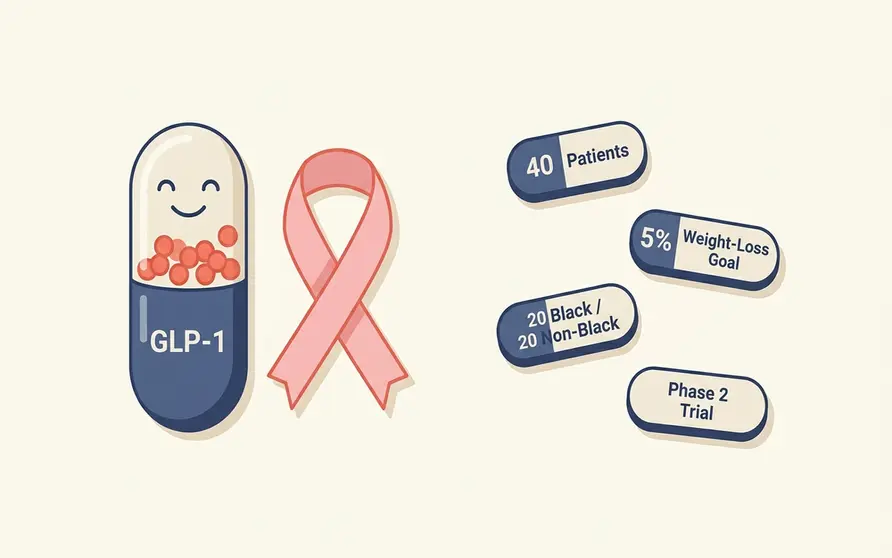
Obesity is common among survivors of hormone receptor-positive breast cancer, and excess weight is linked to worse long-term outcomes in this group. A new Phase 2 trial at Rutgers, known by the acronym FITWISE, is now testing whether tirzepatide - the GLP-1/GIP dual agonist sold as Mounjaro and Zepbound - can safely help these patients lose weight while they remain under active cancer surveillance.1
What is the FITWISE trial testing?
The official title is "Feasibility Study of Tirzepatide for Weight Loss Intervention in Early-Stage Hormone Receptor Positive/HER2 Negative Breast Cancer," registered as NCT06518837.1 It is sponsored by Rutgers, The State University of New Jersey, with the Ludwig Institute for Cancer Research listed as a collaborator, and led by principal investigator Coral Omene, MD, PhD.1 The trial is a single-arm, open-label Phase 2 study - every enrolled patient receives tirzepatide, and there is no placebo or comparator group.1
Who can join the FITWISE trial?
Eligible patients are adults with previously untreated, early-stage (I, II, or III) hormone receptor-positive, HER2-negative breast cancer who have already completed definitive treatment - surgery, chemotherapy, and radiotherapy as indicated - and now have a BMI of 30 kg/m² or higher, or 27 kg/m² or higher with a weight-related complication such as hypertension or type 2 diabetes.1 Patients also need an ECOG performance status of 0 to 2 and adequate heart and organ function.1
The trial excludes anyone with stage IV or metastatic breast cancer, HER2-positive or triple-negative disease, another active malignancy, type 1 diabetes, or a known gastric emptying disorder.1 Notably, the enrollment target of 40 patients is deliberately split into 20 Black and 20 non-Black participants, a design choice the registry record attributes to an "established significant disparity in HR+ breast cancer and obesity related outcomes" in Black patients.1
| Trial feature | Detail |
|---|---|
| Design | Phase 2, single-arm, open-label |
| Sponsor | Rutgers (collaborator: Ludwig Institute for Cancer Research) |
| Enrollment target | 40 (20 Black, 20 non-Black patients) |
| Intervention | Weekly subcutaneous tirzepatide, titrated to a 15 mg maximum |
| Primary outcome | Proportion reaching ≥5% body weight reduction |
| Secondary outcomes | 3-year IDFS/DRFS, ctDNA, metabolic markers, safety |
| Status | Recruiting (as of January 21, 2026) |
Source: ClinicalTrials.gov record NCT06518837.1
How is tirzepatide dosed in this trial?
Patients start at 2.5 mg once weekly, then move to 5 mg after four weeks, with further 2.5 mg increases allowed every four weeks up to a maximum of 15 mg.1 Recommended maintenance doses are 5 mg, 10 mg, or 15 mg weekly, with tolerability guiding which dose a patient stays on.1 This is the identical titration schedule used in tirzepatide's approved chronic weight management indication, which has produced average weight loss above 20% at 72 weeks in trials of adults without cancer.Separate research on tirzepatide's weight-loss performance outside an oncology setting gives useful context, though FITWISE is the first prospective trial testing this same drug specifically in breast cancer survivors under active surveillance.
Why track circulating tumor DNA (ctDNA)?
Circulating tumor DNA is fragments of a tumor's genetic material detectable in a blood draw, and rising ctDNA levels can signal a cancer recurrence months before it becomes visible on imaging. FITWISE monitors ctDNA throughout tirzepatide treatment specifically to check whether meaningful weight loss coincides with any change in this early recurrence signal, alongside the standard 3-year IDFS and DRFS survival endpoints.1
"Every participant in FITWISE receives tirzepatide - there is no placebo group to compare against."
What are the trial's limits?
FITWISE is small (40 patients) and open-label, with no masking and no comparator arm - the design cannot isolate how much of any weight change is due to tirzepatide versus other factors like diet counseling that may accompany the study visits.1 Because it enrolls patients with an already-treated, early-stage cancer and excludes anyone with metastatic or more aggressive subtypes, its findings would not automatically extend to breast cancer patients with active or advanced disease.1
Does the FITWISE trial have results yet?
No. The most recent registry update, posted January 21, 2026, lists FITWISE as recruiting, with sites open in New Jersey including Trinitas Comprehensive Cancer Center in Elizabeth and RWJBarnabas Health locations in Livingston and Monmouth.1 Estimated primary completion and full study completion are both set for September 30, 2027.1 Until then, no weight-loss, safety, or recurrence data exists to cite.
In one sentence: Rutgers is testing whether weekly tirzepatide, dosed exactly as it is for obesity, can help 40 breast cancer survivors lose weight without raising cancer-recurrence risk, but the trial is still recruiting and has produced no results yet.
Frequently asked
What is the FITWISE trial testing in breast cancer patients?+
Is it safe to take tirzepatide after breast cancer treatment?+
Does the FITWISE trial have results yet?+
References
- Omene C, Rutgers, The State University of New Jersey (collaborator: Ludwig Institute for Cancer Research). Feasibility Study of Tirzepatide for Weight Loss Intervention in Early-Stage Hormone Receptor Positive/HER2 Negative Breast Cancer (FITWISE). ClinicalTrials.gov. Identifier: NCT06518837. Status: Recruiting (last updated January 21, 2026). Estimated primary completion and study completion: September 30, 2027.
Evidence current as of July 9, 2026. This article describes an ongoing, unpublished clinical trial and is educational only, not medical advice. It is not a report of study results. Breast cancer survivors considering weight loss treatment should discuss the choice with their oncologist and prescribing clinician, not this article.
Translating new metabolic and obesity research into plain English for people living on GLP-1 therapy. Every claim is traced to its source.