Do GLP-1 drugs age skin directly?
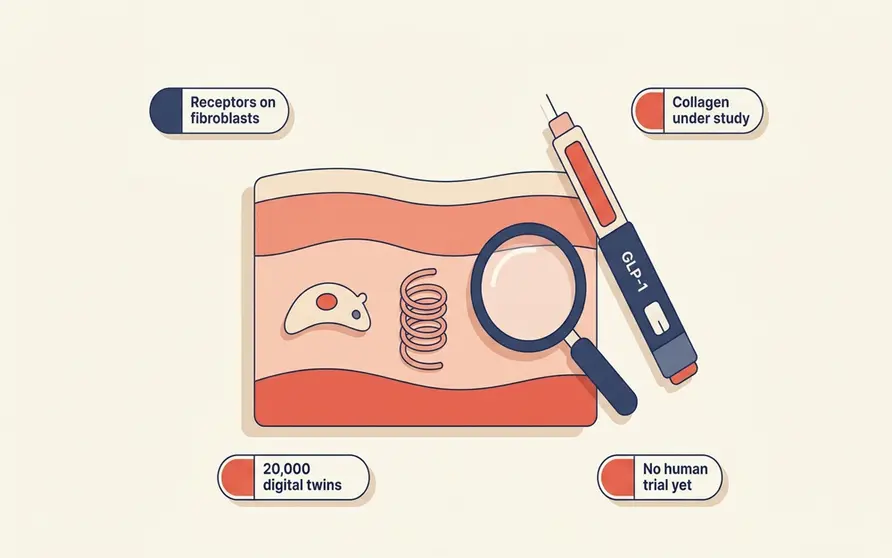
Researchers are actively studying whether GLP-1 drugs age skin on their own, separate from the weight loss they cause. The idea is biologically plausible, because skin fibroblasts and facial fat stem cells carry GLP-1 receptors. But as of 2026 it rests on laboratory reasoning, review papers and computer models, not a human trial.
Our explainer on what causes Ozempic face gave the honest answer to the common question: most of the facial hollowing during GLP-1 weight loss is the weight loss itself, fat leaving the face as total body fat falls. That article ended on an open door. It noted that some reviews propose the drugs may also act on skin cells, and that the idea was unproven.
This article walks through that open door. The question here is narrower and more scientific: setting the fat loss aside, is there any sign that a GLP-1 drug ages skin on its own? Researchers are chasing exactly that in 2026, and the honest status is that the question is interesting, plausible, and not yet answered.
What does "directly" mean here?
Direct skin aging means the drug acting on skin cells to speed up aging, independent of how much fat a person loses. Indirect aging is the familiar route: fat leaves the facial pads, the face deflates, and loose skin shows. The two ideas are easy to confuse because they produce a similar look.
The difference matters because it changes what you can do about it. If the change is purely the fat loss, then losing weight more slowly should soften it. If the drug also acts on skin directly, slower weight loss would not fully prevent it, and the problem would need a different answer. That is why researchers want to separate the two.
Do skin cells respond to GLP-1?
Some skin cells appear to. A 2025 review in Endocrine reports that adipose-derived stem cells and fibroblasts, the cells that help build and support collagen, both carry the GLP-1 receptor on their surface.1 A 2026 review in the Journal of Clinical Medicine agrees that GLP-1 receptors are expressed in skin tissue, while stressing that their role in skin aging "remains insufficiently clarified".2
The evidence is not uniform across skin, and that is the catch. A 2025 review in the Journal of Cosmetic Dermatology points out that the receptor picture is contradictory, citing a study in which human keratinocytes, the cells of the outer skin layer, showed no GLP-1 receptors at all.5 So a plausible entry point exists on some skin cell types, but not on every one, which already tells you the effect will not be simple.
What mechanism do researchers propose?
The Endocrine review lays out a chain of proposed steps. Stimulating the GLP-1 receptor on fat stem cells is said to reduce the protective signals those cells normally send, which allows reactive oxygen species to build up and cause oxidative damage to nearby fibroblasts.1 The same review proposes that the drugs lower the cells' glucose uptake, reducing their energy supply and pushing some toward cell death, and that they reduce estrogen produced in facial fat, which in turn means less stimulation of fibroblasts to make collagen.1
These are proposed mechanisms, not effects measured in a living face. The review itself frames the complication as "not exclusively related to decreased facial fat, but there are more aging mechanisms that have to be elucidated".1 The Journal of Cosmetic Dermatology review adds a related observation, that facial fat often shrinks more than overall weight loss alone would predict, which it reads as a sign of a localized, tissue-specific drug action rather than a whole-body one.5
Is there a human study?
There is human data on the skin changes, but it cannot answer the direct-aging question. A 2026 systematic review in Aesthetic Plastic Surgery pooled 40 human studies published up to May 2025 and found a consistent picture: facial volume loss, dermal thinning, loss of collagen and elastin fibers, and decreased skin elasticity in people on GLP-1 drugs.3
The review attributes those changes to the rapid reduction of fat under the skin, which is the weight-loss route.3 That is the limit of the current human evidence. It documents what skin does during GLP-1 weight loss, but it cannot separate a drug effect on skin cells from the effect of the fat simply leaving. To do that, a study would need to compare skin changes at the same amount of weight loss, with and without the drug, and that study has not been done.
What about the computer-model trials?
The one study that tries to isolate the mechanism is a simulation, not a clinical trial. A 2026 paper in Aesthetic Plastic Surgery describes what its authors call the "first fully computational, mechanistically constrained virtual randomized trial", using 20,000 digital twins to model how the timing of semaglutide affects the response of skin to an ultrasound tightening treatment.4 The model found the fibroblast response was gated by insulin resistance and that starting semaglutide three months ahead gave the best modelled collagen result.4
A computer model is built from assumptions, so its output is a hypothesis to test, not proof of what happens in a real face. This kind of simulation is useful for planning future studies and spotting where timing might matter. It is not evidence that the drug ages, or protects, skin in a person, and the paper presents itself as a virtual trial rather than a clinical one.
Could GLP-1 also help skin?
The direct-effect story is not one-directional. The Journal of Clinical Medicine review notes experimental data suggesting GLP-1 drugs may support wound healing through faster keratinocyte migration, better microvascular blood flow, and antioxidant and cell-protective effects.2 The same review describes the overall skin picture as "heterogeneous and pathway-dependent", meaning the drug may help some skin processes while rapid weight loss strains others.2
The concern is taken seriously enough that the first intervention study has already run. A 2026 trial in Dermatology and Therapy enrolled 25 GLP-1 users (mean age 53) in a 12-week double-blind, split-face study of a topical regimen of Proxylane and wild fruit flavonoids versus placebo, with a single focused-ultrasound session added at week 4.6 That trial tests whether a skincare routine helps GLP-1 users, not whether the drug ages skin, so it measures a response to the problem rather than the cause.
The question is no longer whether skin cells can sense these drugs. It is whether that signal matters in a living face, and no human trial has answered that yet.
How to read the evidence
The honest way to hold all of this is to grade each piece of evidence by what it can and cannot show. Mechanism reviews and receptor findings make the direct-aging idea plausible. Human reviews show real skin change during weight loss. A computer model generates hypotheses. None of them is a randomized human trial that separates the drug from the weight loss, which is the piece that would settle the question.
| Evidence type | What it is | What it can show |
|---|---|---|
| Mechanism reviews | Lab reasoning on receptors and pathways | A plausible mechanism, not proof |
| Receptor studies | Which skin cells carry the receptor | Mixed: fibroblasts yes, keratinocytes disputed |
| Human skin reviews | Skin changes during weight loss | What skin does, not what caused it |
| Computer model | 20,000 simulated patients | Hypotheses to test, not a clinical result |
| Randomized human trial | Does not exist yet | The missing piece that would settle it |
In one sentence: whether GLP-1 drugs age skin directly is an open research question in 2026, supported by receptor findings, mechanism reviews and a computer model, but not yet by any human trial that separates a drug effect from the weight loss.13
Frequently asked
Do GLP-1 drugs age skin directly?+
Do skin cells have GLP-1 receptors?+
Is there a human trial on GLP-1 and skin aging?+
Could GLP-1 drugs be good for skin?+
References
- Paschou IA, Sali E, Paschou SA, Tsamis KI, Peppa M, Psaltopoulou T, Nicolaidou E, Stratigos AJ. GLP-1RA and the possible skin aging. Endocrine. 2025;89(3):680-685. DOI: 10.1007/s12020-025-04293-w. PMID: 40498168. A review proposing that GLP-1 receptor agonists may act on adipose-derived stem cells and fibroblasts, which carry the GLP-1 receptor, to reduce protective cytokines, raise reactive oxygen species and oxidative damage, lower cellular energy, and reduce dermal-fat estrogen and collagen synthesis, concluding the complication is "not exclusively related to decreased facial fat". These are proposed mechanisms, not effects measured in people.
- Effects of Glucagon-like Peptide-1 Receptor Agonists on Skin Homeostasis and Skin Aging Processes. Journal of Clinical Medicine. 2026;15(8):2944. DOI: 10.3390/jcm15082944. PMID: 42074746. A review reporting that GLP-1 receptors are expressed in skin tissue but their role in aging "remains insufficiently clarified"; it summarizes experimental data that GLP-1 drugs may promote wound healing through keratinocyte migration, microvascular perfusion, fibroblast support and antioxidant effects, while rapid weight loss is linked to reduced dermal fat and collagen, and describes the overall picture as "heterogeneous and pathway-dependent", calling for well-designed clinical studies.
- Effects of GLP-1 Receptor Agonists on Skin Quality: A Comprehensive Literature Review. Aesthetic Plastic Surgery. 2026. DOI: 10.1007/s00266-026-05820-4. PMID: 42162206. A PRISMA systematic review of 40 human studies published up to May 2025 (clinical trials, case reports and observational studies) finding that GLP-1-induced weight loss is frequently associated with facial volume loss, dermal thinning, loss of collagen and elastin fibers, and decreased skin elasticity, attributed to the rapid reduction of subcutaneous adipose tissue.
- A Computational Trial of Dermal Mechanotransduction in GLP-1 Receptor Agonist-Associated Premature Facial Ageing. Aesthetic Plastic Surgery. 2026. DOI: 10.1007/s00266-026-05973-2. PMID: 42310090. The authors describe the "first fully computational, mechanistically constrained virtual randomized trial", simulating 20,000 digital twins with a BMI over 30 across five arms that vary semaglutide timing before an ultrasound skin-tightening treatment; the multiscale model found fibroblast response was gated by insulin resistance and that three-month pre-treatment produced the best modelled collagen result. This is a computer simulation, not a study in people.
- Kruglikov IL. Mechanisms of Glucagon-Like Peptide 1 Receptor Agonist-Induced Facial Lipodystrophy and a Path Toward Prevention. Journal of Cosmetic Dermatology. 2025 Nov 28;24(12):e70584. DOI: 10.1111/jocd.70584. PMID: 41316800. A review and commentary noting that facial fat loss on GLP-1 drugs often exceeds overall weight and fat loss, suggesting a localized tissue-specific mechanism through receptor internalization, that the skin-receptor evidence is contradictory (citing a study in which human keratinocytes showed no GLP-1 receptors), and proposing exploratory, not yet proven, prevention approaches such as local modulation of CAV1.
- Clinical Efficacy of a Flavo-Proxylane Topical Regimen Pre- and Post-ultrasound Procedure for Subjects Undergoing Glucagon-Like Peptide 1 (GLP-1) Receptor Agonist Therapy. Dermatology and Therapy. 2026. DOI: 10.1007/s13555-026-01699-w. PMID: 41781778. A 12-week, double-blind, randomized, split-face and split-neck study of 25 GLP-1 users (mean age 53.4, Fitzpatrick skin types II to VI) testing a topical regimen of Proxylane and wild fruit flavonoids versus placebo, with a single focused-ultrasound treatment at week 4; it tests a skincare response for GLP-1 users, not whether the drug ages skin.
Evidence current as of October 5, 2026. Whether GLP-1 drugs age skin directly, beyond fat loss, is an open research question. The supporting evidence is mechanism reviews, mixed receptor findings and a single computer simulation; the skin changes seen in people are documented but are tied to weight loss, and no randomized human trial has separated a direct drug effect from the weight loss. No GLP-1 drug is approved or tested for skin aging or facial appearance. This content is educational only, not medical advice. Do not start, stop or change any medicine based on this article; concerns about skin changes should be discussed with a clinician or dermatologist.
Translating new metabolic and obesity research into plain English for people living on GLP-1 therapy. Every claim is traced to its source.