Do GLP-1 drugs work as well for every ethnicity?
Current evidence suggests GLP-1 drugs like Ozempic and Mounjaro produce broadly similar percentage weight loss across ethnic groups, but the studies are too small to prove it. A 2026 meta-analysis found nearly identical percentage loss in Asian and non-Asian adults, while one real-world clinic reported that Hispanic patients lost less.
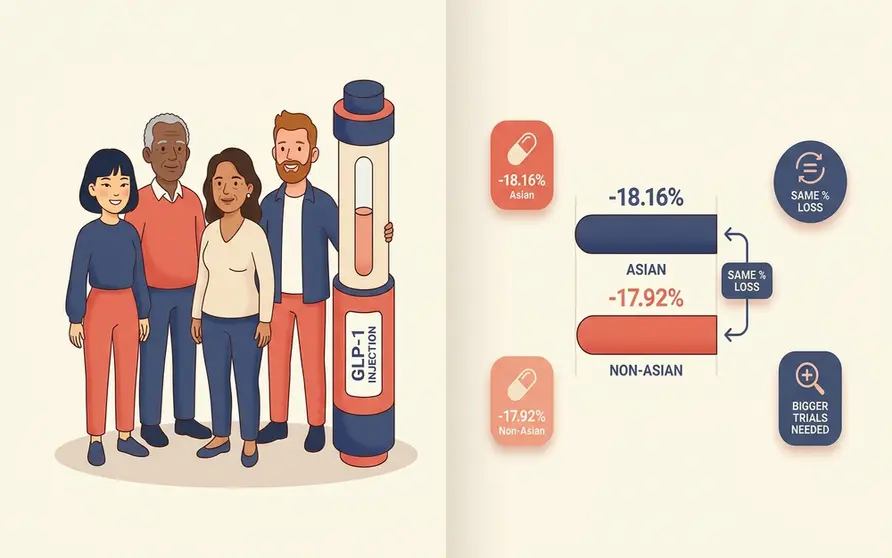
GLP-1 drugs like Ozempic, Wegovy, and Mounjaro drive some of the largest weight loss ever produced by medicine. A fair question follows: do they work as well for everyone, or does the benefit depend on your ethnic background? Two 2026 studies give the first real answers, and both come with an honest catch.
The short version: the percentage of body weight people lose looks broadly similar across ethnic groups, but the studies built to test this are small, and one real-world clinic found that some patients lost less. Broadly similar is not the same as proven equal, and this article keeps those two ideas apart.
Do the drugs work across ethnicities?
On the evidence available today, GLP-1 drugs appear to work broadly similarly across ethnic groups when results are measured as a percentage of body weight. A 2026 meta-analysis of tirzepatide found almost the same percentage weight loss in Asian and non-Asian trial populations.1 The catch is that the studies are too small, and compared too indirectly, to prove the groups are truly equal.
So the honest answer is "probably yes, but not proven". That is a more useful answer than a confident "yes", because it tells you where the evidence is strong and where it still has gaps. The rest of this article walks through what each study actually measured.
Is the percentage weight loss the same?
The strongest evidence comes from a systematic review and meta-analysis published in Endocrinology, Diabetes & Metabolism in 2026, which pooled five Phase 3 SURMOUNT trials of tirzepatide in adults with obesity but without diabetes.1 Across six comparisons and 4,022 participants, tirzepatide at its highest tolerated dose produced an 18.04% greater reduction in body weight than placebo.
The analysis then split the trials into two Asian trials, SURMOUNT-CN and SURMOUNT-J, and four predominantly non-Asian trials.1 Measured as a percentage of body weight, the results were strikingly close: -18.16% in the Asian trials versus -17.92% in the non-Asian trials, a difference that was not statistically significant. On this measure, the drug looks like it treats obesity similarly regardless of ancestry.
For context, tirzepatide is one of the most effective weight-loss drugs approved. In the pivotal SURMOUNT-1 trial, adults taking the 15 mg dose lost 20.9% of their body weight over 72 weeks, compared with 3.1% on placebo.3 The Academy compares the two leading options in tirzepatide versus semaglutide for weight loss.
Why did non-Asian adults lose more weight?
Here is where a single number can mislead. While the percentage loss was nearly identical, the absolute weight loss in kilograms was larger in non-Asian adults: -23.46 kg versus -16.72 kg, a difference that was statistically significant.1 Read on its own, that gap looks like the drug worked better in one group.
It did not. The meta-analysis authors attribute the difference largely to higher baseline weight in the non-Asian trials.1 A person who starts at 120 kg and loses 18% drops more kilograms than a person who starts at 90 kg and loses the same 18%. Percentage of body weight is the fairer way to compare, because it adjusts for how much a person weighed to begin with.
| Trial group | Percentage weight loss | Absolute weight loss |
|---|---|---|
| Asian trials | -18.16% | -16.72 kg |
| Non-Asian trials | -17.92% | -23.46 kg |
| Difference significant? | No (p = 0.94) | Yes (p = 0.03) |
Figures from the 2026 tirzepatide meta-analysis in Endocrinology, Diabetes & Metabolism (five trials, 4,022 adults). The percentage of body weight lost was nearly identical between groups; the kilogram difference mainly reflects higher starting weight in the non-Asian trials.1
These exploratory, indirect findings do not establish ethnic equivalence and require confirmation in adequately powered, ethnicity-stratified trials. From the 2026 meta-analysis conclusion
Do real-world results differ by group?
Trials enrol selected patients and support them closely, so a second 2026 study looked at ordinary clinical care. Researchers at a gastroenterology-based obesity clinic in New York City reviewed 163 adults who stayed on weekly semaglutide for at least 12 months.2 Their average weight loss was 8.1% of body weight, well below the figures seen in tightly-run trials.
The study then asked which patients lost the least. Type 2 diabetes, age over 60, and self-identified Hispanic ethnicity were each linked to poorer weight loss.2 After adjusting for other factors, Hispanic ethnicity was independently associated with failure to reach 5% weight loss, with an odds ratio of 0.32. That means those patients were substantially less likely to hit that first clinical milestone.
Two cautions matter here. The study was retrospective, ran at a single clinic, and included only 163 people, so it detects a pattern rather than proving a cause. And two of its senior authors disclosed financial ties to Novo Nordisk and Eli Lilly, the makers of these drugs.2 The finding is a real-world signal worth studying further, not a verdict.
Why might GLP-1 response vary?
Weight loss on any GLP-1 drug is shaped by far more than the molecule. Starting weight, whether someone has type 2 diabetes, age, dose reached, side effects, diet, physical activity, and how consistently a person can afford and access the drug all move the result. Several of these factors are unevenly distributed across ethnic and socioeconomic groups, which can create differences that look ethnic but are really about circumstances.
The New York clinic study fits that picture: diabetes and older age, both of which independently predicted less weight loss, are also more common in some of the groups studied.2 Untangling biology from access, diet, and disease burden is exactly what the current studies are too small to do. That is why researchers keep calling for larger, more diverse trials rather than announcing a settled difference.
What the evidence cannot prove yet
Neither study was designed to answer the ethnicity question head-on. The meta-analysis compared whole trials against each other rather than randomising people of different ancestries within one trial, an indirect method the authors themselves call exploratory and underpowered.1 The clinic study was small, retrospective, and based at one site.2
The two sources also emphasise different things. The meta-analysis stresses how similar the percentage results were; the clinic study highlights a specific group that did worse.1 Both can be true at once, and holding them together is the honest reading: broadly similar efficacy on average, with real-world variation that is not yet explained. This is an open question, not a proven disparity.
What does this mean for you?
If you are considering or already taking a GLP-1 drug, your ethnicity is not a reason to expect the medicine to fail or to avoid it. The best current evidence points to broadly similar percentage weight loss across groups, and no study shows the drug does not work in any ethnicity.1 Your starting weight, other health conditions, dose, and support are far stronger predictors of your result.
What the data do support is a call for better trials that include more people from more backgrounds, so that any real differences can be measured properly rather than guessed at. Until then, the sensible move is to set expectations with your doctor based on your full health picture, not on a headline about one group.
In one sentence: GLP-1 drugs appear to produce broadly similar percentage weight loss across ethnicities, but today's studies are too small to prove equal results, and none is a reason to avoid treatment based on your background.
Frequently asked
Do GLP-1 drugs work as well for all ethnicities?+
Do Hispanic patients lose less weight on Ozempic?+
Why did non-Asian adults lose more weight in the study?+
Should I avoid a GLP-1 drug because of my ethnicity?+
References
- Kamrul-Hasan ABM, Khalil I, Dutta D, Mahajan K, Nagendra L, Pappachan JM. Comparative efficacy and safety of tirzepatide in Asian and non-Asian adults with obesity without diabetes: a systematic review and meta-analysis. Endocrinol Diabetes Metab. 2026 Jul;9(4):e70291. PubMed. doi:10.1002/edm2.70291. PMID: 42487213. PMCID: PMC13392206. Pooled five Phase 3 SURMOUNT trials (six comparisons, N = 4022), two Asian (SURMOUNT-CN, SURMOUNT-J) and four predominantly non-Asian. Tirzepatide produced an 18.04% greater weight reduction than placebo (95% CI -19.86 to -16.22; I2 = 77%). Percentage weight loss was comparable between Asian (-18.16%) and non-Asian (-17.92%) trials (p = 0.94), while absolute loss was greater in non-Asians (-23.46 vs -16.72 kg; p = 0.03), largely reflecting higher baseline weight. Authors declared no conflicts of interest and state the findings are exploratory and cannot establish ethnic equivalence.
- Cornet NC, Buckholz AP, Yeung M, Kumar S, Rogers L, Magahis PT, Sharaiha RZ, Krisko TI, Fortune BE, Newberry CA. Diabetic status, advanced age, and Hispanic ethnicity predict poorer weight loss in patients with obesity receiving semaglutide. Endocr Pract. 2026 Jun 4 (online ahead of print). PubMed. doi:10.1016/j.eprac.2026.05.029. PMID: 42248359. Retrospective study of 163 adults on weekly semaglutide for at least 12 months at a gastroenterology-based obesity clinic in New York City; mean weight loss 8.1% TWL. Hispanic ethnicity, type 2 diabetes, and age over 60 were associated with reduced weight loss; Hispanic ethnicity was independently associated with failure to achieve 5% TWL (odds ratio 0.32; 95% CI 0.14 to 0.74). Authors S. Kumar and C. Newberry disclosed consulting and advisory relationships with Novo Nordisk and Eli Lilly, respectively.
- Jastreboff AM, Aronne LJ, Ahmad NN, Wharton S, Connery L, Alves B, Kiyosue A, Zhang S, Liu B, Bunck MC, Stefanski A; SURMOUNT-1 Investigators. Tirzepatide once weekly for the treatment of obesity. N Engl J Med. 2022 Jul 21;387(3):205-216. PubMed. doi:10.1056/NEJMoa2206038. PMID: 35658024. Phase 3 randomised, double-blind, placebo-controlled trial of 2,539 adults with obesity. Mean weight change at week 72 was -15.0% (5 mg), -19.5% (10 mg), and -20.9% (15 mg) with tirzepatide versus -3.1% with placebo (P < 0.001 for all comparisons). Cited here for baseline tirzepatide efficacy context.
Evidence current as of September 10, 2026. This article is educational only and is not medical advice. The evidence on GLP-1 weight loss across ethnicities comes from an indirect, underpowered meta-analysis and a small, single-clinic retrospective study; neither can prove GLP-1 drugs work equally, or unequally, across ethnic groups, and neither shows the drugs fail in any group. GLP-1 drugs (Ozempic, Wegovy, Mounjaro, Zepbound) are prescription-only medicines. Individual results vary. Do not start, stop, or change a prescribed medicine because of anything you read here; discuss any GLP-1 drug with your doctor.
Translating new metabolic and obesity research into plain English for people living on GLP-1 therapy. Every claim is traced to its source.