Does microdosing Ozempic or Mounjaro work, and is it safe?
Microdosing means using roughly 25% to 50% of a GLP-1 drug's recommended starting dose, or spacing doses further apart. It is an off-label practice, and high-quality evidence for it is essentially absent. Early reports suggest it may ease nausea and lower cost, but no trial shows a microdose matches an approved dose for weight loss.
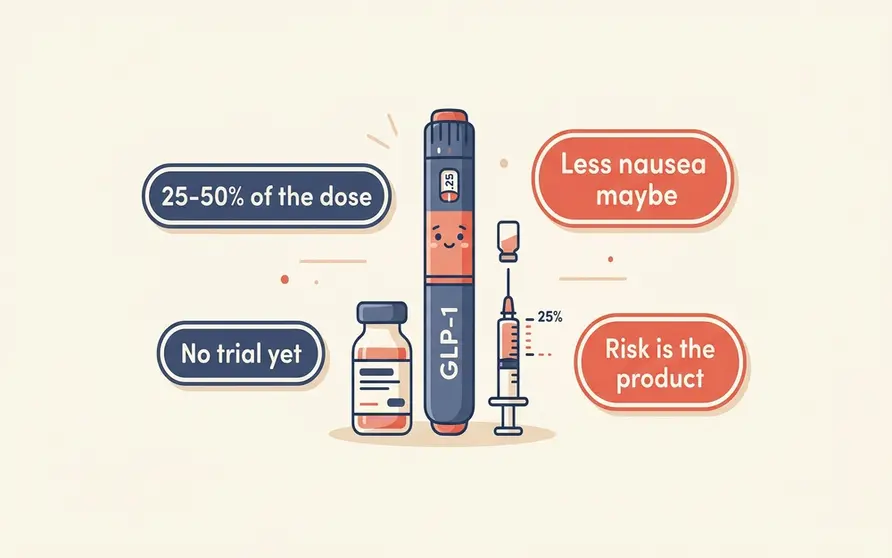
Microdosing is one of the fastest-rising GLP-1 conversations of 2026, and it is easy to see why. The full starting dose of a drug like Ozempic or Mounjaro often causes nausea, the drugs are expensive, and some people want only modest weight loss. The BMJ put the exact question to readers on October 1, 2026: does microdosing GLP-1s work?3
The honest answer is that nobody can yet say for certain. Microdosing spread through patient forums, telehealth programs, and clinician anecdote, not through clinical trials, so the evidence base is thin. This article explains what microdosing actually is, what the early reports do and do not show, and where the real safety risks sit.
What is microdosing a GLP-1 drug?
Microdosing is the off-label use of a smaller-than-recommended amount of a GLP-1 drug, typically 25% to 50% of the manufacturer's recommended starting dose, or the same dose spaced further apart than the label advises. A 2026 clinical commentary in Expert Opinion on Pharmacotherapy describes it in exactly those terms.1
In practice, people do it in two ways. Some use "click counting" on a multi-dose injector pen to dial a fraction of a standard dose, and some simply inject less often than weekly. The commentary notes the practice gained traction during the recent semaglutide and tirzepatide shortages, passed along through patient communities and telemedicine weight-loss programs rather than any trial protocol.1
Why do people microdose?
Three reasons drive it, according to the clinical literature. The biggest is tolerability: GLP-1 drugs cause dose-dependent gastrointestinal side effects, and nausea is the one people most want to avoid.1 If nausea is your reason, there are evidence-based ways to manage it without quitting, which we cover in a separate guide on dealing with Ozempic nausea.
The second reason is cost. Even with recent pricing agreements, the drugs remain expensive, and a smaller dose stretches a prescription further. The third, described in a 2026 brief report for nurse practitioners, is "vanity weight": some users want only a few pounds of loss rather than the full effect the approved dose is designed to produce.2
Does microdosing actually work?
Here is the part that matters most: high-quality clinical evidence for microdosing is essentially absent. The 2026 commentary states this plainly, because no randomised trial has tested whether a microdose delivers the weight-loss or blood-sugar results that the approved doses are proven to deliver.1
What exists instead is early, real-world reports. These suggest possible benefits: less nausea, better adherence, and some modest weight loss.1 That makes "a microdose may be gentler and cheaper" a reasonable thing to say. It does not make "a microdose works as well as a full dose" a true thing to say, because that comparison has never been tested.
Two things can be true at once. A microdose might cause less nausea and cost less while also producing less weight loss than the full doses that the weight-loss trials actually studied. Anecdote from an online group is not the same as evidence from a trial, and the honest position is to name that gap rather than fill it with testimonials.
| Common claim | What the evidence shows |
|---|---|
| Works as well as a full dose | Not tested; no trial has compared them |
| Causes less nausea | Plausible; early reports suggest it |
| Costs less | True by design; a smaller dose lasts longer |
| Is automatically safer | No; the product and dosing method can add risk |
Based on the clinical commentary in Expert Opinion on Pharmacotherapy, 2026.1
"A microdose may be gentler and cheaper. That is not the same as working as well as a full dose."
Is microdosing safe?
The most useful safety insight is that the danger is usually not the lower dose itself, but how people go about it. A 2026 brief report in the Journal of the American Association of Nurse Practitioners lays out the real hazards, and most of them are about the product and the method, not the amount.2
The report flags unregulated "research-grade" peptides bought from online sellers and medical spas, which may be impure, mislabelled, or non-sterile. It flags nonstandard dose measurement, including manipulating a pen that was never designed to deliver a fraction of a dose, which causes dosing errors. It also flags medication sharing and the legal grey zone around compounded "copies" now that the FDA shortage that justified mass compounding has ended.2
Microdosing is also, by default, unsupervised. A clinician can sometimes individualise a low dose safely for a specific patient. A stranger in an online forum cannot, and the practice happens largely outside medical oversight, which is a risk in itself.
Are there any microdosing trials?
Yes, but they are early and they will answer narrow questions first. The first dedicated trials are now registered, and neither has posted results.
The more rigorous one is a small academic Phase 2 randomised trial at UTHealth Houston (NCT07325500), testing semaglutide microdosing to prevent weight regain after a standard dose, in people with HIV. It is recruiting and is not expected to report until 2028.4 A second, larger study (NCT07092605) is run by AgelessRx, a commercial longevity company, and uses soft, mostly self-reported endpoints such as pain and quality of life; it has posted no results.5
Even when these trials report, they will test specific uses, such as holding off weight regain or tracking longevity markers, not "microdose instead of ever using a full dose for weight loss". So the definitive answer does not exist yet, and it will arrive in pieces.
In one sentence: microdosing a GLP-1 drug means using a fraction of the recommended dose, it may be gentler and cheaper but has never been shown to match a full dose, and the real risk is usually the unregulated product and do-it-yourself dosing, not the small amount itself.
Frequently asked
What does microdosing Ozempic or Mounjaro mean?+
Does microdosing a GLP-1 drug actually work?+
Is microdosing a GLP-1 drug safe?+
References
- Beck H, Clements JN. Considerations and challenges in microdosing of GLP-1-based receptor agonists. Expert Opinion on Pharmacotherapy. 2026 (online ahead of print). DOI: 10.1080/14656566.2026.2740393. PMID: 42788826. University of South Carolina College of Pharmacy. Author disclosures are not stated in the abstract record.
- Trainer N. The "microdosing" dilemma: balancing patient anecdotes with clinical safety amid GLP-1 compounding restrictions. Journal of the American Association of Nurse Practitioners. 2026 (online ahead of print). DOI: 10.1097/JXX.0000000000001296. PMID: 42201545. The George Washington University.
- Weight loss drugs: does microdosing GLP-1s work? BMJ. October 1, 2026. PMID: 42823071. Analysis feature (not original research); cited here as the published framing of the question.
- Incretin microdosing for cardiometabolic health in people with HIV. ClinicalTrials.gov, NCT07325500. The University of Texas Health Science Center, Houston. Phase 2, randomised, N=30; status recruiting; primary completion estimated May 2028; no results posted (verified October 8, 2026).
- Effectiveness of microdosed GLP-1 in improving health, quality of life, and longevity measures. ClinicalTrials.gov, NCT07092605. AgelessRx (commercial longevity company). Early Phase 1, randomised, N=150; status enrolling by invitation; primary outcome self-reported pain; no results posted (verified October 8, 2026).
Evidence current as of October 8, 2026. This article is educational and not medical advice. Never start, stop, split, or change a prescribed medicine on your own; if you want a lower dose, the safe route is a conversation with your prescriber, not a pen hack or an online vial.
Translating new metabolic and obesity research into plain English for people living on GLP-1 therapy. Every claim is traced to its source.