Does Ozempic affect your voice or throat?
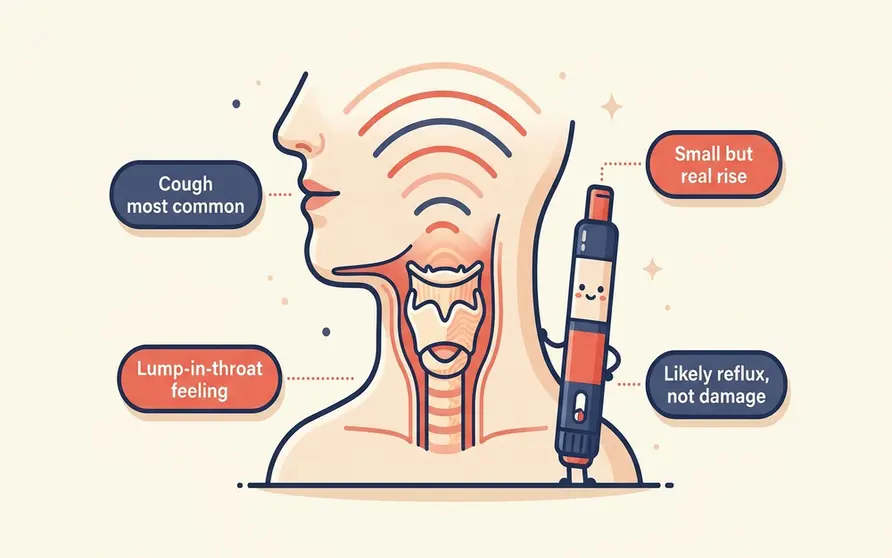
If your voice sounds different or you keep clearing your throat since starting Ozempic, a large 2026 study suggests the drug may play a small part. In 617,296 users, GLP-1 medicines were tied to slightly more cough, throat and voice symptoms. The effect is real but small, and the likely cause is treatable reflux, not vocal damage.
A quiet cluster of reports has followed these drugs: my voice sounds different, I keep needing to clear my throat, I have a nagging cough or a lump-in-the-throat feeling since I started. For a long time there was no good way to tell whether the medicine was doing it. In 2026 a large study put the first real number on the question.
This article explains what that study actually found, why the honest answer is reassuring rather than alarming, and when a voice change is a reason to see a doctor instead of reading an article. It is patient education, not a warning that these drugs "ruin your voice", and not advice to start, stop or switch any medicine.
What did the 2026 study find?
The study is a large retrospective cohort published in The Laryngoscope, using the TriNetX United States network of health records.1 It compared 617,296 adults with obesity who started a GLP-1 drug against 3,503,102 matched people who did not, looking at throat and voice symptoms in the first 1, 3 and 6 months.1
To stop other illnesses explaining the result, the researchers excluded anyone with head and neck cancer, head and neck radiation, autoimmune disease, or existing airway conditions.1 Over 6 months, GLP-1 use was linked to a modestly higher risk of any laryngeal symptom, meaning any voice-box or throat symptom, with an odds ratio of 1.19 (95% confidence interval 1.16 to 1.21).1
Which throat symptoms came up most?
The strongest single signal was cough, with an odds ratio of 1.46.1 Next came a foreign-body sensation, the feeling that something is stuck in the throat, which was also significantly higher (p less than 0.001), and voice and resonance changes, meaning how the voice sounds, with an odds ratio of 1.19 (p equals 0.002).1
These are the symptoms a reader actually notices: a persistent tickle and cough, a globus or lump feeling, and a voice that sounds huskier or different. The study reports how often each appeared, not why, so the numbers describe the pattern rather than the cause.1
| Symptom (6 months) | Odds ratio | Reading |
|---|---|---|
| Any laryngeal symptom | 1.19 (1.16 to 1.21) | Small but statistically clear |
| Cough | 1.46 | The biggest single signal |
| Foreign-body / lump feeling | Higher (p < 0.001) | A "something stuck" sensation |
| Voice and resonance | 1.19 (p = 0.002) | How the voice sounds |
Source: Shah et al., The Laryngoscope, 2026, a TriNetX cohort of 617,296 GLP-1 users.1 The published abstract gives a clean odds ratio for cough and voice, and reports the foreign-body sensation as significantly higher without a clean figure, so only the direction is stated here.
Did every GLP-1 drug show it?
No, and this is one of the more interesting details. The raised 6-month risk showed up with exenatide, liraglutide, semaglutide, dulaglutide and lixisenatide, each with a statistically significant but modest increase.1 It did not reach significance with albiglutide or tirzepatide, the drug sold as Mounjaro and Zepbound.1
That agent-by-agent split is worth noting but easy to over-read. A single records-based study cannot say why tirzepatide looked different, and the numbers for individual drugs are far less certain than the overall result. The safest reading is that the signal is a class-wide tendency that was clearest for the older and more widely used agents.1
"Statistically significant is not the same as big. With hundreds of thousands of people, a small difference becomes certain without becoming large."
Why would a drug affect your throat?
The study did not prove a mechanism, but the symptom pattern points to a familiar one. GLP-1 drugs slow how fast the stomach empties, which can push stomach contents back up toward the throat. That is laryngopharyngeal reflux, and reflux is a well-recognised cause of exactly these symptoms: cough, throat-clearing, a lump feeling and a hoarse voice.2
Our guide on why Ozempic causes burping and acid reflux covers that slowed-emptying route in detail. Rapid weight loss can also thin the soft tissue around the voice box and subtly change how the voice sounds. Both explanations treat the throat as reacting to reflux and change, not as being damaged, but both are reasoned mechanisms rather than things this study measured.1
Is it damaging your vocal cords?
There is no evidence that it is. The study counted symptoms in health records; it did not find vocal-cord injury, and the cough-and-reflux pattern argues against direct harm to the voice box.1 The authors rate their own work as level 3 evidence, meaning a large observational study that shows an association and cannot prove the drug caused each symptom.1
There is also no randomised trial testing a GLP-1 drug for voice or throat effects, and a search of the clinical-trials registry found none under way. That gap matters: it means the definitive test does not yet exist. The reassuring side is that if reflux is the route, the symptoms are often manageable with the same measures used for ordinary reflux, which a clinician can advise on.2
When is a voice change a red flag?
A changed voice is usually benign, but it is also the main symptom doctors use to catch serious throat problems, so persistence is the signal to act on. The American Academy of Otolaryngology hoarseness guideline advises a proper look at the voice box when hoarseness lasts more than about three to four weeks, or sooner if there are warning signs.2
Get checked promptly if a voice change comes with a lump in the neck, trouble or pain swallowing, or coughing up blood. Hoarseness is one symptom of thyroid and throat cancers, which is a different and far less likely cause than reflux; our article on Ozempic and thyroid cancer risk keeps that rare possibility in proportion. The point is simple: a short-lived husky voice is common, but a hoarse voice that will not settle should be examined, not self-diagnosed.2
In one sentence: a large 2026 study tied GLP-1 drugs to a small, real rise in throat and voice symptoms, most often cough and a lump-in-the-throat feeling, that is best explained by treatable reflux rather than vocal-cord damage, while any hoarseness that persists or comes with warning signs still needs a doctor.
Frequently asked
Can Ozempic give you a cough or change your voice?+
Does Ozempic damage your vocal cords?+
When should a voice change or hoarseness be checked?+
References
- Shah P, Kayekjian D, Nguyen SA, Meenan K, O'Rourke AK. Association of glucagon-like peptide-1 receptor analogues and laryngeal symptoms in obese adults. The Laryngoscope. 2026 (online ahead of print, Aug 12). DOI: 10.1002/lary.70808. PMID: 42584027. Retrospective TriNetX cohort, authors' stated level of evidence 3. Author disclosures and funding are not stated in the abstract record.
- Stachler RJ, Francis DO, Schwartz SR, Damask CC, Digoy GP, Krouse HJ, et al. Clinical practice guideline: hoarseness (dysphonia) (update). Otolaryngology-Head and Neck Surgery. 2018;158(1_suppl):S1-S42. DOI: 10.1177/0194599817751030. PMID: 29494321. American Academy of Otolaryngology-Head and Neck Surgery Foundation.
Evidence current as of October 12, 2026. This article is educational and not medical advice. It describes an association found in observational data, not a proven side effect. If your voice or throat changes and does not settle, or comes with a neck lump, trouble swallowing or coughing up blood, see a clinician; never start, stop, or change a prescribed medicine on your own.
Translating new metabolic and obesity research into plain English for people living on GLP-1 therapy. Every claim is traced to its source.