Does Ozempic help or worsen Crohn's and colitis?
The honest answer is that the evidence pulls in two directions and no randomised trial has finished yet. GLP-1 drugs like Ozempic and Mounjaro are linked to fewer IBD-related surgeries in some data, but the single best-designed study found they do not reduce flares. None is approved to treat Crohn's or colitis.
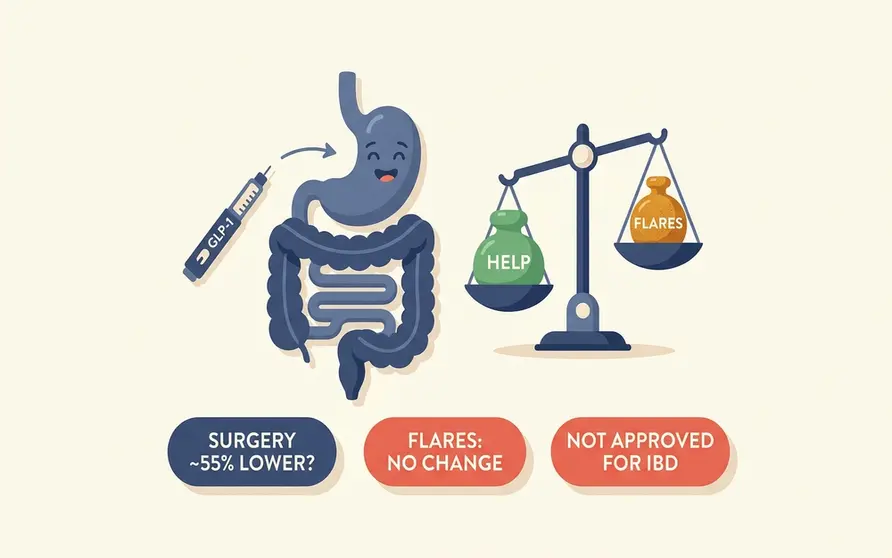
If you have Crohn's disease or ulcerative colitis and you are carrying extra weight or type 2 diabetes, you have probably seen the headlines pulling both ways. One week a study says a GLP-1 drug could cut your risk of bowel surgery. The next, a bigger analysis says it does nothing for your flares. Both stories are real, and they are not describing the same thing.
This piece takes the 2026 evidence apart and says plainly what each study does and does not show. The short version: there is a hint that GLP-1 drugs might be linked to fewer IBD-related surgeries, the best-designed study found no effect on disease flares, and nothing here means these drugs treat IBD or that you should avoid them because of it.
Is this two questions or one?
It is really two. The first is whether a GLP-1 drug could help inflammatory bowel disease, either by calming inflammation or by reducing the complications that lead to surgery. The second is whether taking one is safe if you already have Crohn's or colitis, or whether it might set off a flare. People asking online usually blur the two, but the studies answer them separately.
Inflammatory bowel disease (IBD) is the umbrella term for Crohn's disease and ulcerative colitis, two conditions in which the immune system drives chronic inflammation of the gut. GLP-1 receptor agonists such as semaglutide (Ozempic, Wegovy) and tirzepatide (Mounjaro, Zepbound) are approved for type 2 diabetes and weight management, not for IBD. The interest in IBD comes from laboratory work suggesting these drugs may have anti-inflammatory effects, which is a reason to study them, not evidence that they work.
Could a GLP-1 lower surgery risk?
This is the encouraging half, and it needs to be read carefully. A 2025 systematic review and meta-analysis in Frontiers in Medicine pooled six cohort studies of IBD patients with metabolic conditions, comparing those who used GLP-1 drugs with those who did not.1 For IBD-related surgery, GLP-1 use was associated with a significantly lower risk, with a pooled estimate of 0.45 (95% confidence interval 0.35 to 0.59), which works out to roughly 55% lower.
The catch is the quality of the underlying data. The review's authors graded the certainty of the evidence as low, and three of the six included studies, half of them, were non-peer-reviewed conference abstracts rather than full papers.1 A second outcome, IBD-related complications, showed only a non-significant trend toward benefit (0.39, 95% confidence interval 0.15 to 1.03) with extreme statistical heterogeneity, meaning the studies disagreed with each other enough that the authors called that result unstable.
So the honest way to read the surgery number is as an observational signal worth following, not a proven benefit. The people in these cohorts were taking GLP-1 drugs for their weight or diabetes, and those who happen to be on such treatment may differ from those who are not in ways that also affect their bowel disease. An association like this can point research in a direction; it cannot tell a patient the drug will keep them out of the operating room.
Does it reduce IBD flares?
Here the best evidence says no. A 2026 target trial emulation in Clinical Gastroenterology and Hepatology used a large administrative claims database to mimic a randomised trial, comparing stable IBD patients who started semaglutide or tirzepatide against closely matched patients who did not.2 This design is more rigorous than the surgery meta-analysis because it carefully matches the two groups to reduce the bias that makes simple cohort comparisons unreliable.
The result was flat. Among 2,028 patients on 5-aminosalicylates or no IBD medication, the one-year risk of relapse, defined as an IBD-related hospitalisation, surgery, or a course of prednisone, was 7.9% whether or not they added a GLP-1 drug (relative risk 1.01, 95% confidence interval 0.82 to 1.24).2 In a second group of 346 patients already on advanced biologic or immunomodulator therapy, relapse was 12.4% with a GLP-1 versus 15.6% without, a difference that did not reach statistical significance (relative risk 0.80, 95% confidence interval 0.55 to 1.15).
The authors' conclusion was blunt: adjunctive treatment with semaglutide or tirzepatide does not improve outcomes in patients with stable IBD.2 This is the study that should carry the most weight on the question of disease activity, and it found no benefit. It does not contradict the surgery finding so much as measure a different thing, over a shorter window, in a more careful way.
How do the two findings compare?
Laying them side by side shows why both can stand at once. They measure different outcomes, over different timeframes, with different levels of rigour, and neither was built to prove that a GLP-1 treats IBD.
| Surgery signal (2025 meta-analysis) | Flare risk (2026 emulation) | |
|---|---|---|
| What it measured | Risk of IBD-related surgery | One-year risk of relapse |
| The finding | About 55% lower (estimate 0.45) | No reduction (7.9% vs 7.9%) |
| Study design | Meta-analysis of 6 cohort studies | Target trial emulation of claims data |
| Certainty | Low (half were conference abstracts) | Stronger design, still observational |
| What it proves | Association, not cause | No flare benefit found |
Surgery column from the 2025 Frontiers in Medicine meta-analysis; flare column from the 2026 Clinical Gastroenterology and Hepatology target trial emulation. The two describe different outcomes and are not two measures of the same thing.12
A weak signal that surgery might be less common, and a stronger study showing no change in flares. That is an open question, not a treatment. Reading the IBD evidence honestly
Can it make your IBD worse?
This is the fear that sends most people searching, and the current evidence is reassuring on it. In the same 2026 target trial emulation, adding a GLP-1 drug did not increase safety events compared with not adding one, with a relative risk of 0.88 in both patient groups.2 In other words, the study that found no flare benefit also found no flare harm. Starting a GLP-1 did not appear to push stable IBD into relapse.
The label evidence points the same way. The current US prescribing information for Ozempic does not list inflammatory bowel disease, Crohn's disease, or ulcerative colitis anywhere as an adverse reaction or a warning.4 There is no recognised signal that these drugs trigger or worsen IBD as a disease.
The genuine complication is tolerability, not inflammation. In the emulation, 33% to 36% of patients stopped their GLP-1 drug within a year.2 GLP-1 drugs commonly cause nausea, diarrhea, and cramping, and in someone with Crohn's or colitis those common gut side effects can be hard to tell apart from a flare, which makes careful monitoring by a specialist important. The drug does not appear to inflame the bowel, but it can upset it.
Is Ozempic approved to treat IBD?
No, and this is the fixed point under all the shifting data. No GLP-1 receptor agonist is approved anywhere to treat Crohn's disease or ulcerative colitis. The Ozempic label lists only type 2 diabetes glycemic control, cardiovascular risk reduction, and a chronic kidney disease indication.4 Any use for IBD would be off-label and unsupported by a completed trial.
That matters because it sets the correct expectation. If a GLP-1 drug is prescribed to someone with IBD today, it is being prescribed for their weight or their diabetes, and any effect on their bowel disease is an unproven side story, not the reason for the prescription.
What are the trials to watch?
The question will finally get a real answer from two ongoing Phase 3 trials run by Eli Lilly, one in Crohn's disease (NCT06937099, 290 participants, primary completion May 2028) and one in ulcerative colitis (NCT06937086, 350 participants, primary completion April 2028).3 Both enrol patients who have moderately to severely active IBD along with obesity or overweight.
Two details are worth holding onto. First, these trials do not test a GLP-1 drug on its own; they give tirzepatide alongside mirikizumab, an approved IBD biologic, so they ask whether adding the weight-loss drug helps, not whether it treats IBD by itself.3 Second, Eli Lilly makes both tirzepatide and mirikizumab, so the company funding the studies owns both drugs being combined, a conflict of interest worth remembering when the results arrive. Until then, there is no completed randomised evidence.
In one sentence: GLP-1 drugs like Ozempic and Mounjaro are linked to fewer IBD-related surgeries in low-certainty data but did not reduce flares in the best-designed study, they show no signal of worsening IBD, and none is approved to treat Crohn's disease or ulcerative colitis.
Frequently asked
Can Ozempic or Mounjaro help Crohn's or ulcerative colitis?+
Will a GLP-1 drug make my IBD worse?+
Are Ozempic and Mounjaro approved to treat IBD?+
Is it safe to take Ozempic if I have Crohn's or colitis?+
References
- Yang M, Huo Y, Liu Z, Bai G, He D, Zhang L. The role of GLP-1 receptor agonists in IBD-related surgery and IBD-related complications of inflammatory bowel disease among patients with metabolic comorbidities: a systematic review and meta-analysis. Front Med (Lausanne). 2025 Aug 21;12:1621958. PubMed. doi:10.3389/fmed.2025.1621958. PMID: 40917833. PMCID: PMC12408605. Six cohort studies (eight effect estimates); three of six were non-peer-reviewed conference abstracts. IBD-related surgery pooled estimate 0.45 (95% CI 0.35-0.59; I-squared 38.1%); IBD-related complications 0.39 (95% CI 0.15-1.03; I-squared 98.9%, non-significant). Certainty graded low (GRADE); authors declare no conflicts of interest.
- Yeh KH, Ahuja D, Patel SB, et al. Adjunctive GLP-1 receptor agonists in patients with inflammatory bowel diseases and obesity and/or diabetes: a target trial emulation. Clin Gastroenterol Hepatol. 2026 Jun 17 (online ahead of print). PubMed. doi:10.1016/j.cgh.2026.06.008. PMID: 42309434. Emulated from the OptumLabs Data Warehouse (2018-2023). Cohort 1 (2,028 initiators on 5-aminosalicylates or no IBD medication): relapse 7.9% vs 7.9% (relative risk 1.01, 95% CI 0.82-1.24); safety 7.0% vs 7.9% (relative risk 0.88); 36% discontinued within a year. Cohort 2 (346 initiators on advanced therapy/immunomodulators): relapse 12.4% vs 15.6% (relative risk 0.80, 95% CI 0.55-1.15, non-significant); 33% discontinued. Authors conclude adjunctive semaglutide or tirzepatide does not improve outcomes in stable IBD.
- Eli Lilly and Company. A study of mirikizumab and tirzepatide in adults with moderately to severely active Crohn's disease and obesity or overweight (NCT06937099); and a study of mirikizumab administered at the same time as tirzepatide in adults with moderately to severely active ulcerative colitis and obesity or overweight (NCT06937086). ClinicalTrials.gov. NCT06937099, NCT06937086. Both Phase 3, recruiting; Crohn's trial N=290 (primary completion May 2028), ulcerative colitis trial N=350 (primary completion April 2028). Sponsor Eli Lilly and Company, which manufactures both tirzepatide and mirikizumab. Accessed September 2026.
- Novo Nordisk. OZEMPIC (semaglutide) injection, US prescribing information. DailyMed, National Library of Medicine. DailyMed. Indications: type 2 diabetes glycemic control; reduction of major adverse cardiovascular events in type 2 diabetes with established cardiovascular disease; reduction of the risk of sustained eGFR decline, end-stage kidney disease, and cardiovascular death in type 2 diabetes with chronic kidney disease. The label carries no inflammatory bowel disease, Crohn's disease, or ulcerative colitis indication or warning. Accessed September 2026.
Evidence current as of September 8, 2026. This article is educational only and is not medical advice. GLP-1 receptor agonists such as Ozempic (semaglutide) and Mounjaro (tirzepatide) are not approved to treat inflammatory bowel disease, Crohn's disease, or ulcerative colitis. The surgery finding comes from a low-certainty meta-analysis and shows association, not proof of cause; the flare finding comes from an observational study and found no benefit. No completed randomised trial exists. Individual results vary. Do not start, stop, or change a prescribed medicine because of anything you read here; if you have IBD, discuss any GLP-1 drug with your gastroenterologist.
Translating new metabolic and obesity research into plain English for people living on GLP-1 therapy. Every claim is traced to its source.